• Who We Serve
    • Business Owners
    • Individuals & Families
    • Fortune 500 and Large Company Employees
    • New Media
    • Oil & Gas Industry
    • SoCal Edison
  • Services
    • Financial Planning & Retirement
    • Investment Management
    • Tax Planning & Preparation
    • Estate Planning
  • About Us
  • Resources
    • Blog
    • Events
      • Health & Wealth
    • Frequently Asked Questions
  • Partnerships
    • Next Street Tax
    • TownSquare Capital
  • Contact Us
  • Schedule
    • New Clients
    • Current Clients
  • Login
  • Menu Menu

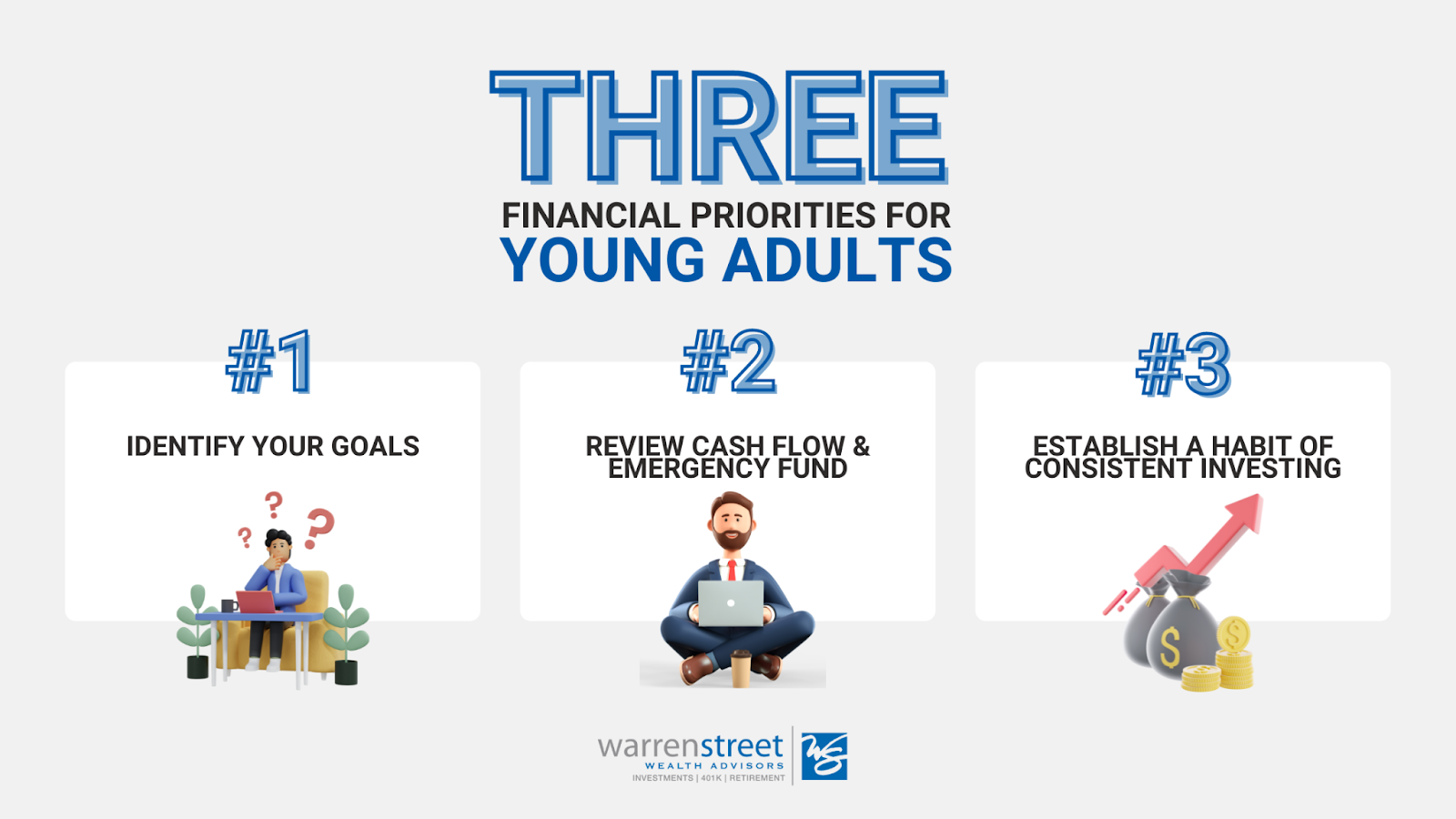
Three Financial Priorities for Young Adults

May 12, 2022/in Education, Financial Planning, General/by Kirsten C. Cadden, CFP®

(or anyone just starting out)

Young adults, or anyone new to managing their own finances, often feel stuck when they think about money. In an age of unlimited access to information, advice, and opinions, deciding what to prioritize can feel paralyzing. At some point, all of us have asked the question “Where do I start?”

To help answer that question, we have identified three priorities for young adults to build a solid financial foundation. Individual circumstances will almost certainly require adaptation, so these three points are intentionally general and flexible so that you can apply them to your situation. 

1. Identify Your Goals

Good financial planning requires goals or targets. There is no singular definition of financial success; your needs, wants, and wishes determine what a successful path looks like.

Like all goals, financial goals should be realistic, flexible, and measurable. Goals may include paying off debt, retiring by a specific age, starting a business, buying a home, supporting loved ones, or any other specific expenses that are important to you. 

Attach a dollar amount to your goals. If you are not sure how much you might need for a certain goal, there are often simple online tools that can help, such as retirement calculators (like these from SmartAsset and NerdWallet) or home affordability calculators (like these from NerdWallet andZillow).   

You may not know all the specifics of a certain goal. For example, when retirement is 20 or 30 years down the road, you might not be able to identify exactly how much income you will need from your investments. Don’t let uncertainty deter you from setting the goal! You can start with an estimate and continue to refine it as your plans take shape.

2. Basic Financial Housekeeping: Cash Flow and Emergency Fund

Cash flow refers to money coming in and money going out. At a minimum, you should know what your income is each month and generally what expenses you have. Don’t worry about making changes at first; just write the information down so you know where you are starting. Then you can start tracking your spending and getting an idea of areas where you may need to make changes. 

A basic emergency fund should cover three to six months of expenses. This money should be kept easily accessible in cash — a regular bank savings account, a high-yield savings account, or an online savings account are all great options. When you use some of this money for an unforeseen necessary expense (such as a car repair, covering your bills during a time of unemployment, or a hospital bill), work to replenish your fund once you are able.

3. Establish a Habit of Consistent Investing

Once you have taken care of your basic financial housekeeping, it is time to look to the future. Even if your goals are still just far-off estimates, establishing good habits now will pay off when it is time to get more specific.

Below are a few examples of investment accounts that might fit your situation:

  • 401(k) or 403(b) plan: If your employer and/or your spouse’s employer offers a 401(k) or 403(b) plan, you can contribute pre-tax dollars and possibly receive contributions from your employer. It’s as close as you can get to free money!
  • IRA or Roth IRA: An IRA is a retirement savings account that is independent of your employer. You can contribute up to a set annual maximum and potentially receive tax benefits. Tax deductions and the ability to contribute to a Roth IRA have some conditions, so check the current IRS rules.
  • Individual or Joint brokerage account: A brokerage account is an investment account that is not specifically for retirement. There are no tax deductions for contributions you make, but there are also no rules about when you can access money in the account. This is a good option for general investing that may be used for anything. There are also no contribution limits for brokerage accounts, so if you are already contributing the maximum to a 401(k) or IRA, a brokerage account can allow for additional long-term savings. 

Keep It Simple

There is an endless supply of financial advice floating around, and knowing what advice to follow can be overwhelming. When in doubt, keep it simple! Focusing on these three starting points will allow you to tune out all the noise and set you up for financial success.

Do you feel like you are ready for steps 4, 5, and 6 in your financial plan? Maybe it’s time to work with a pro. Contact us at Warren Street Wealth Advisors to learn more about how we can help you achieve your financial goals.

Kirsten C. Cadden, CFP®

Associate Advisor, Warren Street Wealth Advisors

Investment Advisor Representative, Warren Street Wealth Advisors, LLC., a Registered Investment Advisor

The information presented here represents opinions and is not meant as personal or actionable advice to any individual, corporation, or other entity. Any investments discussed carry unique risks and should be carefully considered and reviewed by you and your financial professional. Nothing in this document is a solicitation to buy or sell any securities, or an attempt to furnish personal investment advice. Warren Street Wealth Advisors may own securities referenced in this document. Due to the static nature of content, securities held may change over time and current trades may be contrary to outdated publications. Form ADV available upon request 714-876-6200.

https://warrenstreetwealth.com/wp-content/uploads/2022/05/YoungAdults.png 1080 1080 Kirsten C. Cadden, CFP® https://warrenstreetwealth.com/wp-content/uploads/2014/11/Warren_Street_logo-01.svg Kirsten C. Cadden, CFP®2022-05-12 09:00:002024-11-07 09:30:29Three Financial Priorities for Young Adults

5 Options for Last Minute 2021 Tax Moves

February 24, 2022/in Basic, Financial Planning, General, Taxes/by Justin D. Rucci, CFP®

The 2021 calendar year might be over, but that doesn’t necessarily mean that you’re out of luck if you want to make any last-minute tax moves before you file your 2021 return. 

While your options may be somewhat limited after December 31st has passed, below are five options to think about as you get ready to file your 2021 taxes.

  1. Traditional IRA

You may still be able to make an IRA contribution for 2021, even as late as April 18th. In order to receive a deduction for your contribution, you’ll want to review your 2021 AGI (Adjusted Gross Income), ideally with a professional. The income limit phase-out range starts at $66,000 for individuals and $105,000 for married joint filers, with exceptions to these limits being available if you do not have access to a 401K or other retirement plan through work.

Another scenario where an IRA contribution can be beneficial is for a recent retiree. Some retirees will receive earned income from their previous employer in the calendar year following their retirement in the form of a prorated bonus or otherwise. This earned income allows the retiree to make an IRA contribution and take the deduction. If this applies to you, be sure to contact your advisor to discuss your options.

If you decide to make an IRA contribution, the maximum amount for 2021 is $6,000 per individual, or $7,000 for individuals age 50 and older.  

  1. SEP IRA & Small Business Plans

If you are self-employed you may be able to make a last-minute contribution to a retirement plan as well. The most common type of self-employed retirement plan is a SEP IRA, but depending on your tax situation, a Solo 401K, Defined Benefit plan, or other types of retirement plan may be beneficial for you.

The contribution limit for a SEP IRA in 2021 is $58,000, with no income limitations being applied. That said, the amount you will be able to contribute will be dictated by your self-employment income for the year, so work with your advisor and your tax professional to make sure the contributions are done properly to ensure you are maximizing the tax savings. 

  1. Roth IRA

If you are interested in a different type of tax-advantaged retirement savings vehicle, a Roth IRA may better suit your needs. While it does not provide an immediate tax deduction, it does allow you to invest funds in a tax-advantaged manner for the long term. If you meet the requirements at distribution time, all withdrawals will be tax-free.

There are income limits for who can contribute to a Roth IRA. AGI limits start at $125,000 for individuals and $198,000 for joint filers in 2021.

Contribution limits for a Roth IRA are the same as a Traditional IRA – $6,000 per individual, or $7,000 for individuals age 50 and over. This contribution limit is an aggregate for both IRA account types, so between a traditional IRA and a Roth IRA you cannot contribute more than the annual limit in total.

  1. Charitable Contributions & Deductions from 2021

2021 is the last year (pending future legislation) for the “above the line” charitable deduction. In other words, 2021 will be the last year that you will be able to take a deduction for a charitable contribution you made without having to itemize all of your deductions on Schedule A.  

In 2021 you can deduct up to $300 per individual, or $600 for joint filers for charitable contributions without itemizing.

If you made charitable contributions in 2021, now is the time to dig up those receipts and provide them to your tax professional.

If you think you may be able to itemize your deductions, be sure to also include mortgage interest, state taxes paid (property, sales, & income), and medical expenses in the information you provide to your tax preparer.

  1. Health Savings Account Contribution

If you participated in an HSA-eligible “high-deductible health plan” in 2021, you may be eligible to make a tax-deductible contribution to a Health Savings Account for 2021 up to the 2021 tax filing deadline (April 18, 2022).  Contribution limits are $3,600 for individuals and $7,200 for families, with a $1,000 catch-up contribution available for taxpayers age 55 and older.  Contributions to HSAs are tax-deductible and withdrawals are tax-free if the funds are used for qualified medical expenses.    

In conclusion, there are still some strategies that can be utilized when it comes to filing your 2021 taxes. If you have yet to make a decision on any of the above, there is still time before you file your return.

If you are interested in learning more about any of the above or taking any action, be sure to reach out to your advisor at Warren Street to get the conversation started.

Justin Rucci, CFP®

Wealth Advisor, Warren Street Wealth Advisors

Investment Advisor Representative, Warren Street Wealth Advisors, LLC., a Registered Investment Advisor

The information presented here represents opinions and is not meant as personal or actionable advice to any individual, corporation, or other entity. Any investments discussed carry unique risks and should be carefully considered and reviewed by you and your financial professional. Nothing in this document is a solicitation to buy or sell any securities, or an attempt to furnish personal investment advice. Warren Street Wealth Advisors may own securities referenced in this document. Due to the static nature of content, securities held may change over time and current trades may be contrary to outdated publications. Form ADV available upon request 714-876-6200.

Sources:

https://www.irs.gov/retirement-plans/ira-deduction-limits

https://www.irs.gov/retirement-plans/roth-iras

https://www.irs.gov/newsroom/special-300-tax-deduction-helps-most-people-give-to-charity-this-year-even-if-they-dont-itemize

https://www.irs.gov/retirement-plans/plan-sponsor/simplified-employee-pension-plan-sep

https://www.irs.gov/publications/p969

https://warrenstreetwealth.com/wp-content/uploads/2022/02/Blog-Thumbnail-1.png 1080 1080 Justin D. Rucci, CFP® https://warrenstreetwealth.com/wp-content/uploads/2014/11/Warren_Street_logo-01.svg Justin D. Rucci, CFP®2022-02-24 08:30:002022-06-30 11:03:115 Options for Last Minute 2021 Tax Moves

Six Financial Best Practices for Year-End 2021

December 16, 2021/in Basic, Education, Financial Planning, Taxes/by Cary Facer

Believe it or not, another year has rounded third base, and is dashing toward home plate. That said, there’s still time to make a few good plays in 2021, while positioning yourself to score more in the year ahead. Here are six financial best practices for the record books.

1. Keep Your Eye on the Ball. While there are always distracting trading temptations, it seems as if 2021 has had more than its fair share of them. Remember the January excitement over GameStop and its ilk? That frenzy was soon followed by “SPAC-Man” Chamath Palihapitiya, tweeting out “Shooters shoot” to his disciples, as SPACs started flying every which way. Tradeable memes and non-fungible tokens (NFTs) became a thing around then too, followed by the pursuit of fluffy little dogecoins.

Our Best-Practice Advice: Instead of swinging at fast fads, we encourage you to lean into the returns our resilient global markets are expected to deliver over time. As always, this means looking past the wild throws and building a low-cost, globally diversified portfolio, tailored for your personal financial goals and risk tolerances. Isn’t that your aim to begin with?

2. Revisit Your Saving and Spending. COVID changed a lot of things, including our saving and spending patterns. Stimulus and unemployment checks offered cash flow relief for many families. Business owners received generous loans. Moratoriums on paying off college debt or being penalized for dipping into retirement savings helped as well. Retirees were permitted to skip taking Required Minimum Distributions (which is NOT the case in 2021).

Our Best-Practice Advice: As these and similar relief programs wind down, now is an excellent time to recalibrate your own financial plans. If you borrowed from your future self by withdrawing from or not adding to your retirement reserves, please establish a disciplined schedule for paying yourself back. If you became accustomed to spending less on items you used to think you couldn’t live without, try directing those former expenditures to restoring your retirement and rainy-day funds. Work with a financial planner to assess other ways your budgeting may benefit from a fresh take. Every little bit counts!

3. Watch for Fund Distributions. Even as we’ve continued to weather the pandemic storm, our forward-looking, global markets have been delivering relatively strong returns year-to-date for many foreign/U.S. stock funds. That’s good news, but it also means mutual funds’ capital gain distributions may be on the high side this year. Capital gain distributions typically occur in early December, based on the fund’s underlying year-to-date trading activities through October. For funds in your tax-sheltered accounts, the distributions aren’t taxable in the year incurred, but they are for funds held in your taxable accounts.

Our Best-Practice Advice: Taxable distributions aside, staying put to earn all potential market returns is the more important determinant in our buy-and-hold approach. With that said, in your taxable accounts only, if you don’t have compelling reasons to buy into a fund just before its distribution date, you may want to wait until afterward. On the flip side, if you are planning to sell a fund anyway—or you were planning to donate a highly appreciated fund to charity—doing so prior to its distribution date might spare you some taxable gains.

4. Consider Tax Gain Harvesting. Along with relatively strong year-to-date market performance, many Americans are also benefiting from historically lower capital gain and income tax rates that may or may not last. Often, taxpayers view each tax season in isolation, seeking to minimize taxes owed that year. We prefer to view tax planning as a way to reduce your lifetime tax bill. Of course, we can’t know what your future taxes will be. But it can sometimes make good, big-picture sense to intentionally generate taxable income in years when tax rates seem favorable.

Our Best-Practice Advice: If you have “room” to take some taxable capital gains this year—and if it actually makes sense for you to take them—you may want to consider working with your tax planning team to do so. 

5. Seize the Day on Your Charitable Giving. Unlike many other pandemic-inspired tax breaks, several charitable-giving incentives still apply for 2021, but may not moving forward. This includes the ability for single/joint filers to deduct up to $300/$600 in cash contributions to qualified charities, even if they’re already taking the standard deduction on their tax return. If you’re so inclined, you also can still donate up to 100% of your AGI to qualified charities.

Our Best-Practice Advice: Charitable giving remains another timeless tactic for offsetting taxable capital gains you may want or need to report, as well as any other extra taxable income you may be incurring. And charitable organizations need our contributions as sorely as ever. So, if you’re charitably inclined, you may as well make the most of your generosity by pairing it with your 2021 tax planning.

6. Plan Ahead for Estate Planning. Holiday shoppers may not be the only ones facing supply chain shortages this year. Estate planning attorneys, CPAs, and similar planning professionals may also be in shorter supply toward year-end and beyond. In addition to the usual year-end crunch, many such service providers have been extra busy responding to a “COVID estate planning boom,” as well as to the fast-paced action in Washington.

Our Best-Practice Advice: If you’ve been thinking about revisiting your estate or tax planning activities, know that the process may take longer than usual. Especially if you’re planning for changes that are up against a hard deadline (such as year-end or April 15th), you’ll benefit yourself by giving your attorney, accountant, and others the time they need to do their best work for you. High-end estate planning in particular is best approached as a months-long, if not years-long process.

How else can we help you wrap 2021 and position yourself and your wealth for the year ahead? As always, we stand ready to assist!

Cary Facer

Partner Emeritus, Warren Street Wealth Advisors

Investment Advisor Representative, Warren Street Wealth Advisors, LLC., a Registered Investment Advisor

The information presented here represents opinions and is not meant as personal or actionable advice to any individual, corporation, or other entity. Any investments discussed carry unique risks and should be carefully considered and reviewed by you and your financial professional. Nothing in this document is a solicitation to buy or sell any securities, or an attempt to furnish personal investment advice. Warren Street Wealth Advisors may own securities referenced in this document. Due to the static nature of content, securities held may change over time and current trades may be contrary to outdated publications. Form ADV available upon request 714-876-6200.

https://warrenstreetwealth.com/wp-content/uploads/2021/12/Blog-Thumbnail.png 1080 1080 Cary Facer https://warrenstreetwealth.com/wp-content/uploads/2014/11/Warren_Street_logo-01.svg Cary Facer2021-12-16 08:30:002024-06-03 10:47:54Six Financial Best Practices for Year-End 2021

5 Bare Essentials to Consider When Retiring from SCE

November 16, 2021/in Education, Financial Planning, Retirement/by Cary Facer

Retirement can seem like the most exciting thing in the world — and the most overwhelming. On one hand, you finally get to spend your time on your terms. Maybe that’s traveling the world. Maybe it’s spending more time with your grandkids. Or maybe it’s just spending quiet evenings at home. 

Still, there’s that lingering question: “How does this all work?” So much goes into planning for retirement, as well as managing your money appropriately once you get to that point. It can be unnerving to consider how you’ll manage the nuances of your retirement plan, navigate Social Security benefits, and ensure you have the money you need to support your lifestyle in retirement. 

At Warren Street Wealth Advisors, we hear these concerns from clients often. In response, we’ve developed a specialty focus on retirement planning for Southern California Edison employees. After helping hundreds of SCE retirees navigate this crucial time, we know your retirement packages and employee benefits programs inside and out. Below are the top five bare essentials you need to know to retire from SCE.

1. Take your final distribution when you want.

It’s a common misconception that you are forced to take your final distribution at retirement, but that’s not the case. You can wait until Jan. 1, request your final distribution, and then take a direct payment to avoid penalties using the “55 Rule” if you are 55 years or older. This will also allow you to defer the income tax due until the following year’s tax return.

2. Understand that it’s possible to retire penalty-free between age 55 and 59 ½.

Here’s a scenario we see all the time: you’re 57. You want to retire. You don’t want to wait until 59 ½ to do it. But you know that there’s a 10% federal tax penalty and a 2.5% California state tax penalty if you take the money out of your IRA before 59 ½. So are you stuck? Nope.

There are a lot of moving parts to this process, but we can take advantage of IRS rules like 72(t) distributions or the previously mentioned “55 Rule” to ensure our clients do everything possible to avoid paying penalties.

3. Take advantage of your medical subsidy.

Did you know that you are eligible for a retiree medical subsidy? The most common subsidies are 50% and 85%. When you retire, Edison will pay either 50% or 85% of your current medical insurance premium as a “continuation benefit” in retirement. Simply put, what you pay today is what you’ll pay in retirement. Of course, this is as long as you reach your required benefit milestone. (Unsure what your benefit is? Call EIX Benefits at 866-693-4947 to ask what benefit you have and at what age you’ll receive it.)

4. Weigh your Social Security options.

There is all kinds of information out there about what to do with your Social Security. Let us boil it all down: you don’t have to take it at 62! When we build a financial plan for a client, we calculate all options for optimizing Social Security. It’s ultimately your decision, but we suggest weighing your options before committing to collecting the 25-30% reduced benefit at age 62.

5. Use your 401(k) efficiently.

Your 401(k) can be an immensely powerful tool if you understand how to max it out and diversify your investments. In most cases, this is the point at which you’ll want to hire a professional team to help. One tool that can help you is the Charles Schwab Personal Choice Retirement Account (PCRA) option included in your 401(k) plan. The PCRA option lets you purchase investments on your own or hire a professional advisor to do it for you. This is made available through your Tier 3 option. 

These are just a few of the tips and resources we offer SCE employees. For a deeper dive into strategies you can take to help you maximize your money in retirement, download our full SCE Retirement Handbook here.

Want to chat further? Feel free to reach out. We’ve worked with hundreds of employees with your exact plan and are glad to point you in the right direction.

Cary Facer

Partner Emeritus, Warren Street Wealth Advisors

Investment Advisor Representative, Warren Street Wealth Advisors, LLC., a Registered Investment Advisor

The information presented here represents opinions and is not meant as personal or actionable advice to any individual, corporation, or other entity. Any investments discussed carry unique risks and should be carefully considered and reviewed by you and your financial professional. Nothing in this document is a solicitation to buy or sell any securities, or an attempt to furnish personal investment advice. Warren Street Wealth Advisors may own securities referenced in this document. Due to the static nature of content, securities held may change over time and current trades may be contrary to outdated publications. Form ADV available upon request 714-876-6200.

https://warrenstreetwealth.com/wp-content/uploads/2021/11/5-Bare-Thumbnail-1.png 1080 1080 Cary Facer https://warrenstreetwealth.com/wp-content/uploads/2014/11/Warren_Street_logo-01.svg Cary Facer2021-11-16 09:00:242024-06-03 10:48:085 Bare Essentials to Consider When Retiring from SCE

Estate Planning: A Checklist of Essentials

August 24, 2021/in Basic, Financial Planning, General/by Emily Balmages, CFP®

As school starts again and we are getting back to our routines, this may also be a good time to review the following list of estate planning essentials. This is a good checklist to scroll through at least once a year and upon any significant life changes. We will be there to remind you as your life events unfold.


▢ Check Your Beneficiaries: We cannot say this one often enough. Check the beneficiaries on your retirement accounts and your life insurance policies at least once a year and remember to update your beneficiaries upon births, deaths, marriages, and divorces. It is important to have both Primary and Contingent beneficiaries listed. If your retirement account is managed by Warren Street, we will review your beneficiaries during your annual review meeting.

▢ Set Up TOD/POD On Brokerage And Bank Accounts: If you do not have a Trust established yet, be sure to set up a TOD (Transfer On Death) or POD (Payable on Death) feature on all brokerage and/or bank accounts. This feature will add beneficiaries to your accounts, and will keep the accounts out of probate.

▢ Don’t Name Minors As Account Beneficiaries or Life Insurance Beneficiaries: If you do, your estate will need an appointed guardian and will potentially need to provide annual accountings to the probate court. If you want the assets to ultimately flow to a minor, the best option is to name a Trust as the beneficiary of beneficiary-driven accounts.

▢ Review Your Trust, Will, Advanced Health Care Directive, Durable Power of Attorney: If you have not yet established the four documents listed above, please contact Warren Street and we will connect you with an estate attorney. If you have gone through the process of setting up your Estate Plan, you should review these documents on a regular basis. If you would like Warren Street to review these documents with you, please contact us.

▢ Transfer Your House To Your Trust: Once your Trust is established, you will be instructed by your estate attorney to transfer your primary residence to your Trust. If you do not have a Trust yet, and you live in CA, you can add a Transfer-On-Death Deed to your property to name beneficiaries and to keep the property out of the probate process.

▢ Simplify Your Balance Sheet: We are often in the position of helping clients when a family member has passed away. When individuals have several different retirement accounts and several different bank accounts, it can create unnecessary complexity for their beneficiaries. It is often a good idea to consolidate accounts to the extent possible at a minimal number of institutions — this will not only make your life easier, it will also make life easier for your beneficiaries when you pass away.

▢ Guardianship Designations: If you have minor children, it is important to name your chosen Guardians should something happen to you. This will normally be taken care of with your estate attorney during the estate planning process, and these Guardians will be named in your Will. Review these designations on a regular basis.

▢ Review Your Life Insurance Coverage — Is It Enough?: At Warren Street, we typically recommend Term Life Insurance policies with level premiums (policies for a set number of years with a set premium) for clients who have dependents. If you would like us to review your current coverage, please contact us.

▢ Business Owners Should Consider a Buy-Sell Agreement: A Buy-Sell Agreement provides a mechanism for business succession if an Owner should retire or pass away. It is best to establish these agreements long before any transition process. We recommend you work with an experienced attorney to establish your agreement and we recommend that every co-owned business go through this process.

This is just a starting point, and there are certainly more complex issues to address if your estate might be facing an estate tax bill when you pass away. If you have any questions about the specifics of your estate plan, please feel free to reach out to us — it is what we are here for!


Emily Balmages, CFP®, CRTP

Wealth Advisor, Warren Street Wealth Advisors

Investment Advisor Representative, Warren Street Wealth Advisors, LLC., a Registered Investment Advisor

The information presented here represents opinions and is not meant as personal or actionable advice to any individual, corporation, or other entity. Any investments discussed carry unique risks and should be carefully considered and reviewed by you and your financial professional. Nothing in this document is a solicitation to buy or sell any securities, or an attempt to furnish personal investment advice. Warren Street Wealth Advisors may own securities referenced in this document. Due to the static nature of content, securities held may change over time and current trades may be contrary to outdated publications. Form ADV available upon request 714-876-6200.

https://warrenstreetwealth.com/wp-content/uploads/2021/08/checklist.jpg 533 800 Emily Balmages, CFP® https://warrenstreetwealth.com/wp-content/uploads/2014/11/Warren_Street_logo-01.svg Emily Balmages, CFP®2021-08-24 20:06:212021-08-26 17:29:14Estate Planning: A Checklist of Essentials

March Market Madness

March 25, 2021/in Education, Financial Planning, General, Intermediate, Investing/by Phillip Law, CFA

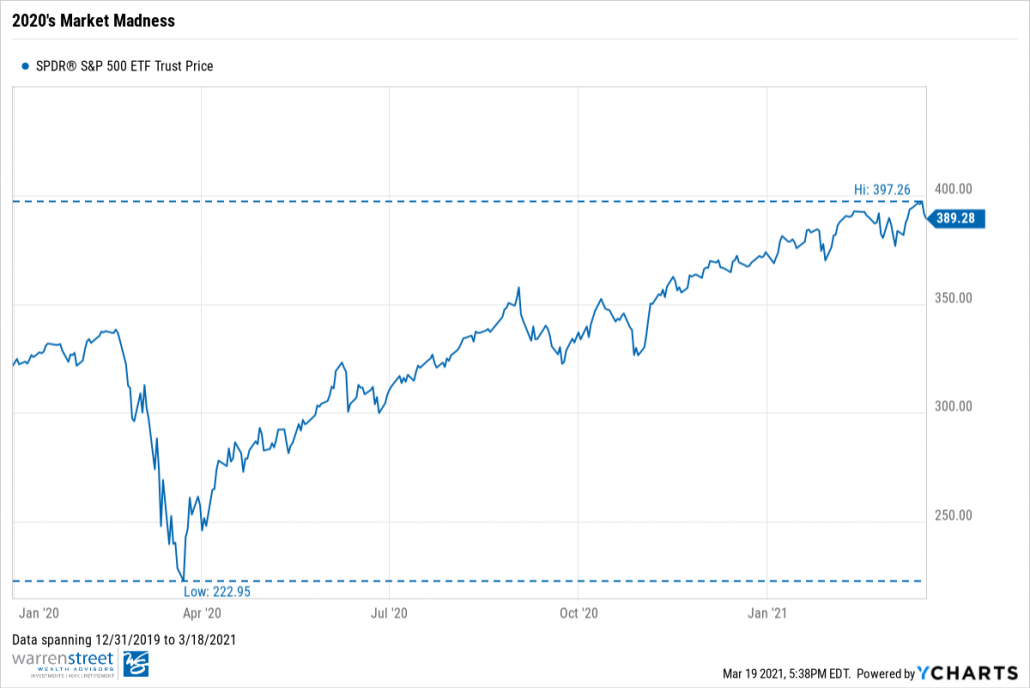
During this time last year, the NCAA canceled March Madness. With college basketball off the table, we were given a different type of madness: Market Madness. The S&P 500 drew down a total of 34% from peak to trough as COVID-19 wreaked havoc across global markets. This week marked the one year anniversary of that drawdown’s market bottom.

In September 2020, we wrote about the astounding fiscal and monetary policy action delivered by both the Federal Reserve and congressional lawmakers in response to the coronavirus. Although we complimented both the central bank and congress, the 2020 Most Valuable Player award quite honestly belongs to Jerome Powell and the Fed.

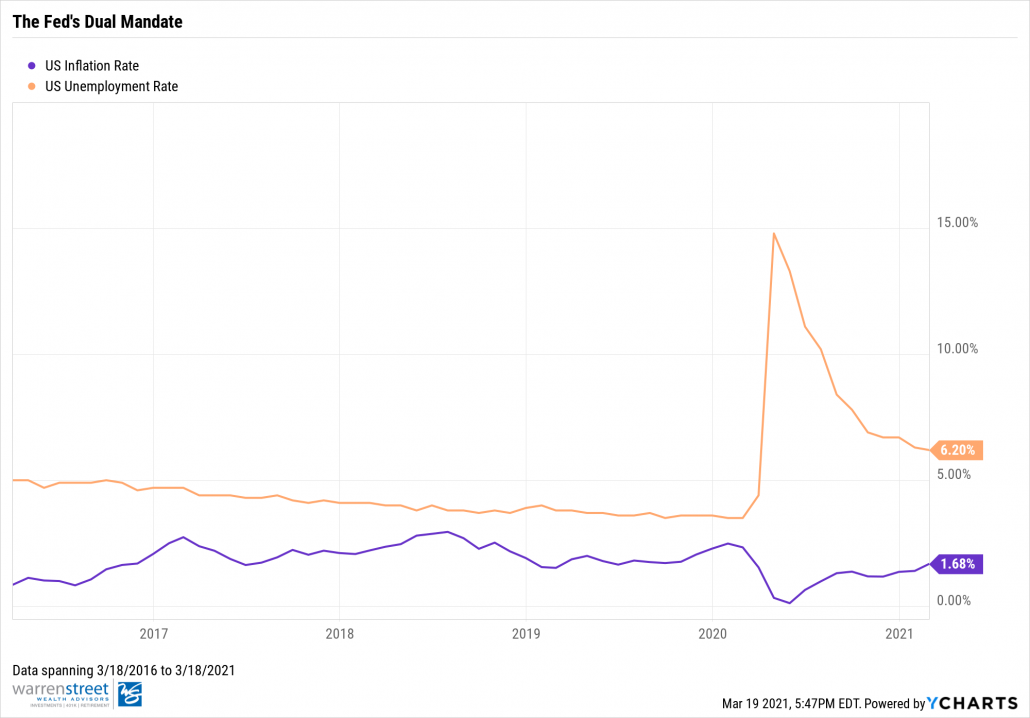
Today, after fending off last March’s Market Madness, the ball is no longer in the Fed’s court. Instead, The Fed is embodying a more reactive approach, awaiting signs of inflation to cross their 2% target before considering rate hikes or tools such as yield-curve control. Now, it’s our congressional leaders’ turn to play offense using fiscal policy. Their most recent time-out play is the $1.9 trillion stimulus package with embedded $1,400 stimulus payments expected to boost inflation.

Is Inflation Bad?

Let’s take a step back and consider why the Fed is setting a target with inflation. It’s important to distinguish that inflation isn’t as daunting as what’s ingrained in our history books. Sure, the inflationary tales of Zimbabwe and the Weimar Republic might seem scary, but the truth is such situations are rare and due to mismanaged policy in less-developed nations. Typically, mild inflation is a sign of rising consumption and increased demand. Today, this type of inflation can be recognized as reflation1; and in our case, reflation would signify that a return to normalcy is en route. 

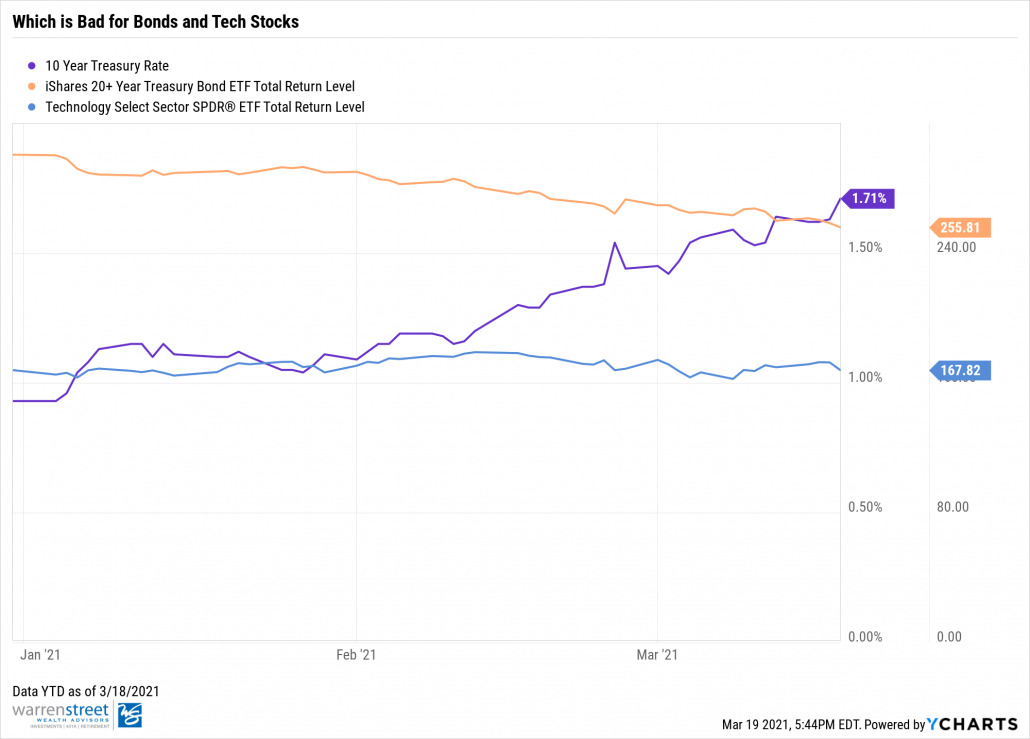
Market expectations for inflation are no laughing matter. A re-opening is expected to usher in increased spending in the form of pent-up demand. Input prices such as lumber and copper are already soaring. The five year breakeven treasury rate, which measures investor expectations for inflation, rose to its highest over point ever since 2014. Bonds, whose kryptonite is inflation, witnessed a sell-off that trickled into tech stocks.

But are markets correct to expect this much inflation? Or are markets overshooting their expectations by falling for this inflation pump fake? Perhaps our stay-at-home habits will prevail in the long-run and spending will not stay elevated, resulting in lower inflationary pressures. If so, we could see a rebound in bond prices and tech names. Nevertheless, this is the hotly debated topic among investors at the moment. 

Run The Play

This brings us back to the analogy with our administration’s most recent time-out-play. The $1.9 trillion relief bill is bringing hope to the workers, businesses, institutions, and communities that have struggled throughout this pandemic. As you can see in the chart below, the $1,400 stimulus payments represent a large percent of the package totalling $422 billion. It makes sense for investors to expect increased inflation as consumers now have higher disposable incomes and propensity to consume – but there is a catch.

Source: Committee For a Responsible Federal Budget (CRFB)

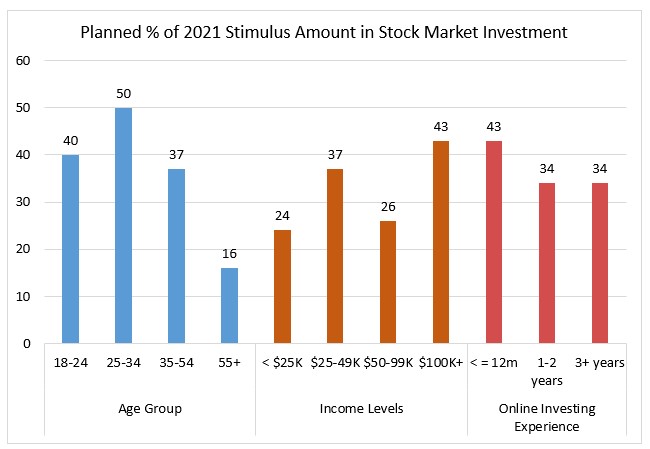
What will happen to actual inflation if these stimulus payments don’t make it back into the economy, but instead find their way into the stock market? A survey by Deutsche Bank revealed that individuals between the ages of 25 to 34 intend on placing 50% of the received payment into the stock market. Ultimately, the survey found that younger and high income earners eyed the stock market as the targeted destination for this income.

Source: Deutsche Bank Asset Allocation, dgDIG, RealVisionFinance
Data presented on 3/08/2021

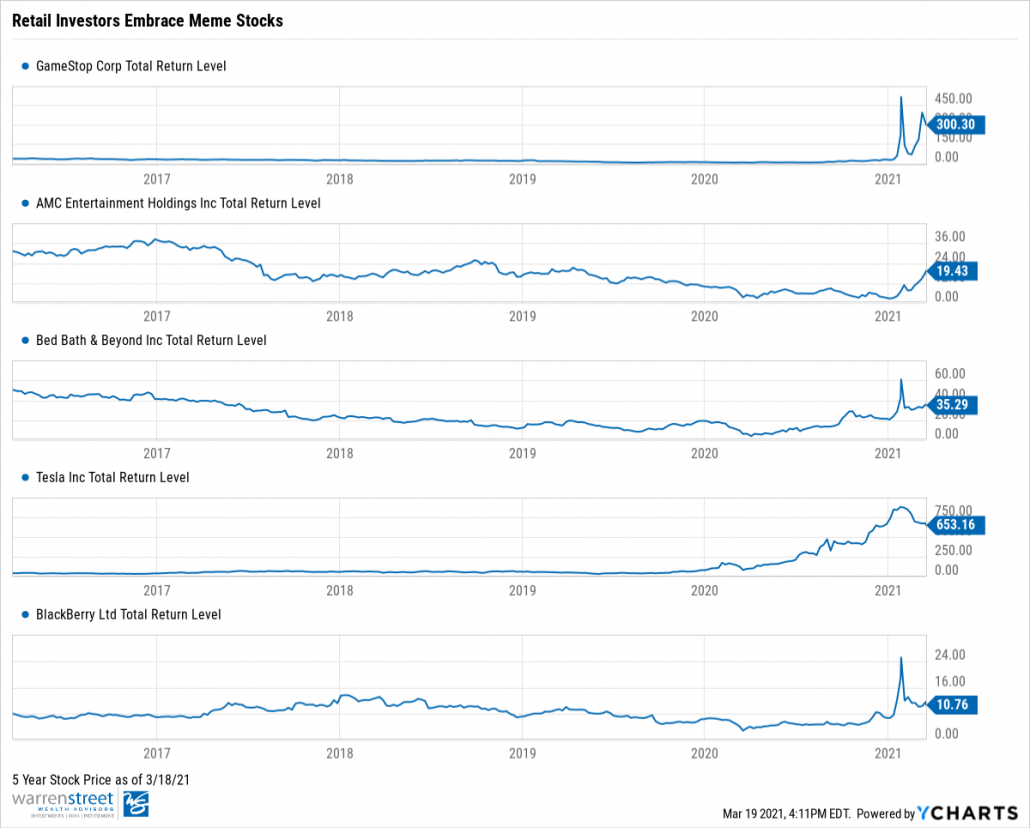
The Deutsche Bank survey, like any other, is going to be scrutinized for sampling error, but we don’t see something like the above being too far-fetched. The recent retail frenzy with “meme stocks2” like GameStop, Blackberry, and AMC has given rise to retail investing. Popular communities like r/WallStreetBets on Reddit have become a breeding ground for investors to commingle. Even more likely are your neighbors, who watched people get rich on the market’s 2020 rally, itching to pummel some of their stimulus money into the S&P 500.

These $1,400 payments are intended to increase demand for goods and prompt businesses to hire more workers, eventually raising wages. If these payments seek risk-assets instead, we could see a halt in the reflation narrative and a prolonged unemployment recovery.

Another risk to consider is the risk of financial stability. We’re seeing speculative behavior, especially from retail investors piling into stocks with less regard for the underlying fundamentals. At the end of the day, it’s quite possible to see a lack of wage growth in the economy while management teams of inefficient and highly-indebted companies get rewarded for little to no profitability.

The Bottom Line

We aren’t here to debate whether or not you should save or spend the money, let’s leave that to Reddit and Twitter. However, should a substantial portion of stimulus payments see capital markets as a more attractive destination than the underlying economy, the risks to reflation and financial stability must not be overlooked.     

We’ll see whether or not the $1.9 trillion time-out play will win the economic recovery game and prevent further Market Madness… if not, let’s hope it at least takes us into overtime.

Footnotes:

  1. Reflation represents increased price levels as a result of monetary or fiscal policy as a means to combat deflation.  
  2. “Meme stocks” are stocks that have gained traction from retail audiences such as Reddit or investment communities. GameStop and AMC are just a few of the many names with this retail comradery, earning these stocks the nickname “meme stocks” and causing a surge in prices throughout early 2021.

Sources: 

Committee For a Responsible Congressional Budget 

Deustche Bank Survey

YCharts

Phillip Law, Portfolio Analyst

Wealth Advisor, Warren Street Wealth Advisors

Investment Advisor Representative, Warren Street Wealth Advisors, LLC., a Registered Investment Advisor

The information presented here represents opinions and is not meant as personal or actionable advice to any individual, corporation, or other entity. Any investments discussed carry unique risks and should be carefully considered and reviewed by you and your financial professional. Nothing in this document is a solicitation to buy or sell any securities, or an attempt to furnish personal investment advice. Warren Street Wealth Advisors may own securities referenced in this document. Due to the static nature of content, securities held may change over time and current trades may be contrary to outdated publications. Form ADV available upon request 714-876-6200.

https://warrenstreetwealth.com/wp-content/uploads/2021/03/clay-banks-TuVChJ1P0IY-unsplash-scaled.jpg 2560 2048 Phillip Law, CFA https://warrenstreetwealth.com/wp-content/uploads/2014/11/Warren_Street_logo-01.svg Phillip Law, CFA2021-03-25 17:17:052021-03-25 17:33:06March Market Madness

Is Tesla Flying Too Close to the Sun?

January 29, 2021/in Education, Financial Planning, General, Intermediate, Investing/by Phillip Law, CFA

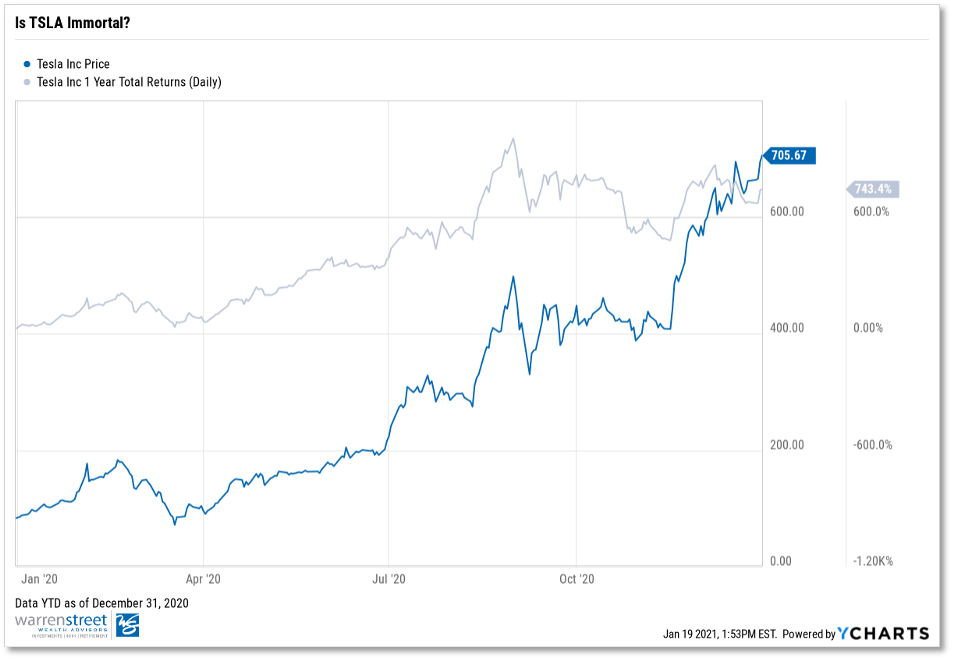
743%. That’s how much Tesla stock (Ticker: TSLA) returned in 20201. Most of us are aware of the bifurcation between the market’s seemingly invisible ceiling and the economy’s continued disarray, but nobody could have foreseen that Elon Musk and his army of “musketeers” would be amongst those most rewarded for owning increased allocations of TSLA stock.

In fact, 2020 was an eventful year for the electric vehicle company. Among a series of roller coaster weeks, a stock split announcement, and raging debate over analyst price targets, perhaps TSLA’s most noteworthy 2020 phenomenon was its inclusion in the S&P 500 Index – a profound move that has us concerned over the stock’s perceived immortality at the forefront.

On December 21, 2020, the S&P 500 Index committee formally added the “profitable” carmaker to the index after denying TSLA index entry earlier in the year. The circumstances around this inclusion eerily resembles something we’ve seen before. Does “You’ve Got Mail” ring a bell? That’s right – we see multiple uncanny parallels between the TSLA and former net stock giant: American Online (AOL).

Echoes of The Past

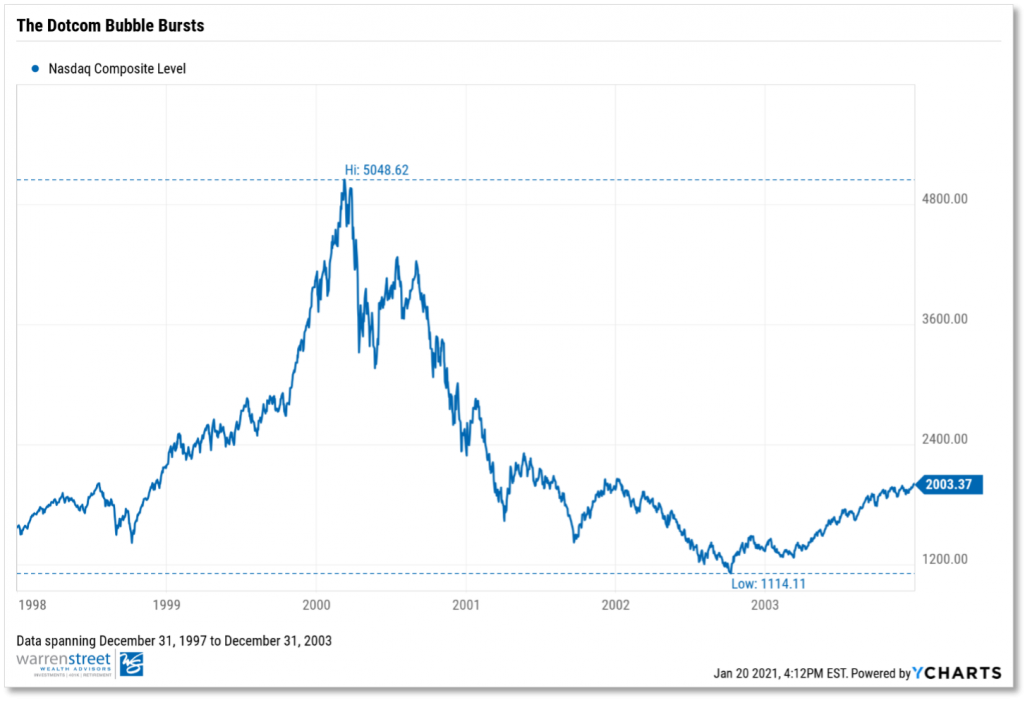
On December 23, 1998, Standard & Poor’s announced it would make American Online the first “net” stock featured in the S&P 500 Index. Leading up to the announcement, AOL rallied 510% year-to-date2, before ending the year with a return of 585%. Compare this to TSLA, which had run-up 388%3 by the time the committee made its announcement on November 16, 2020. As mentioned previously, TSLA’s 2020 return was 743%. Notice here that a large proportion of TSLA’s 2020 return came in the last month and a half in the year…talk about upward volatility.

Arguably, the most intriguing similarity between these two stocks is the amount of price action driven by momentum and fear of missing out (FOMO). Investors overlooked red flags related to both AOL’s fundamentals and underlying profitability of tech stocks. AOL eventually lost 91%4 of its market value after a failed merger with Time-Warner cable. Meanwhile, valuations of tech stocks (represented by the Nasdaq Index) peaked in early 2000 before seeing 78%5 of its value disintegrate. Fast forward to the end of 2020, you have Tesla, a company whose “profitability” is primarily tied to energy credits, octupling (8x) its stock price to levels many investors deem uncomfortable.

Will TSLA suffer the same fate as AOL and other dotcom counterparts? Obviously 2021 is a different year. The carmaker makes electric-powered cars, not an instant messaging platform. We do acknowledge that historical performance is not indicative of future performance; and that correlation does not equal causation. However, it’s important to remember that those who don’t learn from history are doomed to repeat it.

How Much TSLA Do You REALLY Own?

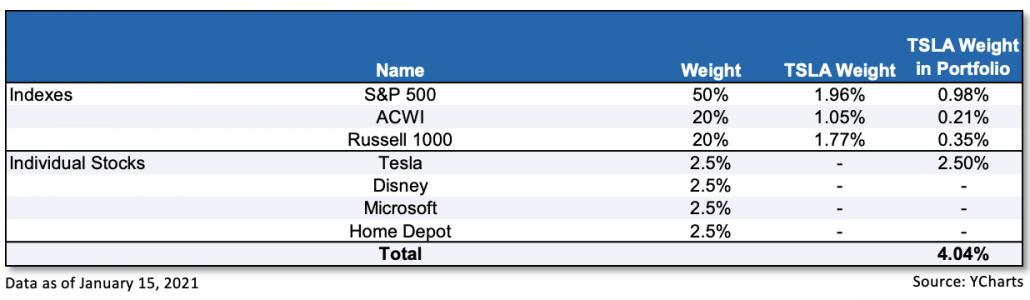
TSLA’s inclusion in the S&P 500 Index raises a new challenge for investors: hidden concentration risk. With TSLA now a part of the NASDAQ, Russell 1000, and widely regarded S&P 500, owning index funds inherently carries TSLA exposure. Borrowing from our friends over at WisdomTree, imagine a scenario where Portfolio A holds broad index funds in addition to a few well-known names.

What investors thought was a 2.50% allocation to TSLA is at 4.00%6. I know, I know. 4% doesn’t seem like a big deal. Besides, what investor puts 90% of their equity allocation into only broad U.S. ETFs? (You’d be surprised). The more important point though, is that volatile price action with TSLA can hide how much of the stock you really own.

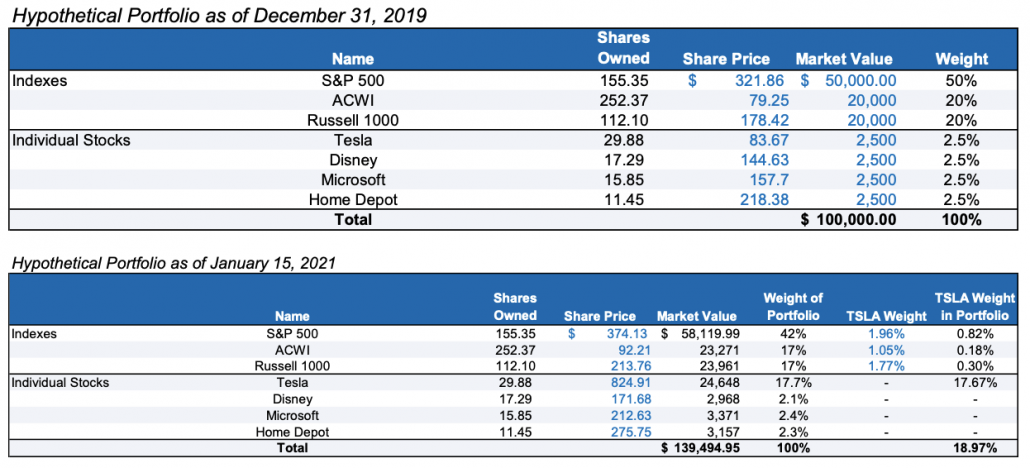
At the end of 2019, TSLA shares were at $83.67. As of Friday, January 15, 2021 – the stock sits at $824.91 – almost ten times over its stock price just a year ago. Let’s say you owned Portfolio A on December 31, 2019. As of January 15 this year, TSLA would comprise 19% of Portfolio A’s exposure (see Appendix A). Obviously, price appreciation and concentration risk create their own problems (e.g., skewed returns, tax consequences), but when the underlying rationale for that price appreciation is in question by the investment community at large, you could have an even bigger problem on your hands.

 Will TSLA Fall Back Down to Earth?

Today, it seems as if TSLA has really shot over the moon, multiplying its stock price ten times in a little over a year. Will the carmaker continue to defy odds throughout 2021? Or, is Tesla a ticking-time bomb waiting to explode?

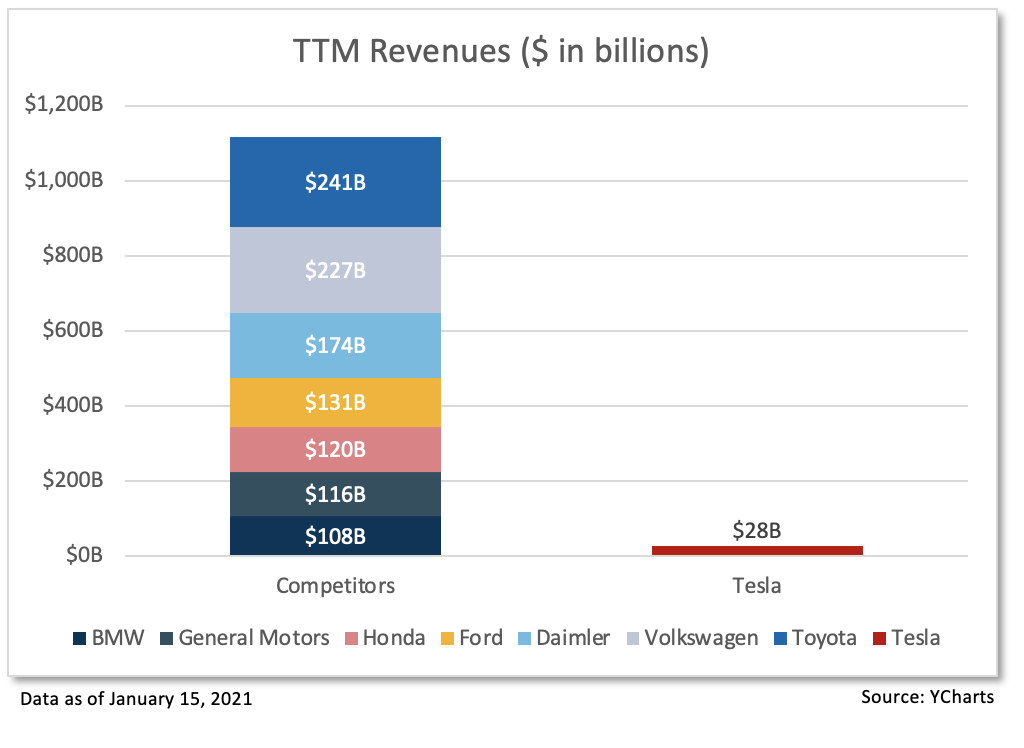
We at Warren Street Wealth Advisors aren’t equity research moguls here to publish a Buy, Sell, or Hold on this highly debated stock. However, we do acknowledge that no company is immune from idiosyncratic risk. Whether Tesla can stay above the influx of foreign competition (e.g., NIO, Volkswagen), or whether or not valuations are outstretched represent just a few of many risks to the company’s stock price.

One observation fueling TSLA’s controversy is that despite having a much larger market cap relative to other established vehicle manufacturers (see above), the company only generated $28.2 billion in sales7. Compare this to a combined $1.1 trillion in sales7 for all its auto competitors listed above. How can a company, which does a fraction of its competitors’ sales, be worth more than all of them combined? Again, TSLA isn’t just a car company – it’s thought to be a generational leader driving the next revolution in clean energy; but nevertheless, some food for thought while you’re on the road.

Tesla’s ride sure was wild in 2020, and nobody can guarantee what will happen in 2021. However, as prudent investors, it’s important to not overlook the implications that a high-flying stock can have on client portfolios. We’re not here to argue whether Tesla’s run has just begun or if the stock’s price is dangerously inflated. But if the latter of those two ideas rings true, the world could be shocked when it sees electricity and a bubble come together.

Footnotes:

  1. YTD total return as of 12/31/2020 sourced to YCharts.
  2. YTD total return for 12/23/1998 and 12/31/1998 sourced to historicalstockprice.com.
  3. YTD total return as of 11/16/2020.
  4. AOL’s market cap plummeted from $226 billion to roughly $20 billion in 2003, sourced to Bezinga.
  5. NASDAQ percent off high spanning 12/31/1997 to 12/31/2003.
  6. 4.04% is the summation of multiplying TSLA weight in index by index weight in portfolio.
  7. Trailing twelve-month figures.

Appendix A

For any questions regarding international investments, emerging markets, or wealth management, please call 714-876-6200 or email phillip@warrenstreetwealth.com. 

Phillip Law, Portfolio Analyst

Wealth Advisor, Warren Street Wealth Advisors

Investment Advisor Representative, Warren Street Wealth Advisors, LLC., a Registered Investment Advisor

The information presented here represents opinions and is not meant as personal or actionable advice to any individual, corporation, or other entity. Any investments discussed carry unique risks and should be carefully considered and reviewed by you and your financial professional. Nothing in this document is a solicitation to buy or sell any securities, or an attempt to furnish personal investment advice. Warren Street Wealth Advisors may own securities referenced in this document. Due to the static nature of content, securities held may change over time and current trades may be contrary to outdated publications. Form ADV available upon request 714-876-6200.
https://warrenstreetwealth.com/wp-content/uploads/2021/01/milan-csizmadia-d0V_DQO_xUM-unsplash-scaled.jpg 2560 2048 Phillip Law, CFA https://warrenstreetwealth.com/wp-content/uploads/2014/11/Warren_Street_logo-01.svg Phillip Law, CFA2021-01-29 22:15:402021-01-30 00:36:33Is Tesla Flying Too Close to the Sun?

PPP Reboot – More Small Business Relief

January 26, 2021/in Basic, Education, Financial Planning, General/by Emily Balmages, CFP®

Last week, the SBA reopened the Paycheck Protection Program (PPP) and will begin accepting applications for “Second Draw” forgivable PPP loans.  

Here is a summary of the eligibility rules for Second Draw loans.  Borrowers can draw loans of up to $2 million provided they: 

  1. Have previously received a “First Draw” PPP loan and used the full amount on eligible expenses  
  1. Have 300 or fewer employees
  1. Document at least a 25% reduction in gross receipts in comparable 2020 and 2019 quarters

PPP borrowers may have their loans forgiven if the proceeds are spent on the following expenses:  payroll (including benefits), mortgage interest, rent, utilities, worker protection costs related to COVID-19, uninsured property damage costs caused by looting or vandalism during 2020, and certain supplier costs and expenses for operations.   

To receive full forgiveness, borrowers must spend at least 60% of the funds on payroll expenses over an 8-24 week period.  

This is a high-level overview; if you have questions about the specifics as they apply to your business, please contact us. We are here to help!

Source: U.S. Small Business Administration

https://www.sba.gov/funding-programs/loans/coronavirus-relief-options/paycheck-protection-program/second-draw-ppp-loans

Emily Balmages, CFP®, CRTP

Wealth Advisor, Warren Street Wealth Advisors

Investment Advisor Representative, Warren Street Wealth Advisors, LLC., a Registered Investment Advisor

The information presented here represents opinions and is not meant as personal or actionable advice to any individual, corporation, or other entity. Any investments discussed carry unique risks and should be carefully considered and reviewed by you and your financial professional. Nothing in this document is a solicitation to buy or sell any securities, or an attempt to furnish personal investment advice. Warren Street Wealth Advisors may own securities referenced in this document. Due to the static nature of content, securities held may change over time and current trades may be contrary to outdated publications. Form ADV available upon request 714-876-6200.
https://warrenstreetwealth.com/wp-content/uploads/2021/01/vitaly-taranov-OCrPJce6GPk-unsplash-scaled.jpg 1707 2560 Emily Balmages, CFP® https://warrenstreetwealth.com/wp-content/uploads/2014/11/Warren_Street_logo-01.svg Emily Balmages, CFP®2021-01-26 02:17:272021-01-28 00:05:55PPP Reboot – More Small Business Relief

Year-End Planning Checklist

December 16, 2020/in Basic, Education, Financial Planning, General, Taxes/by Emily Balmages, CFP®

2020 has been a strange year for all of us, and although some financial planning deadlines have been modified due to the CARES Act, most 12/31 deadlines remain in place.  Below are items we are considering as we wrap up the year with our clients.  Should you have questions about whether or how any of the items below apply to you, please reach out to us as we will be happy to assist.  

 2020 Year-End Planning Items with 12/31 Deadline

  1. Maxing out 401(k) contributions:  Employees can contribute up to $19,500 (plus $6,500 extra for those over 50), into their 401(k)s for 2020.   If you have not yet contributed the maximum amount and your cash flow allows, consider increasing your contributions now to reach the maximum contribution amount prior to year end.  
  1. 401(k) Matching:  If your company offers a 401(k) match, it makes sense to take advantage of the full match opportunity every year.  If you have not received the full match for 2020, let us review your company’s 401(k) plan rules to determine if you can contribute enough to receive the full 2020 match before year end.  
  1. Charitable Giving for 2020:  There are some additional charitable deductions this year as part of the CARES Act.  There is a $300 deduction for taxpayers who don’t itemize, and for clients interested in large donations, taxpayers can deduct up to 100% of their adjusted gross income (up from 60%) for cash donations made to public charities. For clients with taxable accounts, we frequently recommend donating appreciated securities instead of cash via a donor-advised fund (DAF).  This strategy works well when a taxpayer has highly appreciated securities in taxable accounts, and/or in a year when income is higher allowing a client to benefit from a larger charitable deduction.  
  1. Gifting:  The annual gift exclusion amount for 2020 is $15,000 per taxpayer to each recipient.  (Married couples can give $30k.)  Make your annual gifts prior to 12/31 if you haven’t already!  
  1. Tax Loss/Gain Harvesting:  At Warren Street, we employ a continuous monitoring of client accounts for tax loss harvesting opportunities.  Similarly, if a client is experiencing a particularly low tax year, it may be the right time to strategically harvest capital gains.  
  1. Roth Conversions:  Although market downturns are not fun, they can certainly provide an opportunity for strategic Roth Conversions.  This is an annual planning item that we analyze for every Warren Street client.  
  1. LLC / Entity Formation:  If you are in the process of business entity formation for 2020, you may need to have your documents signed and filed prior to the end of the calendar year.  

If you have any questions about the above checklist or any other year-end planning questions, please feel free to reach out to your trusted wealth advisor. We are here to help!

Emily Balmages, CFP®, CRTP

Wealth Advisor, Warren Street Wealth Advisors

Investment Advisor Representative, Warren Street Wealth Advisors, LLC., a Registered Investment Advisor

The information presented here represents opinions and is not meant as personal or actionable advice to any individual, corporation, or other entity. Any investments discussed carry unique risks and should be carefully considered and reviewed by you and your financial professional. Nothing in this document is a solicitation to buy or sell any securities, or an attempt to furnish personal investment advice. Warren Street Wealth Advisors may own securities referenced in this document. Due to the static nature of content, securities held may change over time and current trades may be contrary to outdated publications. Form ADV available upon request 714-876-6200.

https://warrenstreetwealth.com/wp-content/uploads/2020/12/stil-ck0i9Dnjtj0-unsplash-scaled.jpg 2560 1696 Emily Balmages, CFP® https://warrenstreetwealth.com/wp-content/uploads/2014/11/Warren_Street_logo-01.svg Emily Balmages, CFP®2020-12-16 21:22:592020-12-17 21:09:04Year-End Planning Checklist

Where Are We Now?

September 1, 2020/in Education, Financial Planning, General, Retirement, Uncategorized/by Blake Street
Read more
https://warrenstreetwealth.com/wp-content/uploads/2020/09/Screen-Shot-2020-08-31-at-5.26.36-PM-e1598985462379.png 274 412 Blake Street https://warrenstreetwealth.com/wp-content/uploads/2014/11/Warren_Street_logo-01.svg Blake Street2020-09-01 18:08:452020-09-01 18:52:11Where Are We Now?
Page 4 of 10«‹23456›»

Recent Posts

  • IPO Mania: What the Rocket Ships, Chatbots, and Rule Changes Mean for Your PortfolioJune 10, 2026 - 3:01 pm

    SpaceX, OpenAI, and Anthropic are leading a historic $200B IPO wave. Senior Portfolio Manager Phillip Law, CFA analyzes why these mega-offerings are happening now, the “index dilemma” threatening passive investors, and how to maintain a disciplined, quality-focused strategy amid the AI enthusiasm.

  • Meet Jennifer Horner, Operations & Compliance AssociateJune 5, 2026 - 11:11 am

    Meet Jennifer Horner, our new Operations & Compliance Associate at Warren Street. In this Q&A, learn about her crucial role in handling daily account transactions, keeping our firm secure, and how her core values of integrity and family align with our mission.

  • Meet Our Onboarding Coordinator: Isaiah Knox, MBAApril 28, 2026 - 7:02 am

    Meet Isaiah Knox, MBA, Warren Street’s Onboarding Coordinator! In this Q&A, learn how Isaiah ensures a seamless, supportive, and high-quality onboarding experience for new clients. Read about his client-first commitment and the role he plays within the team dedicated to your financial well-being at our firm.

  • On the War in Iran: Do Markets Not Care, and What’s Next?April 24, 2026 - 4:48 pm

    With 80 oil tankers stranded and a 9-million-barrel daily shortfall, why are markets hovering near all-time highs? In our April 2026 update, we dive into the “boxed-in” realities facing both the U.S. and Iran, the seven-step framework for “maximum pressure” negotiations, and why we’re choosing disciplined rebalancing over reactive shifts. Discover why the market is looking past the immediate conflict in what’s now a world of accelerated deglobalization.

Categories

  • Basic
  • Chevron
  • Education
  • Financial Planning
  • General
  • Intermediate
  • Investing
  • Quarterly Economic Update
  • Retirement
  • Taxes
  • Uncategorized

Contact Us

(714) 876-6200

hello@warrenstreetwealth.com

Warren Street Wealth Advisors, LLC
200 Spectrum Center Drive, Suite 300,
Irvine, CA 92618

As a Registered Investment Advisor, Warren Street Wealth Advisors, LLC is required to file form ADV to report our business practices and conflicts of interest. Please call to request a copy at 714-876-6200.

IMPORTANT DISCLOSURE INFORMATION

Stay Connected

© Copyright 2026 - Warren Street Wealth Advisors, LLC - 200 Spectrum Center Drive, Suite 300, Irvine, California 92618 - Enfold Theme by Kriesi
  • Link to Facebook
  • Link to Instagram
  • Link to LinkedIn
  • Link to Youtube
  • Link to Yelp
  • Link to X
  • Link to Mail
Scroll to top Scroll to top Scroll to top