On Equity Market Sell-Offs: Paying to Play
Whether you come face-to-face with a lion or smell smoke in the hallway, your brain gives you one instruction: run. That fight or flight instinct is what’s kept humans alive for thousands of years.
However, investing is often counterintuitive in a way that almost nothing else in life is. Moments where you feel danger are actually when you should stay and fight. Easier said than done – especially with last week’s market declines. However, it’s during these times that we’re here not only to steady your hand, but also to turn your desire for defense into offense.
State of Play
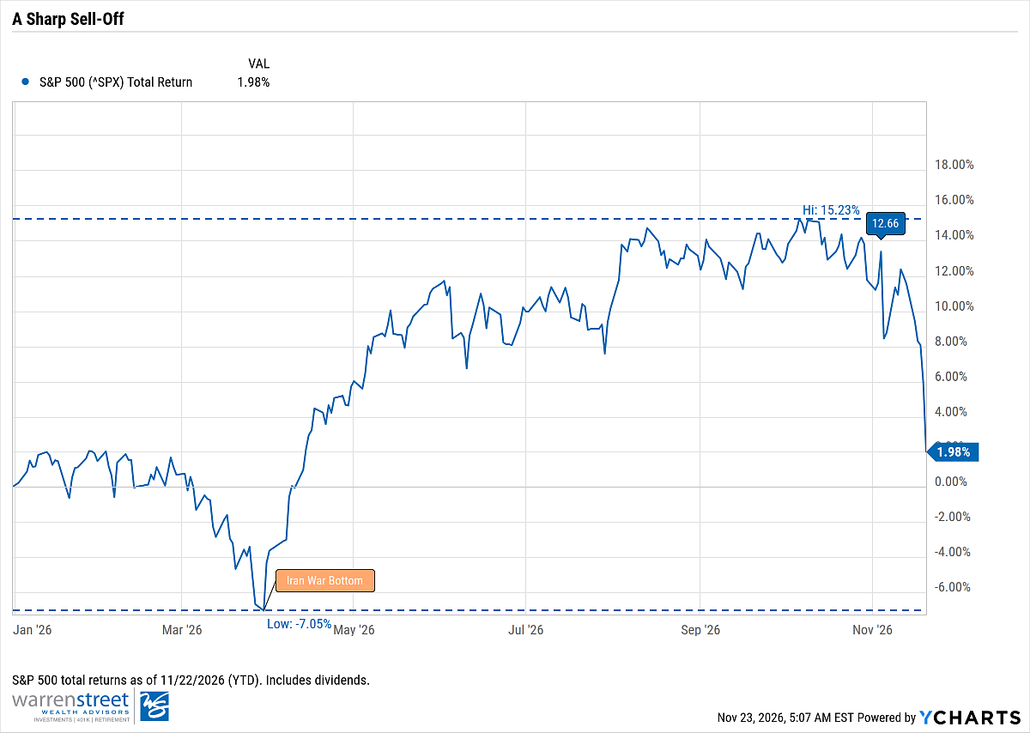
Last Friday, November 20, the S&P 500 fell 3.70% leaving it 11.5% below its all-time highs. Meanwhile, the index’s 2026 year-to-date return fell sharply from 12.4% down to 2.0% over seven trading days. This pace, followed by the uncertainty of continued declines, is enough to make your stomach drop right?
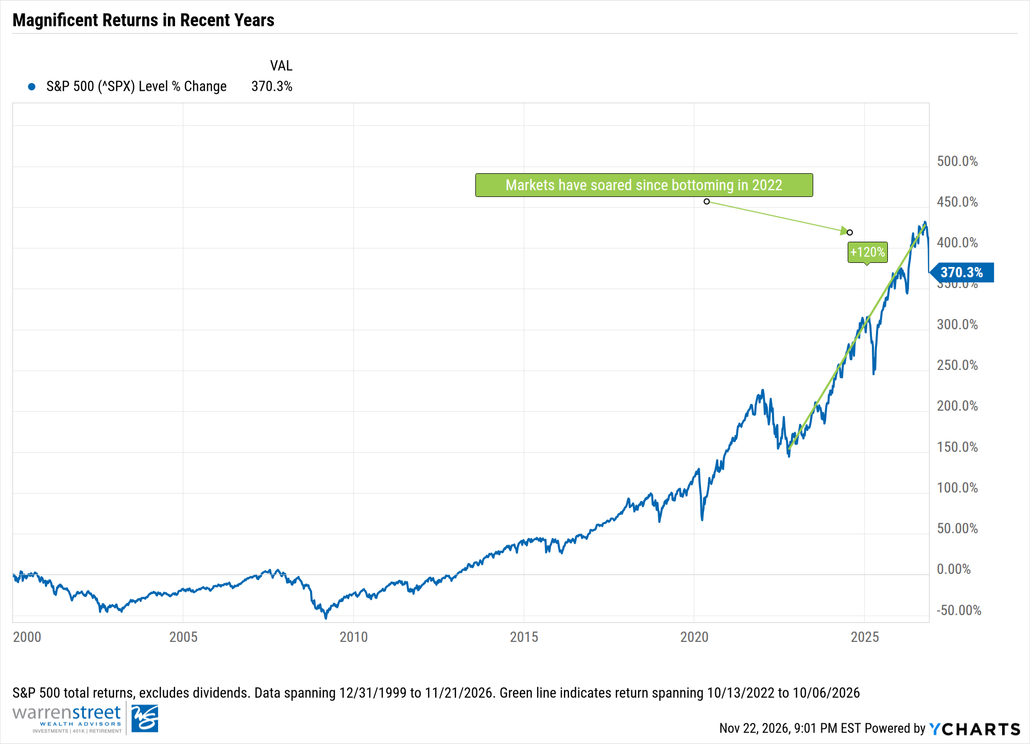
But let’s zoom out for a moment. Since the last market1 bottom in October 2022, the S&P 500 rose 120% before the start of the current sell-off. That’s a ~21% annualized (i.e., yearly) return, compared to average historical return of ~10% per year! With recent returns so generous, it’s easy to forget that there’s a participation fee in the world of stock investing.
Paying to Play
That participation fee is volatility. Said another way, it’s the emotions that invoke your fight or flight instincts during market sell-offs, and those moments come more often than people think. The table below shows the S&P 500’s largest drop each year and where it finished the year.
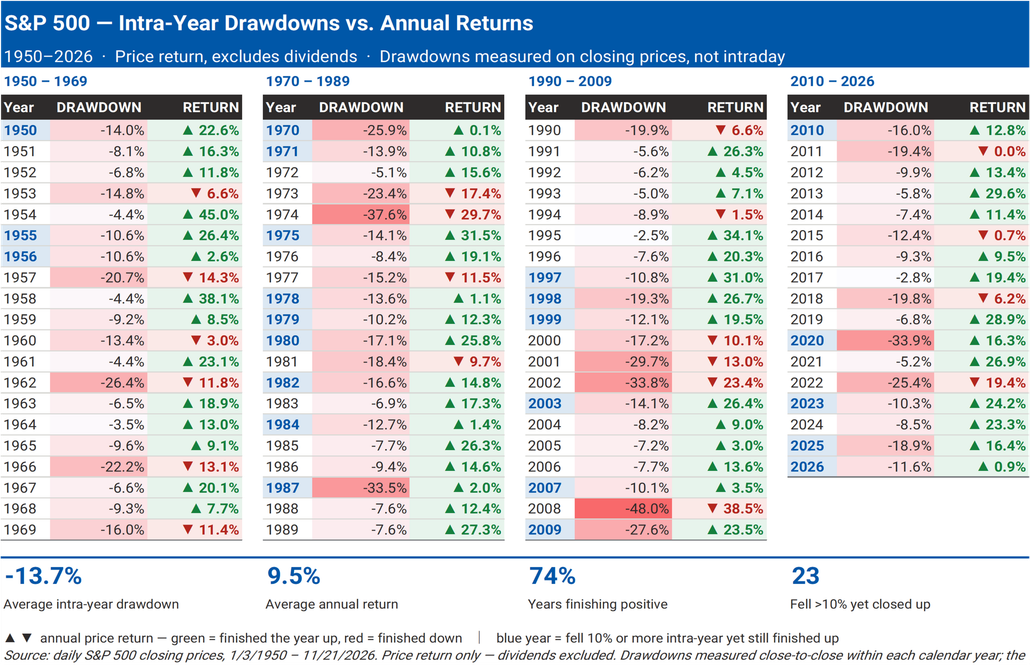
- Since 1950, the typical year has included a decline of ~11%, yet the market finished higher roughly every 3 out of 4 years (75% of the time).
- 42 of those 77 years saw a decline of 10% or more at some point. In 23 of those years the market still ended the year finishing higher.
- In other words, double digit declines are NOT a sign that something is broken – it’s a normal feature (not a bug) of owning stocks.
It’s important to note that this table doesn’t tell the whole story. Some selloffs stretch beyond a single year (e.g., 2000-2002, 2008), and the bigger drawdowns are scary for good reason. Recoveries are never guaranteed, and neither is the 8-10% return the S&P 500 has historically generated.
But courage to fight – not flee – does pay. $10k invested in the S&P 500 in 1950, untouched, would’ve grown to $4.1mm today, before dividends. Someone who invested at the peak of the 2008 crisis, could have still turned that $10k into ~$47k.
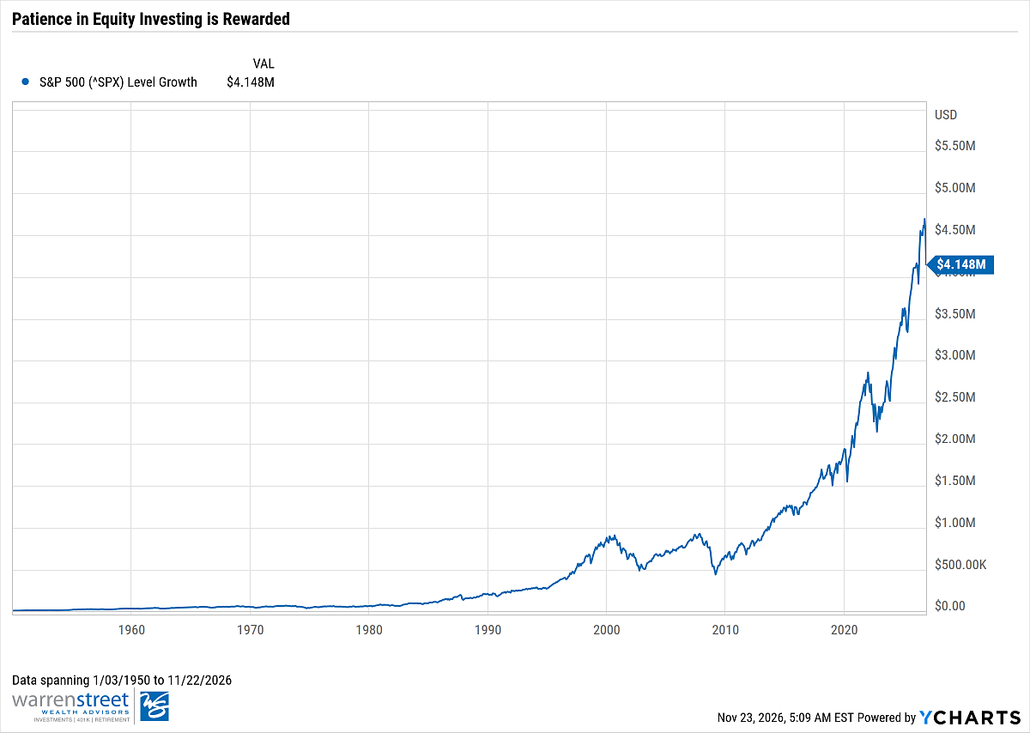
That’s the reward for sitting through uncertainty: uncertain company profits, uncertain economic conditions, and the occasional stomach-turning correction. Stocks have paid more than bonds and cash precisely because they are uncomfortable to hold at times. Take that away, and you lose the powerful return premium that has helped households build wealth over time.
Ultimately, we encourage clients to view that discomfort not as a signal to flee, but as the participation fee for long-term stock returns – a price history shows is worth paying.
Bring Out the Playbook
While we can’t offer insight on when this sell-off will end, we intend to help clients do better than just paying their participation fee. So, what plays can we run together to get some extra points on the score board?
Investment & Trading Considerations
- Put Cash to Work: Downturns can provide opportunities to buy into the market at lower prices.
- Scan for untapped cash (a.k.a. dry powder), which can be deployed via lump sum or a dollar cost averaging schedule of your choice.
- Max your 401k match. Sell-offs present attractive opportunities to increase cash deployments through company matches.
- Rebalance: Following your target asset allocation, trim assets that have held up well (strength) and rotate into weakness, effectively buying low and selling high.
- Tax loss harvesting: Scanning the right portfolios for realizable losses can be used to offset future capital gains and increase take-home returns (after-tax).
- Revisit Your Risk Tolerance: Market sell-offs provide an opportunity to increase risk-tolerance instead of lowering it. Consult your advisor to see if this is an opportunity.
Financial Planning Considerations
- Roth Conversions: Converting while account values are down means less tax today and tax-free growth during the recovery. Talk to your advisor to see if this is a right fit.
- Hold off on large withdrawals: Wait until the market recovers to make larger-than-usual portfolio withdrawals.
Remember, market corrections will always be a part of your investing journey, and Mr. Market will come to your doorstep to collect his participation fee. However, we hope that this framing makes it easier for you to fight rather than flee. And we hope that it makes it easier to “be fearful when others are greedy, and greedy when others are fearful” as legendary investor Warren Buffet famously said.

Phillip Law, CFA
Senior Portfolio Manager
Warren Street Wealth Advisors, LLC., a Registered Investment Advisor
The information presented here represents opinions and is not meant as personal or actionable advice to any individual, corporation, or other entity. Any investments discussed carry unique risks and should be carefully considered and reviewed by you and your financial professional. Nothing in this document is a solicitation to buy or sell any securities, or an attempt to furnish personal investment advice. Warren Street Wealth Advisors and/or its clients may hold positions in the securities mentioned. Holdings may change at any time without notice. Due to the static nature of content, securities held may change over time and current trades may be contrary to outdated publications. Form ADV available upon request 714-876-6200.