Tag Archive for: diversification

Introducing Warren Street Global Equity ETF (WSGE) – An Informed Approach to Diversification

We’re thrilled to announce a major milestone for our firm and our clients: the launch of the Warren Street Global Equity ETF (NASDAQ: WSGE)!

This new Exchange-Traded Fund (ETF) is now available, bringing our disciplined investment philosophy to the public in a convenient, accessible format. This is an exciting step forward as we continue to provide sophisticated investment solutions while delivering on our fiduciary commitment.

The Warren Street Wealth Advisors team celebrates the launch with a visit to the NASDAQ MarketSite in Times Square, New York.

What is WSGE and Why Did We Create It?

The Warren Street Global Equity ETF (WSGE) is designed to be a smarter way to invest in the global stock market. The traditional choice has always been either a simple, broad index fund or a complicated, expensive actively managed fund. We created WSGE to give you the best of both worlds: global diversification with a smart strategy built to enhance returns.

Focus on You: The Key Client Benefits

While the investment strategy is robust, the most important reason we created WSGE is to provide direct, tangible benefits to you, our clients, and to uphold our fiduciary standard:

  • Embedded Tax Efficiencies: As an ETF, WSGE is structured to minimize capital gains distributions compared to traditional mutual funds. This powerful tax efficiency helps you keep more of your investment returns, making your portfolio work harder over the long term.
  • Economies of Scale: By bundling diverse global exposures and our proprietary strategy into a single vehicle, we achieve significant economies of scale. This approach reduces complexity and overall costs, effectively providing you with institutional-quality management at a lower expense.
  • Uniformity Across Clients: WSGE ensures every client benefits from the exact same research-driven exposure and proprietary factor tilts. This uniformity across clients leads to greater consistency, streamlined execution, and clearer reporting, regardless of account size.
  • Time Savings & Simplicity: The single-fund structure drastically simplifies trade execution, rebalancing, and overall portfolio maintenance. This provides time savings for both our advisory team and you, the client, allowing us to focus more on your comprehensive financial plan, retirement goals, and tax strategies.

Learn More

When you invest in WSGE, you’re accessing the same level of rigorous due diligence that defines Warren Street Wealth Advisors. We meticulously select the fund’s underlying investments, focusing on quality management, low cost, and alignment with our goals.

We are proud to bring this innovative solution to market and look forward to partnering with you on your journey toward long-term capital appreciation.

To learn more about the fund, view the prospectus, and review important disclosures, please visit warrenstreetetf.com.

Phillip Law, CFA

Senior Portfolio Manager, Warren Street Wealth Advisors

Investment Advisor Representative, Warren Street Wealth Advisors, LLC., a Registered Investment Advisor

The information presented here represents opinions and is not meant as personal or actionable advice to any individual, corporation, or other entity. Any investments discussed carry unique risks and should be carefully considered and reviewed by you and your financial professional. Nothing in this document is a solicitation to buy or sell any securities, or an attempt to furnish personal investment advice. Warren Street Wealth Advisors may own securities referenced in this document. Due to the static nature of content, securities held may change over time and current trades may be contrary to outdated publications. Form ADV available upon request 714-876-6200.

Important Information

The Fund’s investment objectives, risks, charges and expenses must be considered carefully before investing. This and other important information is contained in the prospectus, which may be obtained by following the links Prospectus and Summary Prospectus or by calling +1.714.876.6200. Please read the prospectus carefully before investing.

The Fund is actively-managed and is subject to the risk that the strategy may not produce the intended results. The Fund is new and has a limited operating history to evaluate.

Median 30 Day Spread: is a calculation of Fund’s median bid-ask spread, expressed as a percentage rounded to the nearest hundredth, computed by: identifying the Fund’s national best bid and national best offer as of the end of each 10 second interval during each trading day of the last 30 calendar days; dividing the difference between each such bid and offer by the midpoint of the national best bid and national best offer; and identifying the median of those values.

Basis Points (bps): A unit of measure used in quoting yields, changes in yields or differences between yields. One basis point is equal to 0.01%, or one one-hundredth of a percent of yield and 100 basis points equals 1%.

Equity Investing Risk. An investment in the Fund involves risks similar to those of investing in any fund holding equity securities, such as market fluctuations, changes in interest rates and perceived trends in stock prices. The values of equity securities could decline generally or could underperform other investments. In addition, securities may decline in value due to factors affecting a specific issuer, market or securities markets generally.

Fixed-Income Risk. The market value of fixed-income securities will change in response to interest rate changes and other factors, such as changes in the effective maturities and credit ratings of fixed-income investments. During periods of falling interest rates, the values of outstanding fixed-income securities and related financial instruments generally rise. Conversely, during periods of rising interest rates, the values of such securities and related financial instruments generally decline. Fixed-income investments are also subject to credit risk.

Large-Capitalization Companies Risk. Large-capitalization companies may trail the returns of the overall stock market. Large-capitalization stocks tend to go through cycles of doing better – or worse – than the stock market in general. These periods have, in the past, lasted for as long as several years.

Mid-Capitalization Companies Risk. Investing in securities of mid-capitalization companies involves greater risk than customarily is associated with investing in larger, more established companies. These companies’ securities may be more volatile and less liquid than those of more established companies. Often mid-capitalization companies and the industries in which they focus are still evolving and, as a result, they may be more sensitive to changing market conditions.

Depositary Receipt Risk. ADRs and GDRs are generally subject to the risks of investing directly in foreign securities and, in some cases, there may be less information available about the underlying issuers than would be the case with a direct investment in the foreign issuer. ADRs are U.S. dollar-denominated receipts representing shares of foreign-based corporations. GDRs are similar to ADRs but are shares of foreign-based corporations generally issued by international banks in one or more markets around the world.

Risk of Investing in Other ETFs. Because the Fund may invest in Underlying ETFs, the Fund’s investment performance is impacted by the investment performance of the selected Underlying ETFs. An investment in the Fund is subject to the risks associated with the Underlying ETFs that then-currently comprise the Fund’s portfolio. At times, certain of the segments of the market represented by the Fund’s Underlying ETFs may be out of favor and underperform other segments.

Focus Investing Risk. The Fund seeks to hold the stocks of approximately 40 companies. As a result, the Fund invests a high percentage of its assets in a small number of companies, which may add to Fund volatility.

Foreign Investment Risk. Returns on investments in foreign securities could be more volatile than, or trail the returns on U.S. securities. Investments in or exposures to foreign securities are subject to special risks,  including differences in information available about issuers of securities and investor protection standards. In addition, foreign securities denominated in other currencies could decline due to changes in local currency.

Factor-Based Investing Risk. There can be no assurance that the factor-based investment selection process employed by the Sub-Adviser will enhance the Fund’s performance. Exposure to the different investment cycles identified by the Sub-Adviser may detract from the Fund’s performance in some market environments.

ETFs may trade at a premium or discount to their net asset value. ETF shares may only be redeemed at NAV by authorized participants in large creation units. There can be no guarantee that an active trading market for shares will exist. The trading of shares may incur brokerage.

This material has been distributed for informational purposes only and should not be considered as investment advice or a recommendation of any particular security, strategy or investment product. We make no representation or warranty as to the accuracy or completeness of the information contained herein including third-party data sources. The views expressed are as of the publication date and subject to change at any time. No part of this material may be reproduced in any form, or referred to in any other publication without express written permission. References to other funds should not to be interpreted as an offer or recommendation of these securities.

An investment in the Fund involves risk, including possible loss of principal. Exchange-traded funds (ETFs) trade like stocks, are subject to investment risk, fluctuate in market value and may trade at prices above or below the ETF’s net asset value (NAV), and are not individually redeemable directly with the ETF. Brokerage commissions and ETF expenses will reduce returns. ETFs are subject to specific risks, depending on the nature of the underlying strategy of the Fund, which should be considered carefully when making investment decisions. For a complete description of the Fund’s principal investment risks, please refer to the prospectus.

Shares of the Funds Are Not FDIC Insured, May Lose Value, and Have No Bank Guarantee.

The Fund is distributed by PINE Distributors LLC. The Fund’s investment adviser is Empowered Funds, LLC, which is doing business as ETF Architect. Warren Street Wealth Advisors, LLC serve as the Sub-advisers to the Fund. PINE Distributors LLC is not affiliated with ETF Architect or Warren Street Wealth Advisors, LLC. Learn more about PINE Distributors LLC at FINRA’s BrokerCheck.

ETFAC-4941235-10/25
Gold Rush of 2020

In 1848, thousands of people grabbed their shovels and crossed land and sea to Sutter’s Mill with hopes of striking gold. Almost 150 years later in 2020, a similar parallel is happening not in San Francisco, but rather in the investable market for this hot commodity.

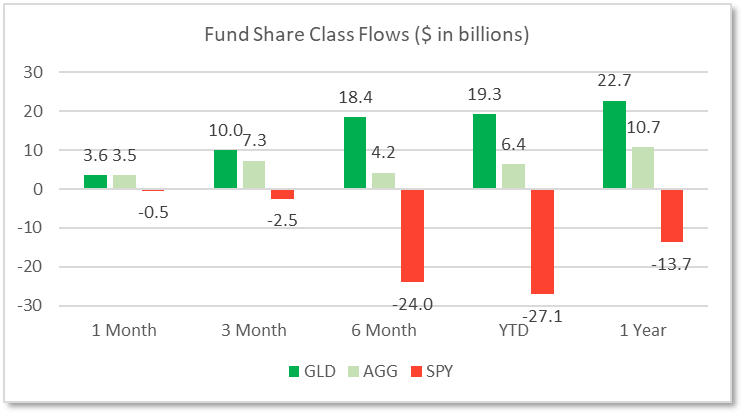
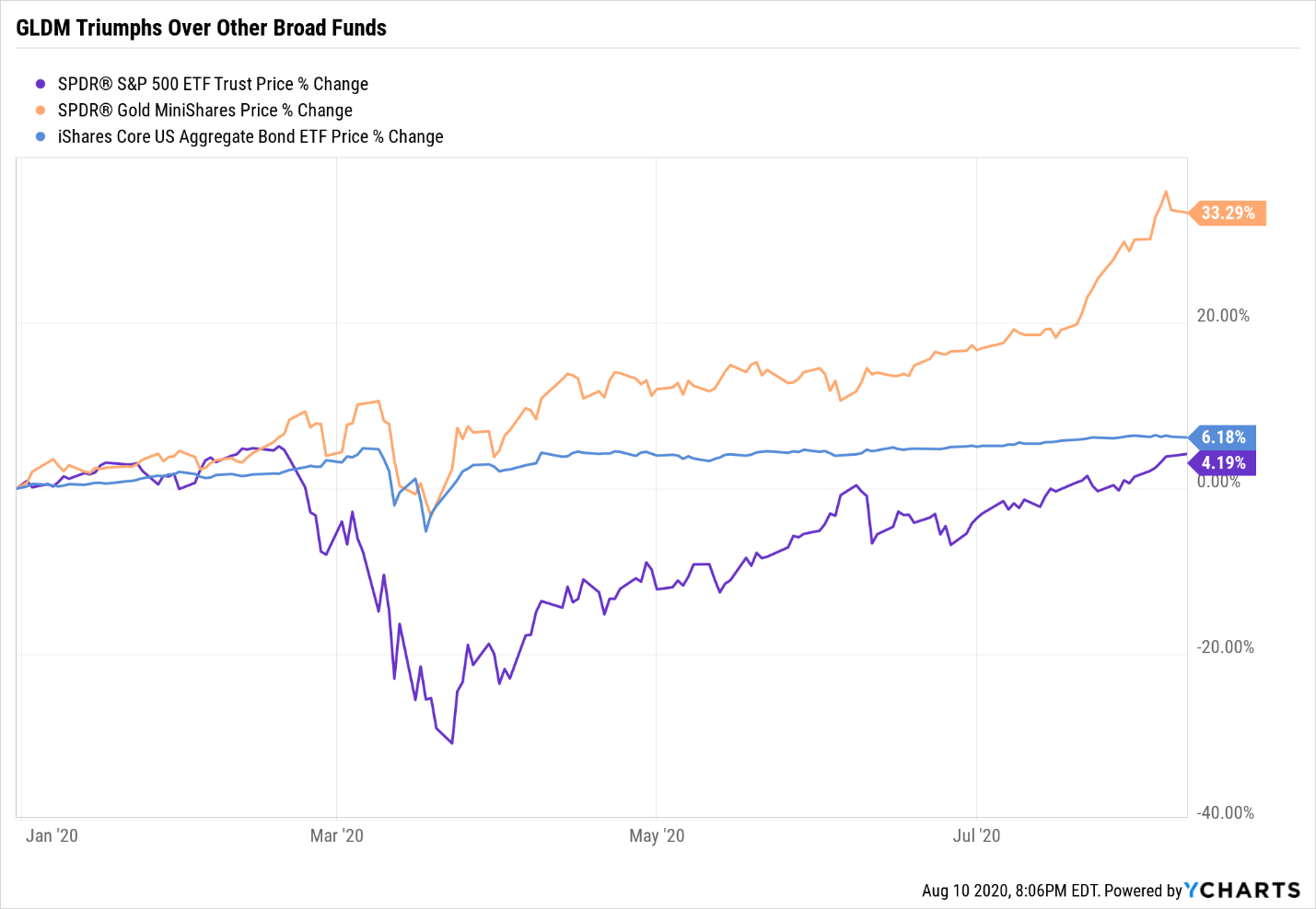
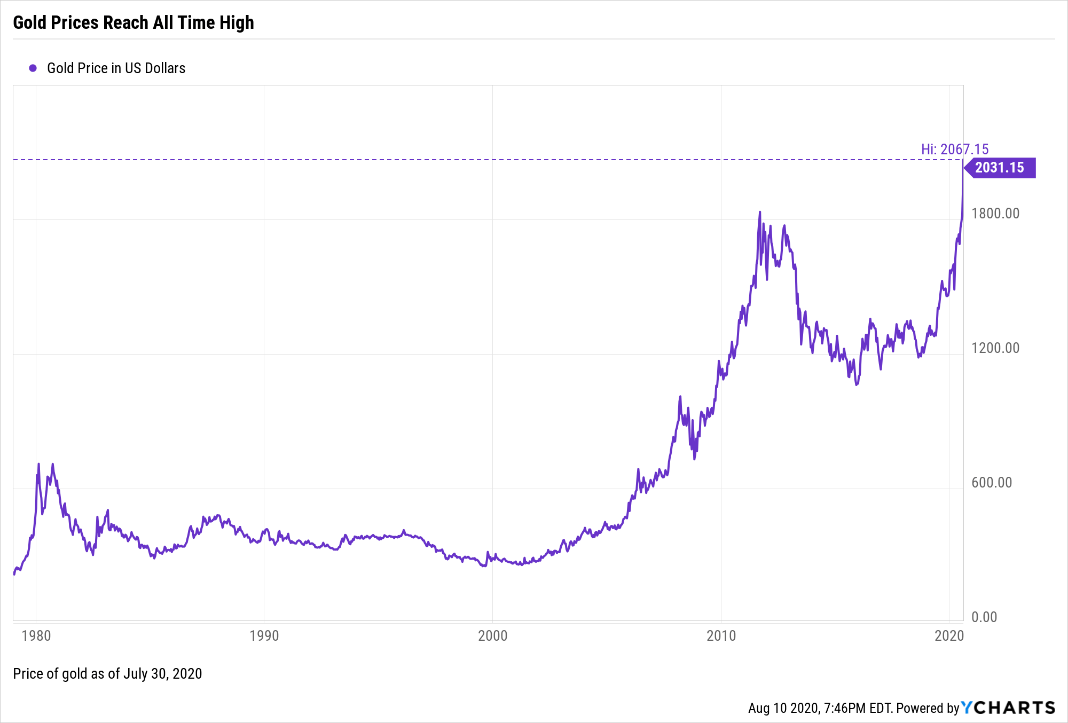
Year-to-date (YTD), gold has experienced more inflows than other broad stock and bond funds, including SPY and AGG which track the S&P 500 and Barclay’s Aggregate Bond Index, respectively. Amongst a myriad of asset classes, investors are choosing gold as their choice for safekeeping, thus driving gold prices to an all-time high. This year alone, gold is up 33.53% YTD compared to U.S. Stocks at 4.69% YTD and U.S. bonds at 7.83% YTD. But why exactly is a gold rush taking place in 2020?

Source: YCharts

Data as of 8/05/2020

You may attribute the surge in gold prices to the pandemic, but mine deeper and you will find more.

Source: YCharts

Data as of 8/05/2020

Source: YCharts

Low Yield Environment: Earlier in March, the Federal Reserve cut the federal funds rate to 0 – 0.25% to stimulate the economy amid an economic crisis. As a result, treasury yields fell drastically. The 10 Year Treasury rate started the year at 1.88% and now only yields an all-time low of 0.52%, or -1.05% adjusted for inflation. Although treasuries are often used as a safe haven during uncertain times, negative real yields alongside inflation expectations might make gold a more attractive store of value.

Inflation Expectations: Fiscal stimulus through a $2.2 trillion package, rapid money printing, and unprecedented quantitative easing has prompted investors to seek gold as an inflation hedge. Current levels of inflation, however, do remain low at 1.19% year-over-year relative to the Fed’s target of 2.0%, and are likely to stay low in the short term (due to aggregate demand and supply shocks). While there is no tell-all sign indicating future long-term inflation is upon us, the following is certain: whether gold investors are overreacting or whether U.S. inflation is a ticking time bomb remains to be seen.

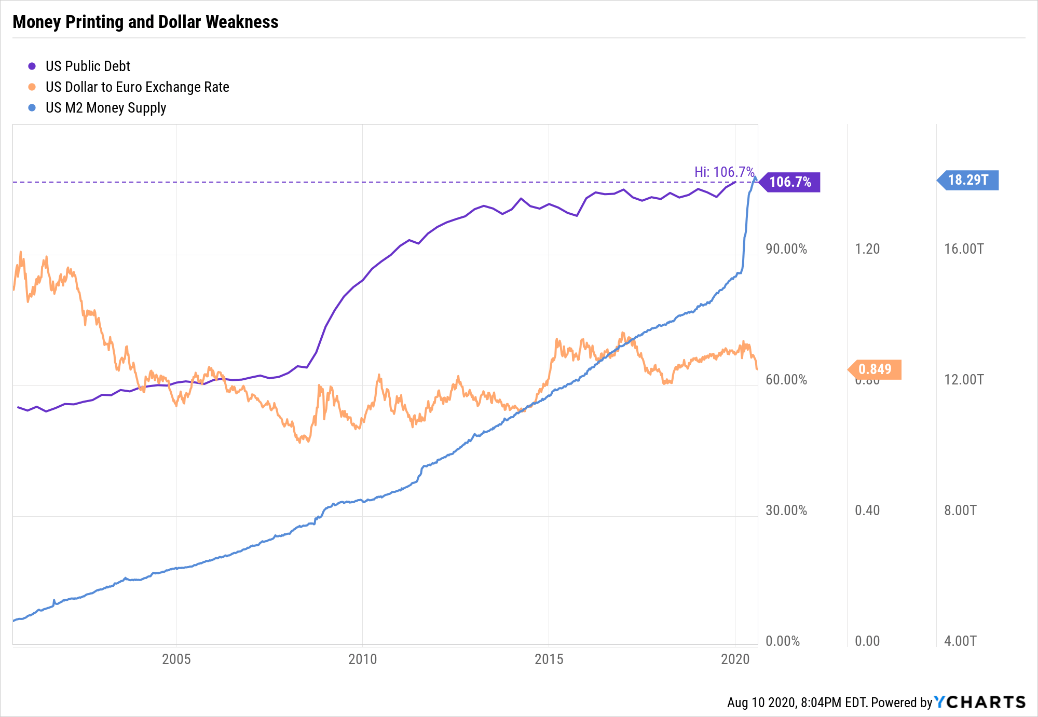
A Weakening U.S. Dollar: With fiscal debt as a percentage of GDP and M2 Money Supply at an all-time high, confidence in the U.S. dollar is diminishing relative to other currencies including the Euro. This comes at a time where the European Union appears to maintain a tighter grasp on COVID-19 outbreaks, alongside newfound unity in the form of a centralized stimulus package and debt mutualization. Overall, supposed weakness in the U.S. dollar has turned investors towards gold to maintain the purchasing power of their greenbacks.

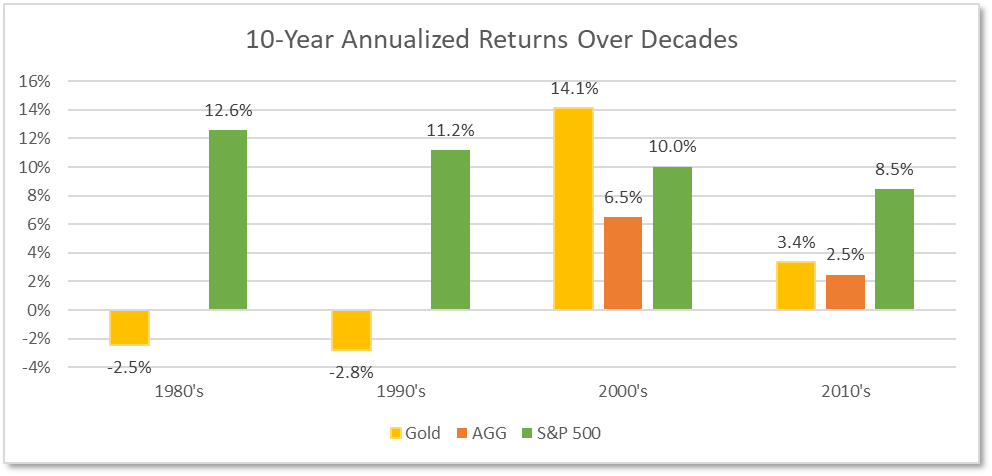
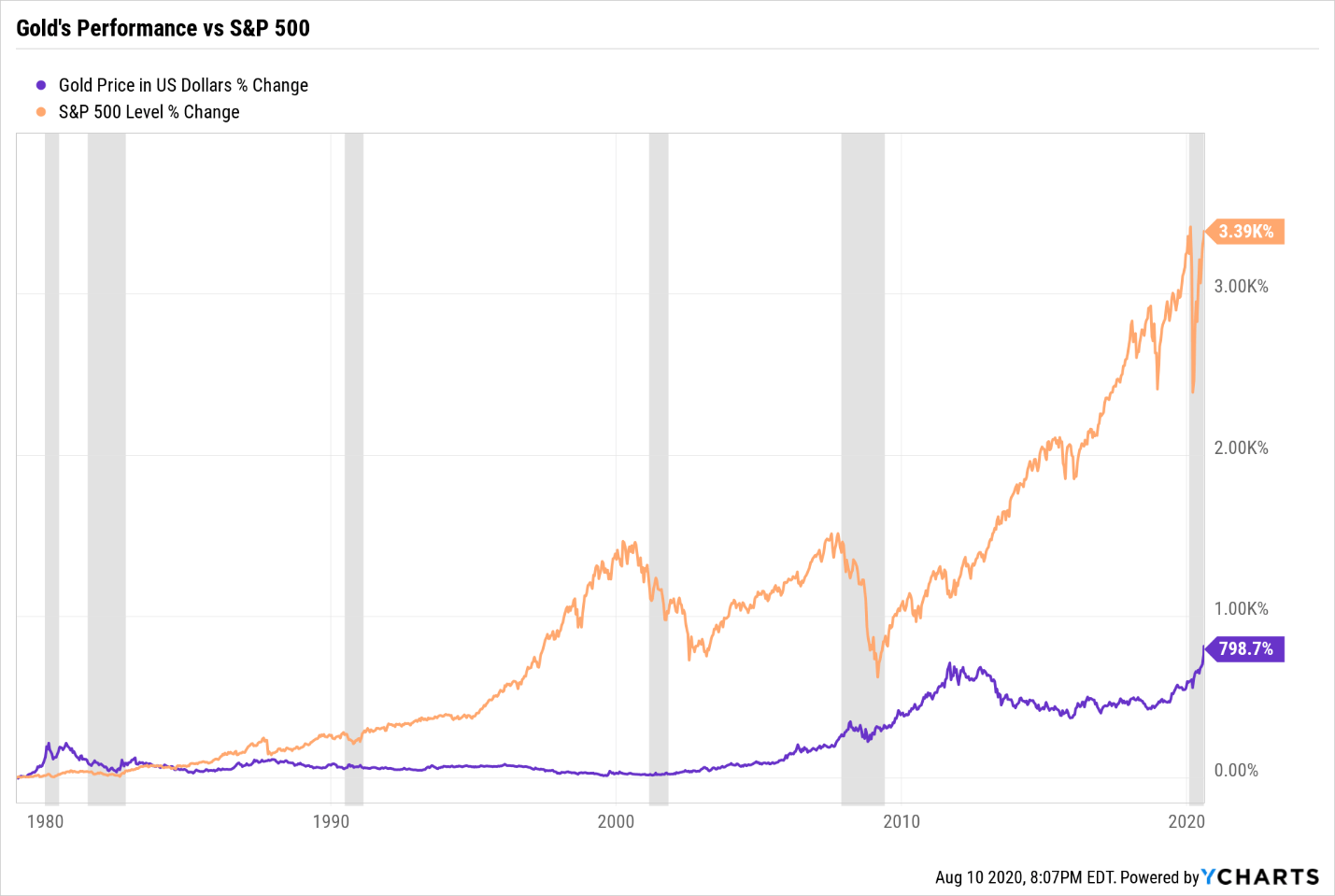
With this context, it seems like anyone would jump at the chance to own gold; but to avoid grabbing a handful of pyrite (fool’s gold), let’s evaluate gold’s performance and properties as an asset class. During the 1980’s and 1990’s, gold yielded less than ideal returns. In the late 2000’s, the metal’s performance accelerated as investor confidence faltered during the Great Recession, but subsequently dipped in the 2010’s when the U.S. economy proceeded onto its longest economic expansion.

Source: YCharts

Data spanning 1/01/1980 to 12/31/2019

Based on history, we can draw two conclusions: 1) gold’s volatile nature indicates that its current run may not be sustainable over long periods of time and 2) gold’s performance suffers when investors regain confidence and begin to adopt a risk-on posture. To see gold’s performance coming out of recessions, see Appendix A. (link)

5-Year Correlation Matrix (Rolling Monthly Returns)

Data as of 8/07/2020

Source: YCharts

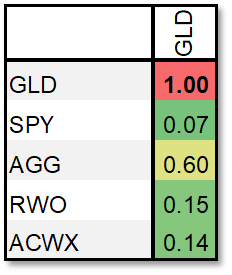
Gold generates zero passive income, so why do investors hold it? One reason is simply because it’s different and provides a diversification benefit. This metal exhibits less correlation compared to broader asset classes, meaning it simply behaves differently. A correlation of 1 indicates that the assets’ return behaviors are identical, while a correlation of -1 means they move in completely opposite directions. Given gold’s weaker correlations, it is likely to thrive when stocks or other asset classes experience large drawdowns. In other words, gold zigs while others zag.

Having understood the nuances of gold as investable asset and its diversification benefit over a long-time horizon, Warren Street Wealth Advisors previously made the decision to maintain gold exposure through Gold Minishares (GLDM) in our Diversifiers sleeve. Our investment strategies are now reaping the benefits of gold’s recent rally and allow for different courses of action. For example, with current gold prices bid up relative to historical levels, we can trim profits to invest in cheaper assets classes with higher potential for appreciation. This in essence, is buying low and selling high.

Gold prices will likely stay in the headlines and continue to gain traction in coming months. Regardless, we encourage you to start with your long-term asset allocation in mind and refrain from overthinking market entry/exit timing on any specific asset class. Preventing permanent capital impairment and building portfolios for your short term and long-term needs remains our top priority. We will diligently tax loss harvest and perform recurring rebalances along the way to take advantage of tactical long-term opportunities we see appropriate. That to us, is striking gold in 2020.

Appendix A:

Phillip Law

Portfolio Analyst, Warren Street Wealth Advisors

Warren Street Wealth Advisors, a Registered Investment Advisor. The information contained herein does not involve the rendering of personalized investment advice but is limited to the dissemination of general information. A professional advisor should be consulted before implementing any of the strategies or options presented. Any investments discussed carry unique risks and should be carefully considered and reviewed by you and your financial professional. Past performance may not be indicative of future results. All investment strategies have the potential for profit or loss.  

The Value of Double-Checking Your Retirement Strategy

the value of double checking your retirement strategyAs you approach your “third act,” does it need to be adjusted?

Provided by: Warren Street Wealth Advisors


Motivational speaker Denis Waitley once remarked, “You must stick to your conviction, but be ready to abandon your assumptions.” That statement certainly applies to retirement planning. Your effort must not waver, yet you must also examine it from time to time.1


For example, the level of risk you chose to tolerate at 35 or 40 may not be worth tolerating at 55 or 60. Additionally, you may realize that you will need more retirement income than previously assumed. With those factors and others in mind, here are some signs that you may need to double-check your retirement strategy.


Your portfolio lacks significant diversification. Many baby boomers are approaching retirement with portfolios heavily weighted in equities. As many of them will have long retirements and a sustained need for growth investing, you could argue that this is entirely appropriate. If your retirement is near at hand, however, you might want to consider the length of this bull market and the possibility of irrational exuberance.


The current bull has lasted about twice as long as the average one and brought appreciation in excess of 200%. It could rise higher: as InvesTech Research notes, two-thirds of the bull markets since 1955 have gained 20% or more in their final phase. Few analysts think a “megabear” will follow this historic rally, but even a typical bear market brings a reality check. The lesser bear markets since 1929 have brought an average 27.5% reversal for the S&P 500 and lasted an average of 12 months.2


A poor quarter makes you anxious. You start watching the market like a hawk and check up on your investments more frequently than you once did. Some of this vigilance is only natural as you near retirement; after all, you have far more at stake than a millennial investor. Even so, this is a sign that you may be uncomfortable with the amount of risk in your portfolio. A portfolio review with a financial professional could be in order. A semi-annual or annual review is reasonable. One bad quarter should not tempt you to abandon a strategy that has worked for years, only to examine it in the face of sudden headwinds.


You find yourself listening to friends & pundits. Your tennis partner has an opinion about when you should claim Social Security. So does your dentist. So does a noted radio personality or columnist. Their viewpoints may be well-informed, but they are likely expressing what they would do as they share what they feel you should do. If you seem increasingly interested in the financial opinions of friends, acquaintances and even total strangers, or the latest “hot tip” on the market, this hints at anxiety or restlessness about your financial strategy. Perhaps it is warranted, perhaps not. It may be time to reexamine some assumptions.


You wonder about the demands your lifestyle may make on your finances. You want to travel, golf, and have fun when you retire, and those potential lifestyle expenses now seem larger than they once were. Here is another instance where you may want to double-check your retirement savings and income strategy.


You see what were once “what-ifs” becoming probabilities. You sense that you or your spouse might face a serious health issue in the not-so-distant future. It looks as if you may end up raising one of your grandchildren. It seems likely that you will provide eldercare for a sibling who may move in with you. These life events (and others) may prompt a new look at your financial assumptions.


You think you will retire to another state. Say you retire to Florida. There is no state income tax in Florida. So your retirement tax burden may decrease with such a move (though some states have higher property taxes to offset the lack of state taxes). To what degree will geographic considerations affect your retirement income, or need for income? Such geographic factors are worth considering.3


You wonder how deeply inflation will impact your retirement income. A recent Morningstar analysis of retiree spending data compiled by the federal government noticed something interesting: for the typical retiree, spending declines in inflation-adjusted terms between age 65 and age 90. So the assumption that retirees increase household spending over time in light of inflation may be flawed. Of course, inflation has been mild for the past several years. If inflation spikes, however, that assumption might prove wholly valid.3


Looking at your retirement strategy anew has merit. As the years go by, priorities change and needs arise. New questions call for appraisals of old assumptions. Reviewing your approach to investing and saving at mid-life is only rational, for your retirement strategy must suit the objectives you now have before you rather than those you set in your past.


Warren Street Wealth Advisors

190 S. Glassell St., Suite 209

Orange, CA 92866

714-876-6200 – office

714-876-6202 – fax


This material was prepared by MarketingPro, Inc., and does not necessarily represent the views of the presenting party, nor their affiliates. This information has been derived from sources believed to be accurate. Please note – investing involves risk, and past performance is no guarantee of future results. The publisher is not engaged in rendering legal, accounting or other professional services. If assistance is needed, the reader is advised to engage the services of a competent professional. This information should not be construed as investment, tax or legal advice and may not be relied on for the purpose of avoiding any Federal tax penalty. This is neither a solicitation nor recommendation to purchase or sell any investment or insurance product or service, and should not be relied upon as such. All indices are unmanaged and are not illustrative of any particular investment.


Citations.

1 – quotes.lifehack.org/quote/denis-waitley/you-must-stick-to-your-conviction-but/ [4/16/15]

2 – fortune.com/2015/04/16/taming-the-bear-market/ [4/16/15]

3 – tinyurl.com/odyle9s [12/25/13]