• Who We Serve
    • Business Owners
    • Individuals & Families
    • Fortune 500 and Large Company Employees
    • New Media
    • Oil & Gas Industry
    • SoCal Edison
  • Services
    • Financial Planning & Retirement
    • Investment Management
    • Tax Planning & Preparation
    • Estate Planning
  • About Us
  • Resources
    • Blog
    • Events
      • Health & Wealth
    • Frequently Asked Questions
  • Partnerships
    • Next Street Tax
    • TownSquare Capital
  • Contact Us
  • Schedule
    • New Clients
    • Current Clients
  • Login
  • Menu Menu

Tag Archive for: ai

Beyond the Magnificent Seven: A 2026 Midyear Check-In

July 29, 2026/in Investing/by Phillip Law, CFA

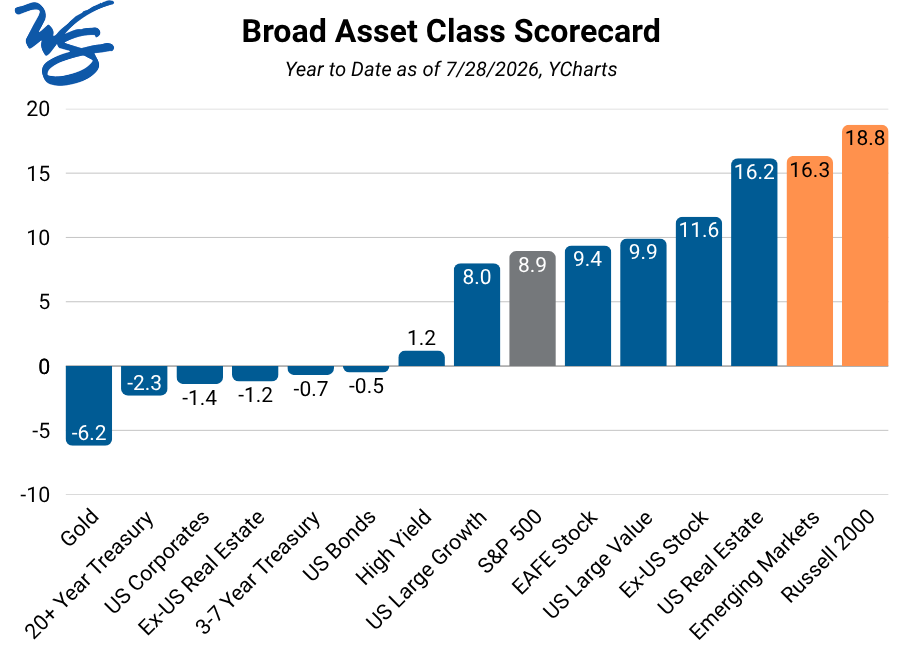
Back in January, we published our 2026 Outlook under the title “Beyond AI & Mega-Cap Tech.” Our argument was simple: real diversification was working and could add value beyond the AI trade which was concentrated to a handful of household names (namely the Magnificent Seven, which includes Microsoft, Amazon, and other big tech names). Six months later, we observe that the AI trade has indeed packed its bag, picked up a passport, and traveled to other asset categories including small caps and emerging markets.

As of late July, small caps and emerging markets are leading the pack. The Russell 2000 (small cap index) is up 18.8% year-to-date while emerging markets 16.3% — all outpacing the S&P 500’s respectable 8.9%. Investors rotated into other corners of the same AI story, with small caps and EM carrying their own AI-adjacent demand related to chips, data centers, and power. 

The AI Trade, Domestically: Rotated, But With More Vulnerability

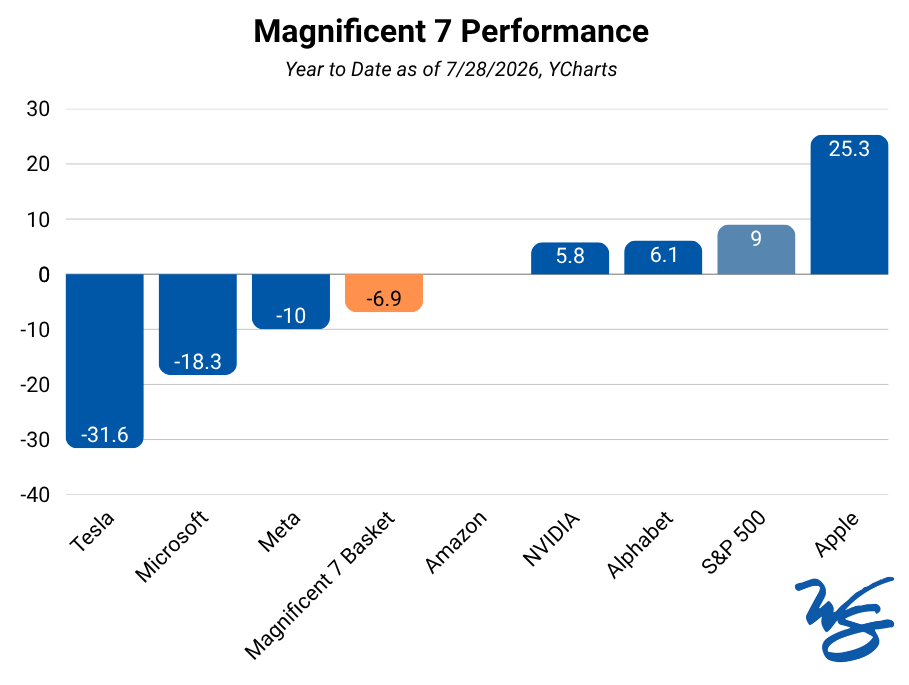
The Magnificent Seven, as a basket, is down 6.9% year-to-date. Hyperscalers (i.e., the biggest spenders on AI infrastructure) including Microsoft (-18.3%), Meta (-10%), and Amazon have struggled in 2026. Only Apple (+25.3%), Alphabet (+6.1%), and Nvidia (+5.8%) are green — and none are this year’s real winners in tech.

That title belongs to the memory and storage names behind the AI buildout: Micron and other chip manufacturers (i.e., CPUs, Memory, etc) are leading the trade, even after “taking a breath” off early-summer highs. Data center demand for memory has minted bigger winners than the household names that started the AI story.

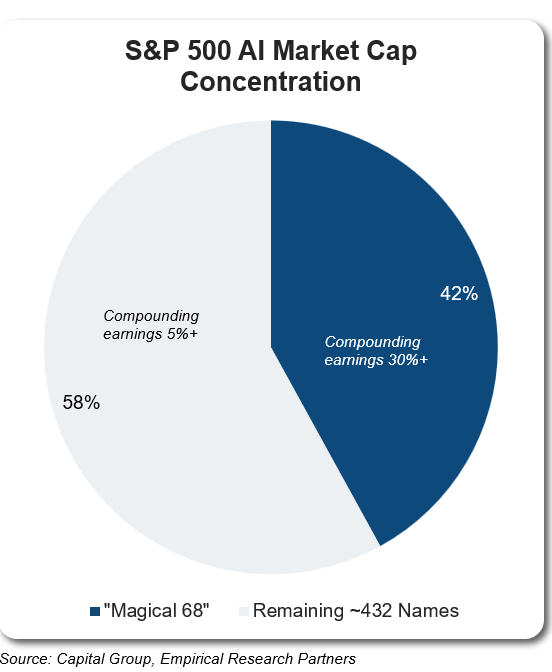
Research cited by Capital Group and Empirical Research Partners shows 68 AI-linked stocks (a.k.a. “Magical 68”) now make up 42% of the S&P 500’s market cap and are compounding earnings north of 30% vs. roughly 5%+ for non-AI stocks – evidence that backlogs are being structurally rewritten to meet supply-constrained demand. In fact, the semiconductors industry alone has also grown from roughly 6–7% of the index three years ago to nearly 20% today.

The bigger question remains whether that demand holds up. Chips are being sold into datacenters built for AI service demands assumed to keep compounding for years – a slowdown, or is absorbed faster than expected – today’s earnings – and the valuations riding on them – could reprice just as fast as they arrived. 

The AI Trade, Internationally: Same Movie, Different Language

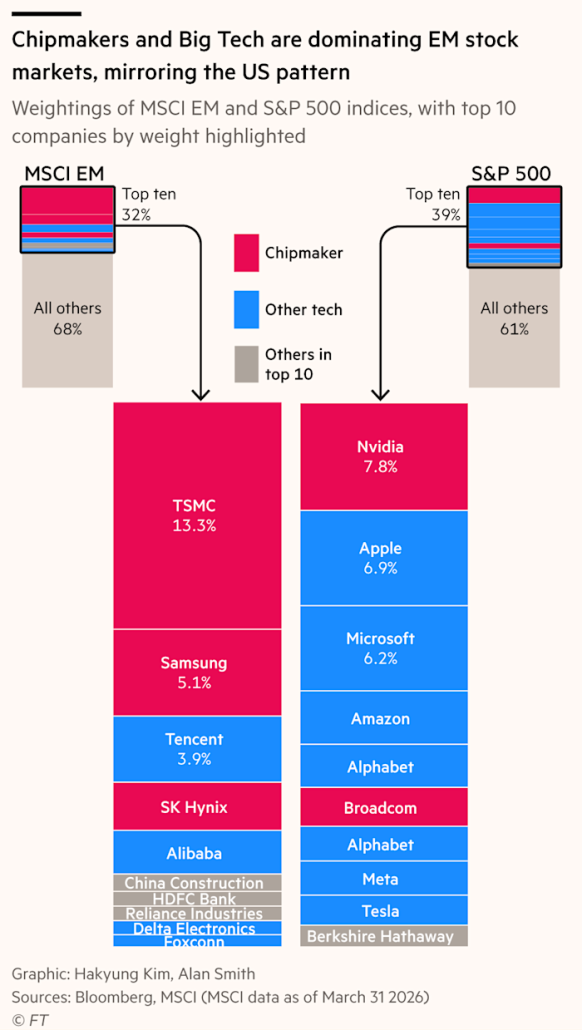
Emerging markets caught the same bug. The MSCI EM Index — up 16% YTD — now carries a heavier tech weighting than the S&P 500, essentially making EM an AI trade. Investors adding EM for diversification may just be buying semiconductors or memory chips in a different currency.

It’s worth noting that EM’s recent outperformance traces back to a handful of AI-linked chip names. Taiwan and South Korea now make up roughly 45% of the benchmark — nearly double their weight a year ago, and above the dot-com peak. Taiwan’s market cap alone exceeds China’s, despite an economy a fraction of the size, with forward earnings (i.e., market cap to cash earnings) running several standard deviations above trend. Put plainly, the diversification benefit of market-cap weighted EM is thinner than it once was and is linked to the fragility of the AI supply chain.

Kevin Warsh and the Inflation Watch

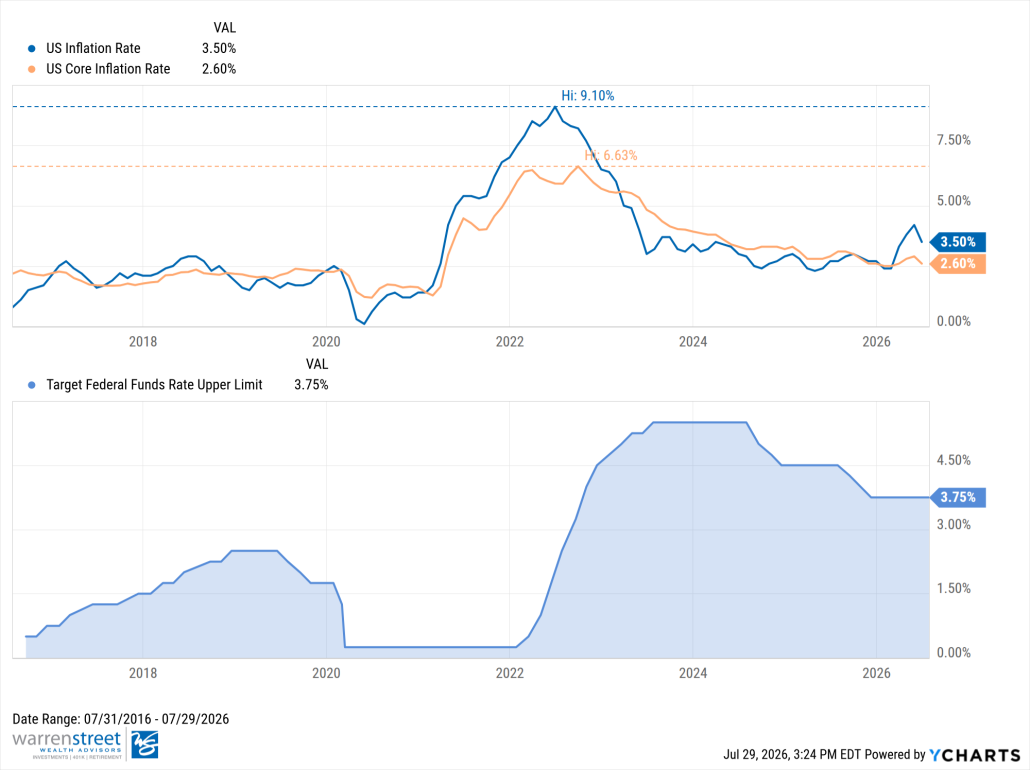
Inflation is sending mixed signals, with core prices (excluding food and energy) running near 2.5%, but the headline number — what you actually feel at the pump and grocery store — is up 3.5% year-over-year due to tensions in the Middle East (the Federal Reserve’s target is ~2%). Consumer spending remains resilient and AI-related business investment is creeping into higher prices. Despite these pressures, cooling wage growth and anchored long-term inflation expectations make it less likely that this turns into a longer-lasting, demand-driven problem.

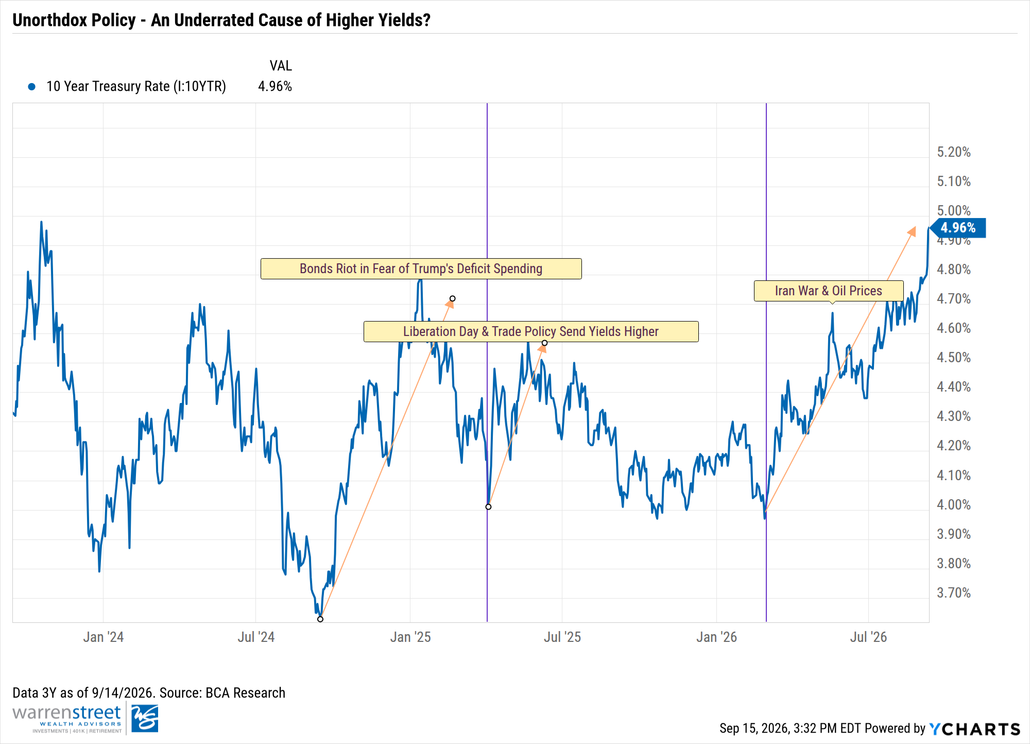
Kevin Warsh, the Fed’s new chair, wasted no time setting a firmer tone. At his first meeting, he scrapped the Fed’s usual forward guidance and signaled a tougher stance, holding rates steady while making clear that further rate hikes — not cuts — could be on the table. That represents a sizable shift from earlier this year, where markets expected two rate cuts; year; now they’re pricing in the possibility of an interest rate hike. 

There’s a less obvious ripple effect worth knowing about: the AI boom is increasingly funded by borrowed money, not just cash on hand. Big tech companies have issued roughly $130 billion in bonds so far this year to fund AI infrastructure, already surpassing all of last year’s total, with the broader AI debt market on track to exceed $500 billion in 2026. If interest rates rise, that borrowing gets more expensive — which could eventually squeeze the profits and stock valuations behind the AI trade that’s driven so much of the market’s gains.

Investment Implications

We recognize the risks building in the AI ecosystem, but the technology remains genuinely transformative, with substantial earnings potential and runway left in the build-out. Rather than timing an exit from one of the market’s most powerful themes, we’ve repositioned equity exposure to manage these imbalances more deliberately.

On the U.S. side, we’ve paired core market-cap-weighted exposure with a Quality tilt (JQUA), favoring companies with stronger balance sheets, durable free cash flow, and healthy returns on equity. This is a more disciplined way to own the AI trade — capturing upside while screening out the accounting and accrual adjustments that can inflate earnings tied to the theme.

On the EM side, we’ve balanced our pure-growth exposure (XSOE) with a value- and income-oriented fund (EYLD), tilting toward cash-generative businesses focused on dividends, buybacks, and debt paydown. This preserves our exposure to developing-market growth while reducing sensitivity to EM’s biggest AI-related vulnerabilities over a multi-year horizon.

The AI story likely has room to run, but we expect turbulence as investors scrutinize return on investment, large language model providers limit token usage, and frontier-model competitors emerge (e.g., Kimi K3). We view these positioning shifts as a thoughtful way to stay invested in AI while diversifying risk and return within an increasingly concentrated market.

Phillip Law, CFA

Phillip Law, CFA

Senior Portfolio Manager

Warren Street Wealth Advisors, LLC., a Registered Investment Advisor

The information presented here represents opinions and is not meant as personal or actionable advice to any individual, corporation, or other entity. Any investments discussed carry unique risks and should be carefully considered and reviewed by you and your financial professional. Nothing in this document is a solicitation to buy or sell any securities, or an attempt to furnish personal investment advice. Warren Street Wealth Advisors and/or its clients may hold positions in the securities mentioned. Holdings may change at any time without notice. Due to the static nature of content, securities held may change over time and current trades may be contrary to outdated publications. Form ADV available upon request 714-876-6200.
https://warrenstreetwealth.com/wp-content/uploads/2026/07/Beyond-the-Magnificent-Seven-A-2026-Midyear-Check-In.png 1080 1080 Phillip Law, CFA https://warrenstreetwealth.com/wp-content/uploads/2014/11/Warren_Street_logo-01.svg Phillip Law, CFA2026-07-29 15:40:252026-07-30 10:30:31Beyond the Magnificent Seven: A 2026 Midyear Check-In

2026 Outlook: Beyond AI & Mega-Cap Tech

January 28, 2026/in General, Investing/by Phillip Law, CFA

“Is AI a bubble?” my uncle asked as I put my fork down mid-bite on New Year’s Eve. I’d wager that this question dominated dinner tables and family gatherings across the country this holiday season. Even my sister, whose focus lies entirely within the arts and creative pursuits, managed to put the two words “AI” and “Bubble” together.

This tells me two things: 1) Concern around AI and “bubble-ness” is virtually inescapable and 2) this question is dominating the audience’s perception of markets, perhaps even more so than the meteoric rise of silver and gold as we enter 2026.

Why Does AI Deserve So Much Attention?

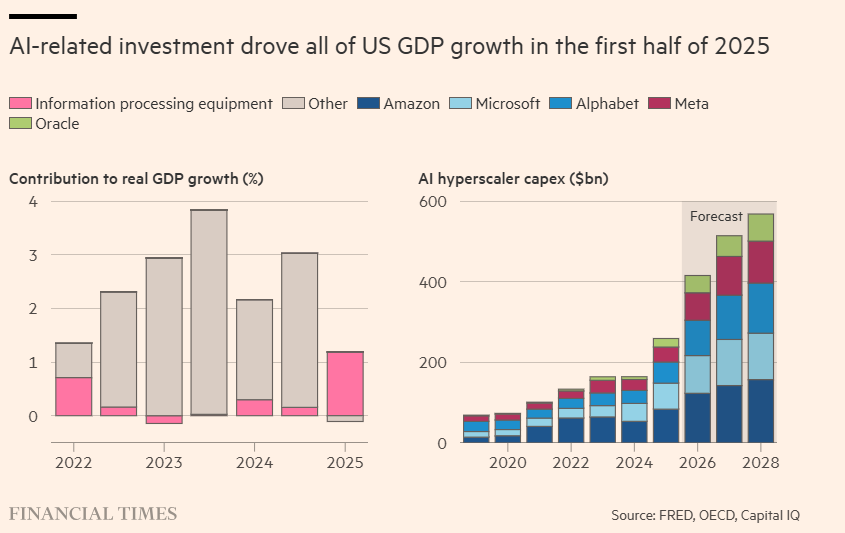
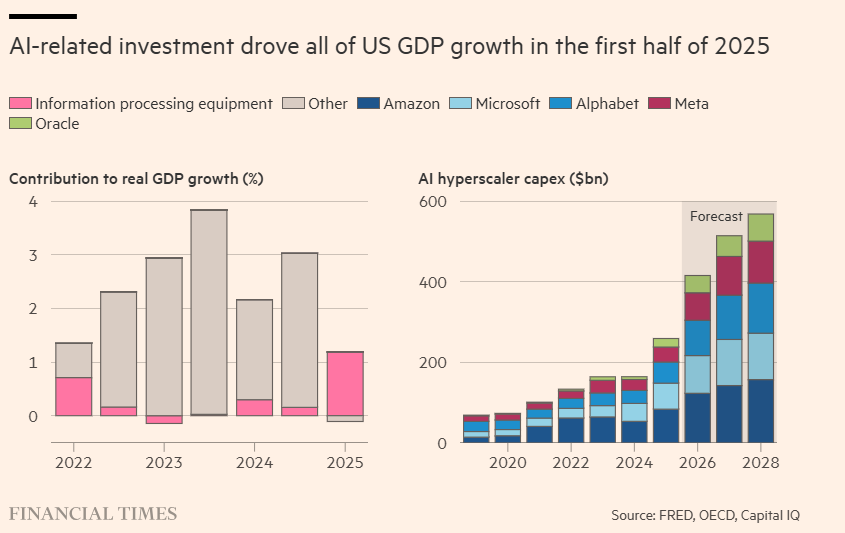
In 2025, AI-related names drove ~60% of the increase in the S&P 500’s value. Furthermore, AI spending from the “Hyperscalers” (Google, Microsoft, etc.) accounted for the lion’s share of our economy’s growth. Without the spending on data center infrastructure—servers, GPUs, and the centers themselves—some estimates suggest US GDP would have grown at a measly 0.1% in the first half of 2025. It’s safe to say that AI alone kept the economy afloat for most of last year.

The robust figures above underscore why AI rightfully commands significant attention. However, fixating on the bubble label can be a trap, much like timing the market. Instead, we should look at bubble psychology and how those excesses may be extending into the AI ecosystem.

Settling the AI Bubble Talk

It’s been over 20 years since we’ve seen such a transformative, general-purpose technology with the potential to deliver productivity gains eclipsing the internet era. This fervor has already minted a class of early winners, leaving everyone else watching with a potent mix of envy and regret. It’s the classic setup for FOMO, where the “AI train” starts looking less like a sound, technological investment and more like a high-speed shortcut to a cushy nest egg.

The danger is that the faster this train moves, the easier it is to speed right past the following flags:

  • Starting Valuations: We pay prices regardless of whether reasonable returns can be generated.
  • Risk/Reward Profiles: We stop asking if we’re actually being compensated for the layers of risk we’re adding to our broader portfolio.
  • Lofty Narratives: AI’s newness unrestrains the imagination to justify price tags that reality can’t yet support.

Behind the Excitement: What’s Different This Time?

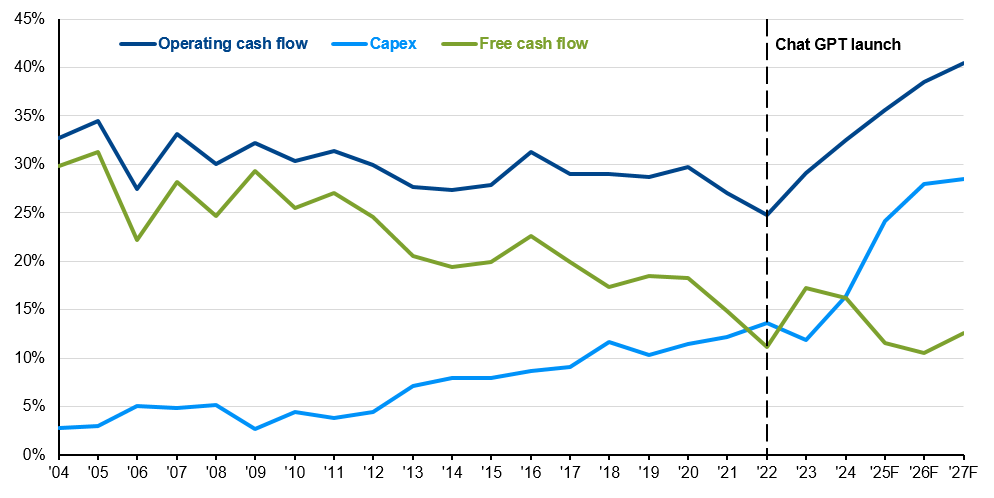
A Stronger Starting Line-Up Unlike the fragile startups of the dotcom era, today’s main AI spenders are profitable, cash-printing businesses. They are self-funding a massive AI arms race with capital expenditures set to leap by 60%, from $250bn in 2025 to over $400bn in 2026. Operating cash flows continue to outspace AI spend as a percentage of sales, allowing this historic investment to feel like a strategic augmentation of their core businesses rather than a reckless gamble.

Justified Valuations While Forward P/E ratios look expensive, today’s multiples are anchored by real-world profit. Take Nvidia: its stock price increased 14x over the last five years, but earnings grew 20x. Today’s titans aren’t as frothy as the dotcom class of 2000 because they are delivering healthy bottom-line results. However, this optimism hinges on perfection. While bulls argue we are buying “cheaper” growth today than at any point in the decade, that narrative leaves a near zero margin for error if adoption slows.

Infrastructure Demand In contrast to the fiber-optic mania of the 90s, the demand for AI build-outs can’t seem to catch a break. Data center vacancy rates are at a record low of 1.6%, and ~75% of pre-construction builds are already pre-leased. Additionally, past infrastructure bubbles saw spending peak between 2% and 5% of GDP, whereas today’s AI investment sits at roughly 1%. This suggests the build-out still has room to run.

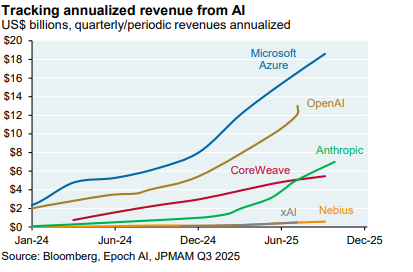
Show Me the Money Revenues are skyrocketing. Alphabet’s Q3 2025 results proved that AI-driven features are accelerating search and ads, with generative AI product revenue surging into the triple-digit percentage range year-over-year. Beyond the titans, some industry participants have grown revenues nearly ninefold since ChatGPT launched. For now, the receipts are keeping the optimism alive.


AI Is Running Fast… But Will it Trip a Wire?

We are in a high-stakes arms race on both a micro level (hyperscalers) and a macro level (US vs. China). Businesses are pouring trillions into this effort to secure US leadership in a technology that will change the fabric of society. But in this race to the top, it’s easy to overlook the blind spots.

Revenues & Profits: Can We Reach the Promised Land? Despite the growth, there is a staggering gap between spending and earning. Analyst Azeem Azhar points out that AI companies are projected to generate $60bn in revenue against $400bn in spending for 2025. That’s a 6-7x gap—far wider than the dotcom bubble (4x) or the railroad boom (2x). Even if revenue catches up, will it translate to profit, or will we see a “race to the bottom” where large language models (LLMs) become commoditized?

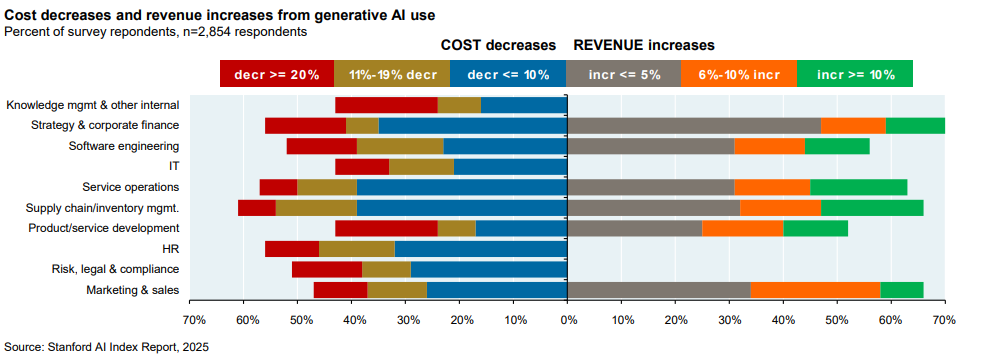
Is Demand Real? Adoption is still in its awkward early stages. Only roughly 10% of firms are using AI to produce goods, though 45% pay for LLM subscriptions. According to the Stanford AI Index and McKinsey, the majority of firms are seeing only modest cost savings (≤10%) and negligible revenue gains (≤5%). Will AI adoption ever truly scale into broad, durable profit expansion?

How Long is Your (Useful) Life? Hyperscalers like Microsoft and Google have boosted profits by extending the “useful life” of their AI assets in their books. If innovation renders chips obsolete in 24 months, these companies will face massive write-downs. More importantly, they are funding this short-lived hardware with 30-year debt, leaving investors holding the bag for “obsolete” infrastructure that won’t be paid off for decades.

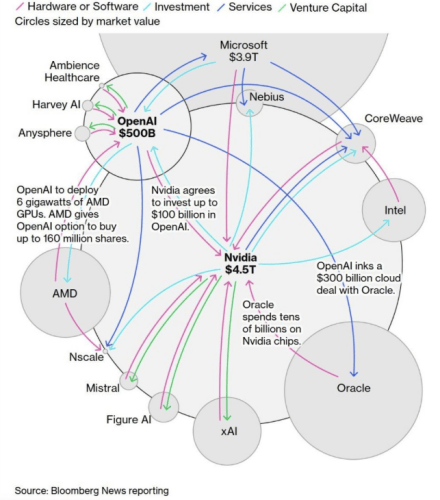
The AI Ouroboros There is an increasingly circular dance where Microsoft invests in OpenAI and then books cloud revenue from them. Nvidia buys stakes in the startups they sell chips to. This means a chunk of today’s “booming” revenue is an internal recycling of capital where true economic profit from external customers remains hypothetical.


Cloudy with a Chance of IOUs: While the biggest players usually use cash, we’re seeing a pivot toward the bond market. Oracle and Meta have emerged as outliers, using long-term bonds and project finance to bankroll their data centers. As free cash flow wilts under the weight of AI spend, their stock prices are feeling the gravity. Furthermore, the industry is using Special Purpose Vehicles (SPVs) to hide this leverage off-balance sheet, adding a layer of obscurity to the trillions being spent.

Conclusion: A Massive Collection of What-Ifs

Ultimately, the AI story comes down to “what-ifs.” What if AGI finally shows up and productivity explodes? Or, what if demand never materializes and the hyperscalers finally blink? With cracks showing—like OpenAI’s recent “Code Red”—it’s impossible to say if we’re headed for a minor correction or a systemic burst.

Our 2026 Recommendations:
  1. Keep a seat at the table: Exposure to market-cap weighted indices allows you to benefit if the “promised land” materializes.
  2. Diversify your sources of risk: Anchor beyond US tech. Gold, international markets, and bonds offer a necessary buffer if signs of excess turn into a choppy ride.

Rebalance systematically: Rebalancing is a controllable hedge. When sector weights become excessive, returning to target allocations helps lock in gains and reduce concentration risk.

Phillip Law, CFA

Senior Portfolio Manager, Warren Street Wealth Advisors

Investment Advisor Representative, Warren Street Wealth Advisors, LLC., a Registered Investment Advisor

The information presented here represents opinions and is not meant as personal or actionable advice to any individual, corporation, or other entity. Any investments discussed carry unique risks and should be carefully considered and reviewed by you and your financial professional. Nothing in this document is a solicitation to buy or sell any securities, or an attempt to furnish personal investment advice. Warren Street Wealth Advisors may own securities referenced in this document. Due to the static nature of content, securities held may change over time and current trades may be contrary to outdated publications. Form ADV available upon request 714-876-6200.
https://warrenstreetwealth.com/wp-content/uploads/2026/01/2026-Outlook-Beyond-AI-Mega-Cap-Tech.png 1080 1080 Phillip Law, CFA https://warrenstreetwealth.com/wp-content/uploads/2014/11/Warren_Street_logo-01.svg Phillip Law, CFA2026-01-28 07:29:002026-01-23 14:40:232026 Outlook: Beyond AI & Mega-Cap Tech

2026 Investment Outlook: AI, Economy, Inflation

January 23, 2026/in General, Investing/by Phillip Law, CFA

With 2025 in the rear view mirror, we look towards the new year. What lessons did we learn and what trends deserve attention? How do we allocate portfolios based on that knowledge? In this piece, we’d like to share three areas of focus heading into 2026:

  1. Artificial Intelligence and Bubbleness
  2. The State of the US Economy
  3. The Biggest Risks to Asset Markets (Namely Inflation)

2025 Recap: Laughing in the Face of Di-worsification:

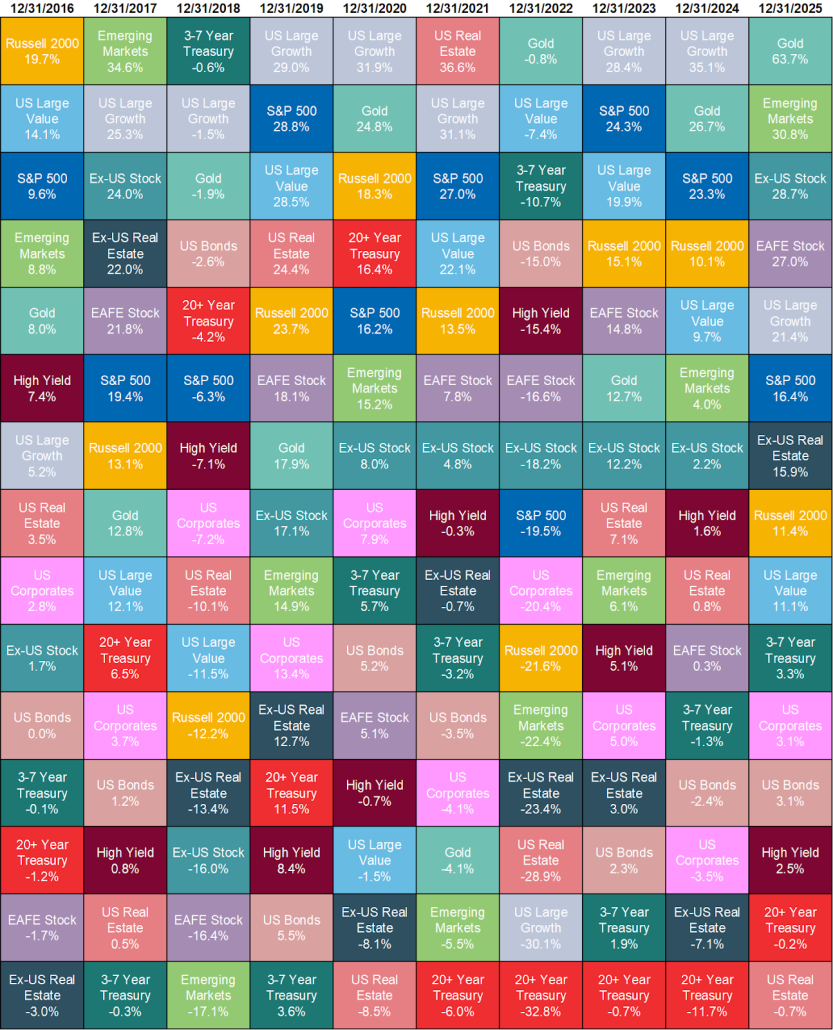
After years of US led-dominance, we saw narratives across asset classes flip on their heads. For the first time in years:

  • US Stocks underperformed developed international and emerging market geographies.
  • Gold, held for its diversification benefits, shined more brightly than most major asset categories. 

Source: YCharts

The year reminded us that “di-worsification” – a term long used to parody the idea that diversifying into less correlated, non-US assets only made portfolios worse – isn’t a universal truth. In 2025, holding different asset segments helped weather volatile trade policy, weakening dollar, and US deficit concerns.

Ultimately, we left 2025 with a more fragmented globe where nations now emphasize national security and independence over globalized efficiencies. In this new regime where the global economy is de-synchronized, we believe diversification is more essential than ever.

Looking to 2026: What of AI and Its Bubbleness?

The topic of artificial intelligence being a bubble is almost inescapable. AI Hyperscalers, bolstered by massive spending commitments on AI investments,  drove over 60% of the S&P 500’s growth and was a key lifeline for the economy in 2025. With AI hyperscalers and key players constituting a significant portion of the S&P 500, the ecosystem will likely continue to define US markets in 2026. So is it a bubble?

We have a separate piece that deep dives into the AI Bubble question which I’ve summarized below:

The Bull Case:

Proponents argue that this time is different compared to other speculative manias. The players here are profitable, cash-printing businesses whose valuations are not only reasonable, but also are pricing in achievable growth. Furthermore, there is ample demand for infrastructure, particularly data centers, unlike the railroad and dotcom bubbles. This all will enable revenue to follow, which has already exhibited enormous growth rates.

The Bear Case:

Despite tremendous growth, AI companies are spending way more than they’re making, (higher than past bubbles). Demand from businesses remains uncertain, with early studies showing only modest cost savings/revenue gains. Also, most revenue booked today is a result of circular investing amongst AI players. Meanwhile, AI companies are using aggressive accounting methods for their chips, which puts future earnings estimates at risk. Lastly, debt is now being used to finance spending, officially adding a shot clock for return on investment to materialize.

What to Do?

Within the deep-dive, we reach two conclusions: 

1. Focusing on the “bubble” label is often unproductive. Even if excesses exist, timing the eventual “burst” is a fool’s errand—will it be in one year or five? Selling too early means potentially missing out on healthy gains.

As Peter Lynch noted, “Far more money has been lost by investors preparing for corrections, or trying to anticipate corrections, than has been lost in corrections themselves.”

2. The AI dilemma is ultimately a huge collection of what-ifs, but we believe keeping a seat at the table while diversifying sources of risk and return in other parts of the portfolio such as international stocks, bonds, or gold is prudent.

How’s the US Economy?

Objectively speaking, the economy is in a healthy state heading into 2026. Let’s look at a few primary indicators:

  • A Productive Economy – GDP grew at an astonishing annualized rate of 4.3% in Q3 2025 and is projected to grow ~2% (long-term average) in 2026. We expect AI spending to continue as hyperscalers add to productivity and other businesses increase adoption.
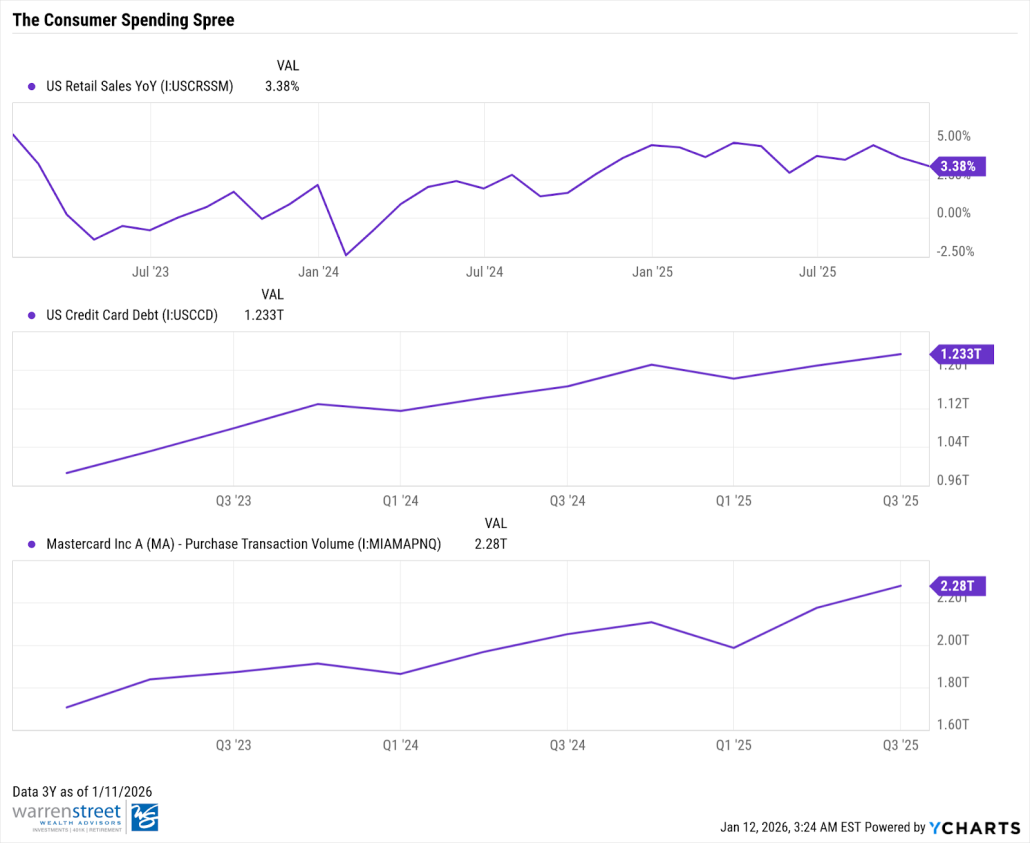
  • The Spending Surprise – Despite rising concerns around job security and waning sentiment, Americans are still spending. In late 2025, retail sales surged 3.5% year-over-year and we observed a healthy uptick in credit card balances.
  • Fiscal & Monetary Stimulus: 
    •  Heading into 2026, we’ve unlocked tax credits from the One Big Beautiful Bill (OBBB). We take estimates with a grain of salt, but if $100bn in total tax refunds and a $3,750 average tax cut per filer could further stimulate consumer spending.
    • The market currently anticipates two rate cuts, which will lower the cost of borrowing for both businesses and consumers (maybe more, pending Federal Reserve politics).

With a solid launching pad to start the year followed by additional liquidity in consumers pockets, we believe the US economy is well-equipped heading into 2026.

What About the Risks?

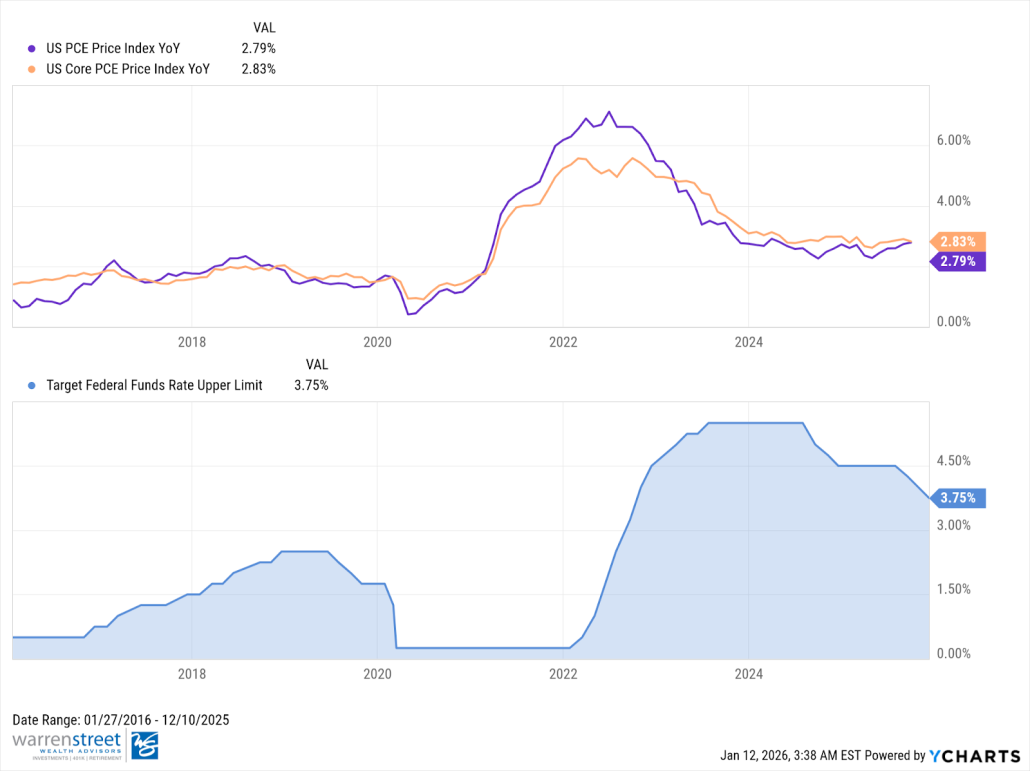
We believe the primary, non-wildcard risk to asset markets is inflation. Although inflation has stabilized from recent years, it remains sticky compared to pre-pandemic levels (around 2%), with the Fed’s preferred measure recently estimated at 2.8%.

The current economic backdrop does allow more sensitivities to a spike in inflation.

  1. Trade fragmentation and tariffs – while most businesses seemingly absorbed the price increases of tariffs in 2025, we’ve begun to see some price hikes passed to consumers in recent inflation prints. 
  2. Is Stimulus a Double-Edged Sword? – While increased liquidity for consumers can be helpful, it may also fuel inflation. The prior stimulus checks led to double-digit drops in equities and bonds (2022) as we raised rates to fight policy-driven inflation.
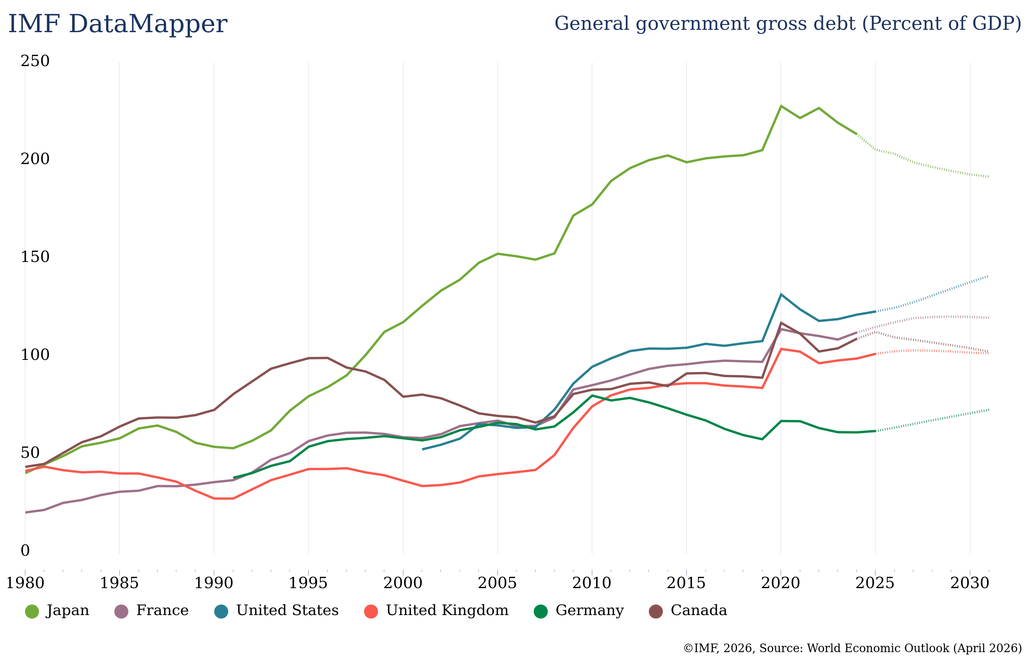
  3. Financial Repression – With US Debt-to-GDP approaching 120%, there is a risk that policymakers resort to “financial repression” – intentionally allowing higher inflation to “inflate away” the real value of government debt.

With US equities trading expensively and bonds vulnerable to inflation, I’d park this risk in the low probability, but high impact camp. To mitigate this risk, owning a portion of your portfolio to hedges (gold, commodities, natural resources) can cushion against a potential 2022 repeat.

Conclusion:

Ultimately, the backdrop seems favorable for US equity markets heading into 2026. Even if markets are frothy, the solution to managing potential excesses and drawdowns is not in timing them, but instead: a) building adequately diversified portfolios b) aligning allocations with your risk tolerance and financial objective and c) rebalancing into weakness to harness the long-term growth of capital markets at more advantageous price levels.

That’s our 2026 outlook. Our advice remains: use these investing principles as your foundation. This will allow 2026 to be less about watching tickers and more about the life you’re building. Hit that PR, read those books, or learn to cook—aim to achieve your best self. While we can recommend investments and share outlooks, there’s no substitute for investing in your own growth and happiness.

Phillip Law, CFA

Senior Portfolio Manager, Warren Street Wealth Advisors

Investment Advisor Representative, Warren Street Wealth Advisors, LLC., a Registered Investment Advisor

The information presented here represents opinions and is not meant as personal or actionable advice to any individual, corporation, or other entity. Any investments discussed carry unique risks and should be carefully considered and reviewed by you and your financial professional. Nothing in this document is a solicitation to buy or sell any securities, or an attempt to furnish personal investment advice. Warren Street Wealth Advisors may own securities referenced in this document. Due to the static nature of content, securities held may change over time and current trades may be contrary to outdated publications. Form ADV available upon request 714-876-6200.
https://warrenstreetwealth.com/wp-content/uploads/2026/01/2026-Investment-Outlook.png 1080 1080 Phillip Law, CFA https://warrenstreetwealth.com/wp-content/uploads/2014/11/Warren_Street_logo-01.svg Phillip Law, CFA2026-01-23 12:03:482026-01-28 08:02:082026 Investment Outlook: AI, Economy, Inflation

Decoding the AI Hype: How Today’s Market Compares to the Dot-Com Bubble

November 19, 2025/in General, Intermediate, Investing/by Phillip Law, CFA

You’ve likely seen headlines comparing today’s AI-driven market to the late-1990s dot-com era. We take those comparisons seriously. This note outlines what’s different today, what still deserves caution, and, most importantly, how we’re positioning your strategy to hold up across a range of outcomes.1

Where Valuations Stand

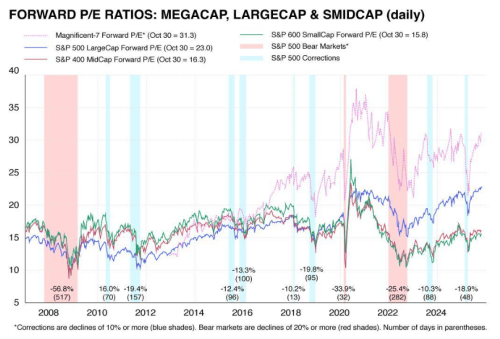
Stock prices have climbed, and by simple measures of “price versus earnings,” the market looks more expensive than its long-term average. That’s a reason for discipline. However, it’s also true that the broad market remains below the most extreme levels reached in the late 1990s. You can see this in the valuation charts that track the relationship between prices and earnings over time.2

What’s Different From Dot‑Com Era

Back then, Barron’s magazine cover story in March 2000, called “Burning Up,” reported that 74% of 207 publicly traded internet companies had “negative cash flows” and at least 51 of those companies were projected to run out of money in the next 12 months. In contrast, today the largest parts of the market are producing real earnings, and overall profit margins across the major U.S. index remain above their five-year average. That doesn’t remove risk, but it does mean prices are supported by business results that we didn’t see from some companies in the dot-com cycle. FactSet’s latest quarterly review provides a good snapshot.3

AI Isn’t Just a Story—There’s Heavy Investment Behind It

A big reason certain companies have led is the build-out of the “plumbing” for AI: data centers, chips, software, and power. You can see this in government data, which shows manufacturing construction near record highs, much of it related to chip facilities, and in rising business spending on information-processing equipment and software. Those are dollars going into real plants, servers, and tools that support future productivity.4,5

Real Fundamentals – But Are AI Profits a Distant Dream?

Today’s AI landscape, where players boast robust business models and real fundamentals stemming from their core businesses, still is not without questions. While fortress balance sheets, resilient revenue, and strong earnings growth remain in place, the central point becomes: does the uncertain return on investment for AI justify the existing valuation levels, even if they aren’t as extreme as the Dotcom era? 

We have to remember that many of today’s leading AI companies still look expensive based on profits they made last year. Meanwhile, the forward looking bull-argument rests entirely on whether their earnings will grow to meet the evergrowing mountain of expectations. 

Intertwining Illusions of Growth

Beyond the frothy valuations, the AI hyperscaler ecosystem can feel like an Ouroboros (i.e.,  a snake that eats its own head). Okay, maybe that’s a bit extreme. However, it doesn’t take away from the increasingly circular dance of chipmakers, cloud providers, and foundational AI companies increasingly investing in one another.

Take for example, Microsoft’s $13billion investment in OpenAi in exchange for OpenAI agreeing to purchase $250 billion in Azure cloud services over the next decade. Microsoft is relying on OpenAI to find real, external customers to honor commitments in due time. 

However, readers should ask – even if OpenAI succeeds in building an Artificial Generative Intelligence (AGI), will there be enough downstream demand for its products and services (especially if AI is displacing jobs)? Or will the primary customer base for AGI simply be the same tech giants who funded its creation? With more interdependence, one setback amongst one of these players could ripple across the entire industry. 

Put simply, today’s “booming” AI revenue isn’t necessarily from new, organic customers with demand for AI services – it’s an internal recycling of investment capital that creates an illusion of growth where economic profit from external customers remains largely hypothetical. While long-term prospects for AI remain strong and we aren’t predicting a bubble, does being invested in an “expensive,” concentrated space predicated on nascent technologies warrant a closer look?  We think it does.

How We’re Managing Your Strategy

That brings us to AI and concentration levels in US Markets. While we’re not sounding alarm bells or declaring an “AI Bubble,” we do recognize concentrated exposure in US Markets (and especially to AI) presents vulnerabilities. That’s why we continue to build adequately diversified portfolios that not only invest around the globe, but also across asset classes such as bonds, gold, and commodities. Recently, we’ve performed a partial rebalance of our market-cap weighted S&P 500 holdings (heavily concentrated to AI) towards US companies with stronger balance sheets and profitability (i.e., “quality” characteristics). Ultimately, we believe we’re in a state where diversifying our client’s sources of “risk” will be prudent for meeting their long-term goals.

If you’d like to meet and discuss how your portfolio is positioned for both stronger and more challenging environments, please give us a call to schedule a meeting.9,10

Bottom line, your portfolio is being actively managed with vigilance and care, and we’re always here if you’d like to discuss further.

Phillip Law, CFA

Senior Portfolio Manager, Warren Street Wealth Advisors

Investment Advisor Representative, Warren Street Wealth Advisors, LLC., a Registered Investment Advisor

The information presented here represents opinions and is not meant as personal or actionable advice to any individual, corporation, or other entity. Any investments discussed carry unique risks and should be carefully considered and reviewed by you and your financial professional. Nothing in this document is a solicitation to buy or sell any securities, or an attempt to furnish personal investment advice. Warren Street Wealth Advisors may own securities referenced in this document. Due to the static nature of content, securities held may change over time and current trades may be contrary to outdated publications. Form ADV available upon request 714-876-6200.
Sources:

1. Insights.com, October 08, 2025. “This Is How the AI Bubble Bursts” https://insights.som.yale.edu/insights/this-is-how-the-ai-bubble-bursts Yale Insights

2. Yardeni.com, 2025. “Stock Market P/E Ratios“ https://yardeni.com/charts/stock-market-p-e-ratios/ Yardeni Research

The S&P 500 Composite Index is an unmanaged index that is considered representative of the overall U.S. stock market. Index performance is not indicative of the past performance of a particular investment. Past performance does not guarantee future results. Individuals cannot invest directly in an index. The return and principal value of stock prices will fluctuate as market conditions change. And shares, when sold, may be worth more or less than their original cost.

The term “Magnificent 7” refers to a group of seven influential companies in the S&P 500, including Apple, Microsoft, Alphabet (Google), Amazon, Nvidia, Tesla, and Meta Platforms.

The S&P MidCap 400 is a benchmark for mid-sized companies. The index is designed to measure the performance of 400 mid-sized companies,

The S&P SmallCap 600 is a benchmark for small-cap companies. The index is designed to track companies that meet inclusion criteria, which include liquidity and financial viability.

3. FactSet.com, October 31, 2025. “Earnings Insight” https://www.factset.com/earningsinsight factset.com

4. Fred.StLouisFed.org, September 25, 2025. “Total Construction Spending: Manufacturing (TLMFGCONS) (manufacturing construction near record highs)” https://fred.stlouisfed.org/series/TLMFGCONS FRED

5. Fred.StLouisFed.org, September 25, 2025. “Private fixed investment in information processing equipment and software” https://fred.stlouisfed.org/series/A679RC1Q027SBEA FRED

6. FederalReserve.gov, October 29, 2025. “Statement” https://www.federalreserve.gov/newsevents/pressreleases/monetary20251029a.htm Federal Reserve

7. Reuters.com, October 29, 2025. “Fed to end balance-sheet reduction on Dec 1, 2025; cuts rates by 0.25%” https://www.reuters.com/business/finance/fed-end-balance-sheet-reduction-december-1-2025-10-29/ Reuters

8. Bloomberg.com, September 30, 2025. “What a US Government Shutdown Means for Markets” https://www.bloomberg.com/news/newsletters/2025-09-30/what-a-us-government-shutdown-means-for-markets Bloomberg 

9. Corporate.Vanguard.com, 2025. “Vanguard’s Principles for Investing Success” https://corporate.vanguard.com/content/dam/corp/research/pdf/vanguards_principles_for_investing_success.pdf Vanguard

10. Morningstar.com, April 1, 2025. “Q1’s Biggest Lesson for Investors: Diversification Works” https://www.morningstar.com/markets/q1s-biggest-lesson-investors-diversification-works

https://warrenstreetwealth.com/wp-content/uploads/2025/11/AI-Headlines-and-Your-Portfolio-Context-That-Helps.png 1080 1080 Phillip Law, CFA https://warrenstreetwealth.com/wp-content/uploads/2014/11/Warren_Street_logo-01.svg Phillip Law, CFA2025-11-19 07:06:002025-11-18 13:15:16Decoding the AI Hype: How Today’s Market Compares to the Dot-Com Bubble

Recent Posts

  • Beyond the Magnificent Seven: A 2026 Midyear Check-InJuly 29, 2026 - 3:40 pm

    The AI rally has packed its bags: mega-cap tech has stalled while small caps and emerging markets lead 2026 gains. From chip supply chains and rising corporate debt to Federal Reserve policy shifts under Chair Kevin Warsh, we analyze where market risks are building and how we’re positioning portfolios for the road ahead.

  • Meet the Team: Victor Campos, CPA, CFP®July 21, 2026 - 9:05 am

    Get to know Victor Campos, the newest Lead Advisor at Warren Street. Victor utilizes his extensive background as both a Certified Public Accountant (CPA) and Certified Financial Planner™ (CFP®) to deliver holistic financial strategies for our clients. Check out the full interview to discover how his background, values, and dual credentials make him a massive asset to your financial journey.

  • IPO Mania: What the Rocket Ships, Chatbots, and Rule Changes Mean for Your PortfolioJune 10, 2026 - 3:01 pm

    SpaceX, OpenAI, and Anthropic are leading a historic $200B IPO wave. Senior Portfolio Manager Phillip Law, CFA analyzes why these mega-offerings are happening now, the “index dilemma” threatening passive investors, and how to maintain a disciplined, quality-focused strategy amid the AI enthusiasm.

  • Meet Jennifer Horner, Operations & Compliance AssociateJune 5, 2026 - 11:11 am

    Meet Jennifer Horner, our new Operations & Compliance Associate at Warren Street. In this Q&A, learn about her crucial role in handling daily account transactions, keeping our firm secure, and how her core values of integrity and family align with our mission.

Categories

  • Basic
  • Chevron
  • Education
  • Financial Planning
  • General
  • Intermediate
  • Investing
  • Quarterly Economic Update
  • Retirement
  • Taxes
  • Uncategorized

Contact Us

(714) 876-6200

hello@warrenstreetwealth.com

Warren Street Wealth Advisors, LLC
200 Spectrum Center Drive, Suite 300,
Irvine, CA 92618

As a Registered Investment Advisor, Warren Street Wealth Advisors, LLC is required to file form ADV to report our business practices and conflicts of interest. Please call to request a copy at 714-876-6200.

IMPORTANT DISCLOSURE INFORMATION

Stay Connected

© Copyright 2026 - Warren Street Wealth Advisors, LLC - 200 Spectrum Center Drive, Suite 300, Irvine, California 92618 - Enfold Theme by Kriesi
  • Link to Facebook
  • Link to Instagram
  • Link to LinkedIn
  • Link to Youtube
  • Link to Yelp
  • Link to X
  • Link to Mail
Scroll to top Scroll to top Scroll to top