• Who We Serve
    • Business Owners
    • Individuals & Families
    • Fortune 500 and Large Company Employees
    • New Media
    • Oil & Gas Industry
    • SoCal Edison
  • Services
    • Financial Planning & Retirement
    • Investment Management
    • Tax Planning & Preparation
    • Estate Planning
  • About Us
  • Resources
    • Blog
    • Events
      • Health & Wealth
    • Frequently Asked Questions
  • Partnerships
    • Next Street Tax
    • TownSquare Capital
  • Contact Us
  • Schedule
    • New Clients
    • Current Clients
  • Login
  • Menu Menu

Tag Archive for: savings

College Payment Strategies: Where Should the Money Come From?

January 13, 2026/in Education, Financial Planning, General/by Veronica Cabral, CFP®

Everyone knows college is expensive. This year, the average tuition and fees for a private college is nearly $45,000 per year. The price tag for some schools might be more than double that amount when factoring in the total cost of attendance.

The good news is that many families don’t end up paying the full sticker price. Grants, scholarships and financial aid packages can help bring down costs. But once those are factored in, what’s the best way to cover the rest?

Consider All Your Options

First, take stock of possible funding sources. These may include 529 college savings plans, taxable brokerage accounts, traditional savings accounts, cash from current income, gifts from family members and loans. Each comes with their own rules and tax treatment. Which sources you tap—and in what order—matters. 

  • 529 plan: Contributions to a 529 college savings plan grow tax-deferred. Withdrawals are tax-free when they’re used to cover qualified education expenses—anything else will likely come with an income tax hit and a 10% penalty on the earnings portion of the withdrawal. The good news is that qualified education expenses cover more than just tuition. You can use tax-free withdrawals to pay for room and board, textbooks, computers and more. One important note: 529 plans owned by parents are treated as parental assets and may reduce financial aid awards. 
  • Brokerage account: When you sell assets to make a withdrawal from a brokerage account, any profit is subject to capital gains tax. Long-term capital gains are taxed at preferential rates, but even so, brokerage account funds are generally less tax-efficient(but much more flexible) than 529 plans in covering education expenses. Your brokerage account balance is also factored into financial aid eligibility. 
  • Savings account: Interest earned on a savings account is taxed as ordinary income. Withdrawals don’t create taxable events. Like brokerage accounts, savings accounts can reduce financial aid eligibility, more so if held by the student.
  • Current income: Making payments from your income doesn’t offer a direct tax advantage, but it can help you avoid tapping into accounts you’d rather not touch. Income is a major factor in financial aid determinations.
  • Gift from a family member: Family members can gift up to $19,000 ($38,000 for married couples) per recipient in 2026 with no tax consequences. Gifts received can affect financial aid if they’re deposited into an account owned by the student or a parent. Family members can also pay tuition directly, avoiding the annual gift tax exclusion limit and any impact on financial aid decisions for students and parents. 
  • Student loans: Parents have access to student loans in the form of Federal Direct Parent Plus Loans and private student loans, both of which can help bridge the gap when savings, income and other resources aren’t enough. Federal loans may offer lower interest rates than private loans. As a parent, you can deduct up to $2,500 in student loan interest from your taxes every year. 

Conventional Wisdom Around Payment Strategies

As a rule of thumb, first take advantage of any “free” money such as scholarships and grants before deciding which source of funding to draw from. Next, consider drawing from taxable accounts before tapping into tax-deferred accounts. The goal here is to let your tax-deferred assets grow as much as possible so they can take advantage of the miracle of compound growth. When these sources of income are exhausted, you may turn to federal or private student loans, which charge interest and can therefore be the most expensive way to pay for college.

Of course, rules of thumb are broad. The strategy that works for one family may not work for yours. That’s where we can help. Together, we can examine your complete financial picture to come up with a withdrawal plan that aligns with your situation and helps keep you on track toward your long-term goals. For instance, it may make more sense to take 529 withdrawals first if your taxable accounts are likely to trigger short-term capital gains, which are taxed at a much higher rate than long-term gains.

The American Opportunity Tax Credit is another factor to consider. Your tuition payments may qualify you for a maximum tax credit of $2,500, but any expenses covered from a 529 plan don’t count toward the tax credit. Making sure you pay tuition bills from more than your 529 can help ensure you maximize the “free” money from the tax credit. At the same time, the size of the credit phases out for higher earners, which can change the calculus depending on your income. 

Avoid Touching Your Retirement Savings

Securing your retirement is fundamentally more important than funding college. That’s because college is something that can be financed with loans if needed. Retirement is not.

Your best bet is to steer clear of using funds from your 401(k) or IRA accounts. While there is a provision allowing penalty-free withdrawals from IRAs for education expenses, it’s generally not worth it to make them. Withdrawing early from a retirement account can mean sacrificing years of tax-advantaged growth. And because these accounts are subject to annual contributions limits, the amount you withdraw can’t always be replaced quickly.

There are many different factors to consider and weigh when designing a college payment strategy. Fortunately, you don’t have to wade through them alone. If you’re wondering about ways to pay for college, reach out and we’ll help you find the approach that’s best for you.

Veronica Cabral

Wealth Advisor, Warren Street Wealth Advisors

Investment Advisor Representative, Warren Street Wealth Advisors, LLC., a Registered Investment Advisor

The information presented here represents opinions and is not meant as personal or actionable advice to any individual, corporation, or other entity. Any investments discussed carry unique risks and should be carefully considered and reviewed by you and your financial professional. Nothing in this document is a solicitation to buy or sell any securities, or an attempt to furnish personal investment advice. Warren Street Wealth Advisors may own securities referenced in this document. Due to the static nature of content, securities held may change over time and current trades may be contrary to outdated publications. Form ADV available upon request 714-876-6200.

https://warrenstreetwealth.com/wp-content/uploads/2026/01/image.png 900 1600 Veronica Cabral, CFP® https://warrenstreetwealth.com/wp-content/uploads/2014/11/Warren_Street_logo-01.svg Veronica Cabral, CFP®2026-01-13 07:42:002026-01-12 16:42:58College Payment Strategies: Where Should the Money Come From?

How Compound Returns Work: A Guide to Growing Your Money

October 17, 2024/in Basic, Education, Investing/by Bryan Cassick, MBA, CFP®

If you’re like most people, you need your investments to grow to achieve the life you want. Fortunately, there’s a simple yet powerful tool that can help you achieve that growth: compounding. Compounding is the process of earning returns on your past investment returns.

The Wonders of Compounding

Compounding can help your portfolio grow exponentially over time. Here’s a simplified example:

You invest $10,000 and earn a 10% return in the first year. By the end of the year, you have an additional $1,000, totaling $11,000. If you keep it invested and earn another 10% return the next year, your 10% return now produces $1,100 rather than $1,000.

The more your investments grow, the more you can reinvest for further growth.

You can pull a couple key levers to make the most of compounding. Using these strategies wisely can significantly boost your savings:

Give It Time

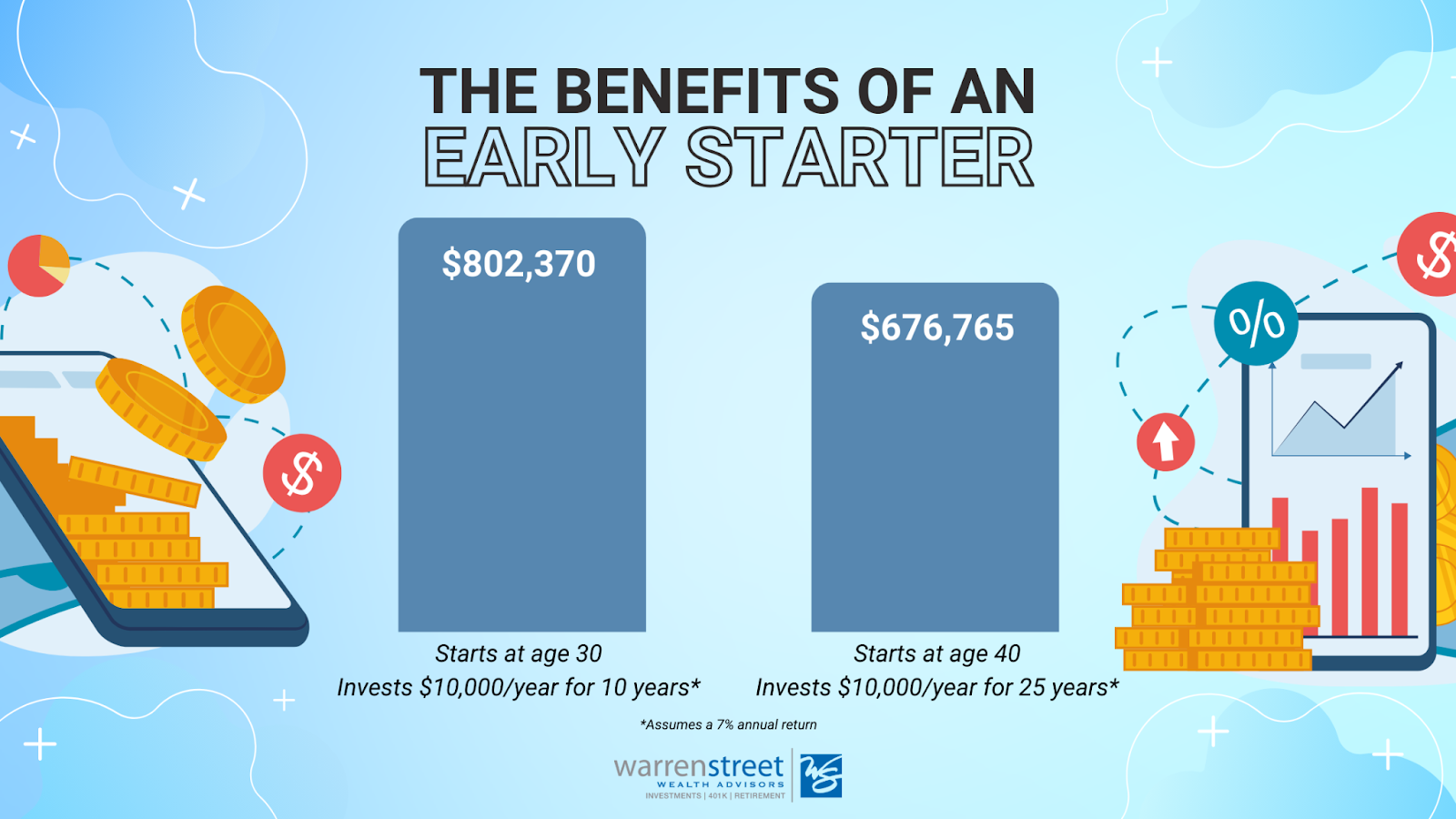
Time allows your investments to snowball. The longer you let your returns compound, the greater the snowball effect. Here’s an example why:

Investor 1: Starts at age 30, invests $10,000 annually for 10 years, earning a 7% annual return. They contribute a total of $100,000 and then stop adding money but let it grow.

  • Portfolio value at age 65: $802,370

Investor 2: Starts at age 40, invests $10,000 annually for 25 years, earning a 7% annual return. They contribute a total of $250,000.

  • Portfolio value at age 65: $676,765

Despite contributing $150,000 more, Investor 2 ends up with about $125,000 less than Investor 1. Starting early makes a huge difference.

Make the Most of Tax Advantages

Taxes can reduce compounding’s power. In a taxable account, interest, dividends, and capital gains trigger taxes that lower your annual return. Lower returns mean less money to grow the next year.

However, in tax-advantaged accounts like a 401(k), traditional IRA, or Roth IRA, you don’t pay taxes on gains while the money is in the account. This allows all your gains to keep working for you.

  • Traditional 401(k) and IRA: You contribute pre-tax money, it grows tax-deferred, and withdrawals after age 59 ½ are taxed at normal income tax rates.
  • Roth IRA: You contribute after-tax money, it grows tax-free, and withdrawals after age 59 ½ and a 5-year holding period are tax-free.

Control What You Can

Like most things in life, investing has many uncontrollable elements, so focus on what you can control. Start early, stay invested for the long term, and use tax-advantaged accounts to maximize compounding and work towards your long-term goals.

Bryan Cassick, MBA, CFP®

Wealth Advisor, Warren Street Wealth Advisors

Investment Advisor Representative, Warren Street Wealth Advisors, LLC., a Registered Investment Advisor

The information presented here represents opinions and is not meant as personal or actionable advice to any individual, corporation, or other entity. Any investments discussed carry unique risks and should be carefully considered and reviewed by you and your financial professional. Nothing in this document is a solicitation to buy or sell any securities, or an attempt to furnish personal investment advice. Warren Street Wealth Advisors may own securities referenced in this document. Due to the static nature of content, securities held may change over time and current trades may be contrary to outdated publications. Form ADV available upon request 714-876-6200.

https://warrenstreetwealth.com/wp-content/uploads/2024/08/Compounding-Return-Basics-101.png 1080 1080 Bryan Cassick, MBA, CFP® https://warrenstreetwealth.com/wp-content/uploads/2014/11/Warren_Street_logo-01.svg Bryan Cassick, MBA, CFP®2024-10-17 07:35:002024-10-15 06:58:33How Compound Returns Work: A Guide to Growing Your Money

Series I Bonds: Are They Right For You?

June 16, 2022/in Education, General, Investing/by Kirsten C. Cadden, CFP®

Series I bonds offer a low-risk, interest-earning addition to your portfolio. As part of a well-diversified portfolio strategy, now may be a good time to put some additional cash into I bonds and take advantage of an attractive interest rate.

What is a Series I bond?

A Series I bond is issued by the US Treasury. The bond accrues interest monthly until it reaches 30 years or you cash it, whichever comes first.

An I bond has two interest rates – the fixed rate and the inflation rate. These two rates combine to determine a bond owner’s actual rate of return, called the composite rate. A new rate will be set every six months based on the fixed rate and on inflation.

The US Treasury limits the composite rate to no less than 0%, meaning the rate of return on I bonds will never be negative.

What’s the benefit?

The composite rate on Series I bonds is currently 9.62% (annualized). Though the interest rate is variable and will change over time, purchasing I bonds now guarantees that you will earn this interest rate until October 2022 when the new rate is set for the next 6 months.

Are there risks?

An I bond is considered an extremely low risk investment. However, the ultimate rate of return is variable and not guaranteed beyond the current 6-month rate. The current interest rate is high because inflation is higher than usual – if Federal Reserve policy reduces inflation the inflation rate for I bonds will also decrease.

Note that an I bond cannot be redeemed for at least one year after purchase, and any redemption between years 1 and 3 does not receive the interest from the three months prior to redemption.

How do I buy a Series I bond?

Visit treasurydirect.gov to purchase electronic I bonds. An I bond must be purchased directly by the investor; it is not something your advisor can add to your portfolio for you. Series I bonds purchased electronically come in any amount to the penny for $25 or more. Paper I bonds can be purchased using your federal income tax refund. The amount of a bond purchased is limited to $10,000 per person per year.

Are I bonds right for me?

Determining what investments are the best fit for you depends on several factors: your age, the timeline for when you need to withdraw from investments, your comfort with risk, and your overall financial health. If you have some cash that is not part of your basic emergency fund and you do not need it in the next 1-3 years, I bonds may be a good choice. However, as with all investing decisions, we recommend consulting with your financial advisor to determine if I bonds are the best fit for your unique situation.

Kirsten C. Cadden, CFP®

Associate Advisor, Warren Street Wealth Advisors

Investment Advisor Representative, Warren Street Wealth Advisors, LLC., a Registered Investment Advisor

The information presented here represents opinions and is not meant as personal or actionable advice to any individual, corporation, or other entity. Any investments discussed carry unique risks and should be carefully considered and reviewed by you and your financial professional. Nothing in this document is a solicitation to buy or sell any securities, or an attempt to furnish personal investment advice. Warren Street Wealth Advisors may own securities referenced in this document. Due to the static nature of content, securities held may change over time and current trades may be contrary to outdated publications. Form ADV available upon request 714-876-6200.

https://warrenstreetwealth.com/wp-content/uploads/2022/06/Series-I-Bond-Blog-Thumbnail.png 1080 1080 Kirsten C. Cadden, CFP® https://warrenstreetwealth.com/wp-content/uploads/2014/11/Warren_Street_logo-01.svg Kirsten C. Cadden, CFP®2022-06-16 08:00:002024-11-07 09:30:00Series I Bonds: Are They Right For You?

5 Options for Last Minute 2021 Tax Moves

February 24, 2022/in Basic, Financial Planning, General, Taxes/by Justin D. Rucci, CFP®

The 2021 calendar year might be over, but that doesn’t necessarily mean that you’re out of luck if you want to make any last-minute tax moves before you file your 2021 return. 

While your options may be somewhat limited after December 31st has passed, below are five options to think about as you get ready to file your 2021 taxes.

  1. Traditional IRA

You may still be able to make an IRA contribution for 2021, even as late as April 18th. In order to receive a deduction for your contribution, you’ll want to review your 2021 AGI (Adjusted Gross Income), ideally with a professional. The income limit phase-out range starts at $66,000 for individuals and $105,000 for married joint filers, with exceptions to these limits being available if you do not have access to a 401K or other retirement plan through work.

Another scenario where an IRA contribution can be beneficial is for a recent retiree. Some retirees will receive earned income from their previous employer in the calendar year following their retirement in the form of a prorated bonus or otherwise. This earned income allows the retiree to make an IRA contribution and take the deduction. If this applies to you, be sure to contact your advisor to discuss your options.

If you decide to make an IRA contribution, the maximum amount for 2021 is $6,000 per individual, or $7,000 for individuals age 50 and older.  

  1. SEP IRA & Small Business Plans

If you are self-employed you may be able to make a last-minute contribution to a retirement plan as well. The most common type of self-employed retirement plan is a SEP IRA, but depending on your tax situation, a Solo 401K, Defined Benefit plan, or other types of retirement plan may be beneficial for you.

The contribution limit for a SEP IRA in 2021 is $58,000, with no income limitations being applied. That said, the amount you will be able to contribute will be dictated by your self-employment income for the year, so work with your advisor and your tax professional to make sure the contributions are done properly to ensure you are maximizing the tax savings. 

  1. Roth IRA

If you are interested in a different type of tax-advantaged retirement savings vehicle, a Roth IRA may better suit your needs. While it does not provide an immediate tax deduction, it does allow you to invest funds in a tax-advantaged manner for the long term. If you meet the requirements at distribution time, all withdrawals will be tax-free.

There are income limits for who can contribute to a Roth IRA. AGI limits start at $125,000 for individuals and $198,000 for joint filers in 2021.

Contribution limits for a Roth IRA are the same as a Traditional IRA – $6,000 per individual, or $7,000 for individuals age 50 and over. This contribution limit is an aggregate for both IRA account types, so between a traditional IRA and a Roth IRA you cannot contribute more than the annual limit in total.

  1. Charitable Contributions & Deductions from 2021

2021 is the last year (pending future legislation) for the “above the line” charitable deduction. In other words, 2021 will be the last year that you will be able to take a deduction for a charitable contribution you made without having to itemize all of your deductions on Schedule A.  

In 2021 you can deduct up to $300 per individual, or $600 for joint filers for charitable contributions without itemizing.

If you made charitable contributions in 2021, now is the time to dig up those receipts and provide them to your tax professional.

If you think you may be able to itemize your deductions, be sure to also include mortgage interest, state taxes paid (property, sales, & income), and medical expenses in the information you provide to your tax preparer.

  1. Health Savings Account Contribution

If you participated in an HSA-eligible “high-deductible health plan” in 2021, you may be eligible to make a tax-deductible contribution to a Health Savings Account for 2021 up to the 2021 tax filing deadline (April 18, 2022).  Contribution limits are $3,600 for individuals and $7,200 for families, with a $1,000 catch-up contribution available for taxpayers age 55 and older.  Contributions to HSAs are tax-deductible and withdrawals are tax-free if the funds are used for qualified medical expenses.    

In conclusion, there are still some strategies that can be utilized when it comes to filing your 2021 taxes. If you have yet to make a decision on any of the above, there is still time before you file your return.

If you are interested in learning more about any of the above or taking any action, be sure to reach out to your advisor at Warren Street to get the conversation started.

Justin Rucci, CFP®

Wealth Advisor, Warren Street Wealth Advisors

Investment Advisor Representative, Warren Street Wealth Advisors, LLC., a Registered Investment Advisor

The information presented here represents opinions and is not meant as personal or actionable advice to any individual, corporation, or other entity. Any investments discussed carry unique risks and should be carefully considered and reviewed by you and your financial professional. Nothing in this document is a solicitation to buy or sell any securities, or an attempt to furnish personal investment advice. Warren Street Wealth Advisors may own securities referenced in this document. Due to the static nature of content, securities held may change over time and current trades may be contrary to outdated publications. Form ADV available upon request 714-876-6200.

Sources:

https://www.irs.gov/retirement-plans/ira-deduction-limits

https://www.irs.gov/retirement-plans/roth-iras

https://www.irs.gov/newsroom/special-300-tax-deduction-helps-most-people-give-to-charity-this-year-even-if-they-dont-itemize

https://www.irs.gov/retirement-plans/plan-sponsor/simplified-employee-pension-plan-sep

https://www.irs.gov/publications/p969

https://warrenstreetwealth.com/wp-content/uploads/2022/02/Blog-Thumbnail-1.png 1080 1080 Justin D. Rucci, CFP® https://warrenstreetwealth.com/wp-content/uploads/2014/11/Warren_Street_logo-01.svg Justin D. Rucci, CFP®2022-02-24 08:30:002022-06-30 11:03:115 Options for Last Minute 2021 Tax Moves

The Retirement Mindgame

March 12, 2018/in Basic, Education, Financial Planning, Investing, Retirement, Taxes/by Cary Facer
Read more
https://warrenstreetwealth.com/wp-content/uploads/2014/11/Warren_Street_Horiz_CMYK-01.png 300 300 Cary Facer https://warrenstreetwealth.com/wp-content/uploads/2014/11/Warren_Street_logo-01.svg Cary Facer2018-03-12 17:23:302019-03-20 21:39:22The Retirement Mindgame

The Many Benefits of a Roth IRA

January 3, 2018/in Basic, Education, Financial Planning, Investing, Retirement/by Cary Facer
Read more
https://warrenstreetwealth.com/wp-content/uploads/2015/02/Final.jpg 565 1821 Cary Facer https://warrenstreetwealth.com/wp-content/uploads/2014/11/Warren_Street_logo-01.svg Cary Facer2018-01-03 11:00:012024-06-03 10:52:15The Many Benefits of a Roth IRA

Are Your Kids Delaying Your Retirement?

May 26, 2015/in Retirement/by Cary Facer

are your kids delaying your retirementSome baby boomers are supporting their “boomerang” children.

Provided by: Warren Street Wealth Advisors


Are you providing some financial support to your adult children? Has that hurt your retirement prospects?

It seems that the wealthier you are, the greater your chances of lending a helping hand to your kids. Pew Research Center data compiled in late 2014 revealed that 38% of American parents had given financial assistance to their grown children in the past 12 months, including 73% of higher-income parents.1

The latest Bank of America/USA Today Better Money Habits Millennial Report shows that 22% of 30- to 34-year-olds get financial help from their moms and dads. Twenty percent of married or cohabiting millennials receive such help as well.2


Do these households feel burdened? According to the Pew survey, no: 89% of parents who had helped their grown children financially said it was emotionally rewarding to do so. Just 30% said it was stressful.1


Other surveys paint a different picture. Earlier this year, the financial research firm Hearts & Wallets presented a poll of 5,500 U.S. households headed by baby boomers. The major finding: boomers who were not supporting their adult children were nearly 2½ times more likely to be fully retired than their peers (52% versus 21%).3

In TD Ameritrade’s 2015 Financial Disruptions Survey, 66% of Americans said their long-term saving and retirement plans had been disrupted by external circumstances; 24% cited “supporting others” as the reason. In addition, the Hearts & Wallets researchers told MarketWatch that boomers who lent financial assistance to their grown children were 25% more likely to report “heightened financial anxiety” than other boomers; 52% were ill at ease about assuming investment risk.3,4


Economic factors pressure young adults to turn to the bank of Mom & Dad. Thirty or forty years ago, it was entirely possible in many areas of the U.S. for a young couple to buy a home, raise a couple of kids and save 5-10% percent of their incomes. For millennials, that is sheer fantasy. In fact, the savings rate for Americans younger than 35 now stands at -1.8%.5

Housing costs are impossibly high; so are tuition costs. The jobs they accept frequently pay too little and lack the kind of employee benefits preceding generations could count on. The Bank of America/USA Today survey found that 20% of millennials carrying education debt had put off starting a family because of it; 20% had taken jobs for which they were overqualified. The average monthly student loan payment for a millennial was $201.2

Since 2007, the inflation-adjusted median wage for Americans aged 25-34 has declined in nearly every major industry (health care being the exception). Wage growth for younger workers is 60% of what it is for older workers. The real shocker, according to Federal Reserve Bank of San Francisco data: while overall U.S. wages rose 15% between 2007-14, wages for entry-level business and finance jobs only rose 2.6% in that period.5,6


It is wonderful to help, but not if it hurts your retirement. When a couple in their fifties or sixties assumes additional household expenses, the risk to their retirement savings increases. Additionally, their retirement vision risks being amended and compromised.

The bottom line is that a couple should not offer long-run financial help. That will not do a young college graduate any favors. Setting expectations is only reasonable: establishing a deadline when the support ends is another step toward instilling financial responsibility in your son or daughter. A contract, a rental agreement, an encouragement to find a place with a good friend – these are not harsh measures, just rational ones.

With no ground rules and the bank of Mom and Dad providing financial assistance without end, a “boomerang” son or daughter may stay in the bedroom or basement for years and a boomer couple may end up retiring years later than they previously imagined. Putting a foot down is not mean – younger and older adults face economic challenges alike, and couples in their fifties and sixties need to stand up for their retirement dreams.


Warren Street Wealth Advisors

190 S. Glassell St., Suite 209

Orange, CA 92866

714-876-6200 – office

714-876-6202 – fax

714-876-6284 – direct

cary@warrenstreetwealth.com

blake@warrenstreetwealth.com


This material was prepared by MarketingPro, Inc., and does not necessarily represent the views of the presenting party, nor their affiliates. This information has been derived from sources believed to be accurate. Please note – investing involves risk, and past performance is no guarantee of future results. The publisher is not engaged in rendering legal, accounting or other professional services. If assistance is needed, the reader is advised to engage the services of a competent professional. This information should not be construed as investment, tax or legal advice and may not be relied on for the purpose of avoiding any Federal tax penalty. This is neither a solicitation nor recommendation to purchase or sell any investment or insurance product or service, and should not be relied upon as such. All indices are unmanaged and are not illustrative of any particular investment.


Citations.

1 – pewsocialtrends.org/2015/05/21/5-helping-adult-children/ [5/21/15]

2 – newsroom.bankofamerica.com/press-releases/consumer-banking/parents-great-recession-influence-millennial-money-views-and-habits/ [4/21/15]

3 – marketwatch.com/story/are-your-kids-ruining-your-retirement-2015-05-05 [5/5/15]

4 – amtd.com/newsroom/press-releases/press-release-details/2015/Financial-Disruptions-Cost-Americans-25-Trillion-in-Lost-Retirement-Savings/default.aspx [2/17/15]

5 – theatlantic.com/business/archive/2014/12/millennials-arent-saving-money-because-theyre-not-making-money/383338/ [12/3/14]

6 – theatlantic.com/business/archive/2014/07/millennial-entry-level-wages-terrible-horrible-just-really-bad/374884/ [7/23/14]


https://warrenstreetwealth.com/wp-content/uploads/2015/05/are-you-retiring-in-the-next-five-years.png 370 555 Cary Facer https://warrenstreetwealth.com/wp-content/uploads/2014/11/Warren_Street_logo-01.svg Cary Facer2015-05-26 16:13:172015-06-16 19:25:26Are Your Kids Delaying Your Retirement?

What’s Your Financial Health Score?

January 21, 2015/in Financial Planning/by Cary Facer

What’s Your Financial Health ScoreCan a 5-question test predict how wealthy you will become?

Provided by: Warren Street Wealth Advisors


In the future, will you become wealthier or poorer? Who knows, right? It seems like you would need a crystal ball to really answer that question given life’s up and downs. What if the answer is right in front of you? What if you can determine it from your present financial behaviors?


Two economists present a brief questionnaire – and an audacious claim. Last month, the Center for Household Financial Stability at the Federal Reserve Bank of St. Louis published an article titled “Five Simple Questions That Reveal Your Financial Health and Wealth.” The authors, William Emmons and Bryan Noeth, argue that your answers to these questions can effectively predict your financial future.1,2


Q: Did you save any money last year?

Q: Did you miss any loan or mortgage payments in the past year?

Q: Did you have a balance on your credit card after the last payment was due?

Q: Do liquid assets make up at least 10% of the value of your total assets?

Q: Is your total debt service (i.e., the cash you devote each month to paying principal and interest) less than 40% of your income?1


The Federal Reserve has actually asked these questions of consumers for decades as part of its Survey of Consumer Finances. Studying the eight SCFs conducted from 1992-2013, Emmons and Noeth looked at the answers respondents provided to these questions and the level of personal wealth they reported. Their assertion: “In summary, good financial health – as measured by our simple five-question scorecard – is highly correlated with the accumulation of wealth.”2


As part of their research, Emmons and Noeth scored the answers. A financially positive answer to a question was assigned 1 point; a financially negative answer, 0 points.2


The average total score (across more than 38,000 households) was 3.01. The highest average score to a question was 0.91 (the one about debt load being less than 40% of income) and the lowest average score to a question was 0.27 (the one about the percentage of liquid assets among total assets).2


There was a surprising conclusion. The authors found that education was no reliable indicator of personal wealth. When it came to being rich or poor, well-educated individuals had no leg up on lesser-educated individuals.2


What’s your score? If you are able to successively answer the above questions with “yes,” “no,” “no,” “yes” and “yes”, your household is probably in pretty good financial shape – or better. In simple terms, those answers would get you a 5.0.


Here’s the bottom line. If you save money consistently and maintain a good cash position, if you make loan and mortgage payments on time and pay off 100% of your credit card debt each billing cycle, if you avoid debts that put a strain on your budget … congratulations. You are doing the right things on behalf of your financial life and promoting your chances to build wealth.


If you’d like to see the precise methodology the researchers used and their definition of a “positive” and “negative” answer for each question, you can go online and download Issue 10 of the St. Louis Fed publication In the Balance (which contains the article and the scorecard) at stlouisfed.org/publications/itb/.


Warren Street Wealth Advisors

190 S. Glassell St., Suite 209

Orange, CA 92866

714-876-6200 – office


This material was prepared by MarketingPro, Inc., and does not necessarily represent the views of the presenting party, nor their affiliates. This information has been derived from sources believed to be accurate. Please note – investing involves risk, and past performance is no guarantee of future results. The publisher is not engaged in rendering legal, accounting or other professional services. If assistance is needed, the reader is advised to engage the services of a competent professional. This information should not be construed as investment, tax or legal advice and may not be relied on for the purpose of avoiding any Federal tax penalty. This is neither a solicitation nor recommendation to purchase or sell any investment or insurance product or service, and should not be relied upon as such. All indices are unmanaged and are not illustrative of any particular investment.


Citations.

1 – stlouisfed.org/newsroom/displayNews.cfm?article=2390 [12/15/14]

2 – stlouisfed.org/publications/pub_assets/pdf/2014/In_the_Balance_issue_10.pdf/ [12/14]

https://warrenstreetwealth.com/wp-content/uploads/2014/11/Warren_Street_logo-01.svg 0 0 Cary Facer https://warrenstreetwealth.com/wp-content/uploads/2014/11/Warren_Street_logo-01.svg Cary Facer2015-01-21 17:50:482015-01-21 17:50:48What’s Your Financial Health Score?

Talking About Money Before & After You Marry

December 3, 2014/0 Comments/in Financial Planning/by Cary Facer

Talking About Money Before & After You MarryNo money secrets should stand between the two of you as you wed.

Provided by: Warren Street Wealth Advisors


No married couple should suffer from financial infidelity. If you hide debt, income or assets from your spouse, it can lead to a fight and possibly even an impasse in your relationship.


Communication & transparency are essential when it comes to money. That truth should be recognized by every couple tying the knot, or even just cohabitating. Yes, financial matters can prove hard to discuss – but if you can’t talk about them together, that’s already a serious problem.


That problem may affect more couples than we realize. In 2013, 7% of engaged individuals who answered a National Credit Counseling Foundation poll said that if they discussed money issues with their fiancé, it would prompt a fight; 11% felt such a talk would uncover financial secrets, and 5% said it would “cause us to call off the wedding.”1


On the bright side, 32% felt a conversation about financial matters would be “a productive and easy conversation to have.” The most frequent response (45%) was that a money discussion would be “awkward,” but also necessary for the health of the marriage.1


You have to tell your future spouse about your debts. Do it before you get married, not after. That debt will become your spouse’s financial concern as well as yours. The two of you should plan together to pay down your individual debts in the coming months or years. Again, this represents a shared commitment. Don’t put your name on your deeply indebted spouse’s credit card. Attaching your name to that account will have minimal impact on your FICO score, but you don’t want to pay a (literal) price for your spouse’s runaway financial impulses.2


If you have six credit cards between the two of you, see if you can slim it down to three or four – the ones with the lowest fees and best rewards programs. Or see if you can just use those three or four and let the other accounts lie dormant. That might be a better move than just canceling the excess credit cards – that could hurt you, especially in the case of older accounts. About 15% of your FICO score is based on the duration of your credit history, so if that was good history, you don’t quite want to say goodbye to it.2


Think about a new joint credit card account for the two of you. If you feel your spouse needs debt counseling before you can make that move, don’t be shy about requesting it. Even if your spouse has been living on plastic, think twice about leaving him or her without a credit card. You want (and need) to show some credit history.


You will have to compromise. The most valuable verb in marriage is also really valuable when it comes to your shared financial life. Maybe you’re a good saver, a future “millionaire next door” – and yet your spouse is a comparative spendthrift. If you can’t compromise on a “money policy,” then maybe you can find a middle ground by saving for a special experience. Or, maybe each of you can set aside a bit of money per month to spend or save purely at your discretion.


You may want to pay the bills proportionately. If one of you earns 70% of the household income, then maybe that spouse should pay for 70% of the household bills and expenses. To many newlyweds, that seems entirely fair.


Build retirement savings & an emergency fund together. Financially, there are few better ways to signify your long-term commitment to one another.


Wait on a big purchase. Consider waiting 24 hours (if you can) before going through with it. Or, alternately, set a dollar limit on such purchases – give each other limited financial autonomy I making major purchases that ends at X hundred or X thousand dollars. If the money exceeds that limit, then you both have to discuss it before it can occur.


Make a budget. In fact, strive to make a zero-based version, a budget in which income minus expenses comes precisely to zero each month. This is a way of accounting for each and every dollar spent (actual or projected) and a way to pinpoint potential monthly savings or redirection of income toward expenses.


Watch those taxes. Should you file your taxes jointly? Not necessarily. That is wise for many couples, but if your incomes vary greatly it may be better to file separately. Consult a tax preparer for an answer. Also, look at your W-4 at work. It may be time to adjust your withholding status. If your spouse isn’t employed, you get to add another withholding allowance. Assuming he or she is employed, you can turn to irs.gov to learn how many allowances you are due in total. Then, you can divide that total by two. You and your employer need to follow the instructions on the W-4 so you don’t withhold more or less than you should.


Talking about money isn’t always pleasant, but candor, communication and full disclosure can lead to clarity in your financial lives.


Warren Street Wealth Advisors

190 S. Glassell Street, Suite 209

Orange, CA 92866


Securities offered through Cambridge Investment Research, Inc., a Broker/Dealer, Member FINRA/SIPC.
Advisory services offered through Cambridge Investment Research Advisors, Inc., a Registered
Investment Advisor. Warren Street and Cambridge are not affiliated.


This material was prepared by MarketingPro, Inc., and does not necessarily represent the views of the presenting party, nor their affiliates. This information has been derived from sources believed to be accurate. Please note – investing involves risk, and past performance is no guarantee of future results. The publisher is not engaged in rendering legal, accounting or other professional services. If assistance is needed, the reader is advised to engage the services of a competent professional. This information should not be construed as investment, tax or legal advice and may not be relied on for the purpose of avoiding any Federal tax penalty. This is neither a solicitation nor recommendation to purchase or sell any investment or insurance product or service, and should not be relied upon as such. All indices are unmanaged and are not illustrative of any particular investment.


Citations.

1 – nfcc.org/press/multimedia/news-releases/two-thirds-of-engaged-couples-express-negative-attitudes-toward-discussing-money/ [5/31/13]

2 – washingtonpost.com/news/get-there/wp/2014/09/23/for-richer-or-poorer-a-financial-plan-for-newlyweds/ [9/23/14]

https://warrenstreetwealth.com/wp-content/uploads/2014/11/Warren_Street_logo-01.svg 0 0 Cary Facer https://warrenstreetwealth.com/wp-content/uploads/2014/11/Warren_Street_logo-01.svg Cary Facer2014-12-03 17:41:432014-12-03 17:41:43Talking About Money Before & After You Marry

Recent Posts

  • IPO Mania: What the Rocket Ships, Chatbots, and Rule Changes Mean for Your PortfolioJune 10, 2026 - 3:01 pm

    SpaceX, OpenAI, and Anthropic are leading a historic $200B IPO wave. Senior Portfolio Manager Phillip Law, CFA analyzes why these mega-offerings are happening now, the “index dilemma” threatening passive investors, and how to maintain a disciplined, quality-focused strategy amid the AI enthusiasm.

  • Meet Jennifer Horner, Operations & Compliance AssociateJune 5, 2026 - 11:11 am

    Meet Jennifer Horner, our new Operations & Compliance Associate at Warren Street. In this Q&A, learn about her crucial role in handling daily account transactions, keeping our firm secure, and how her core values of integrity and family align with our mission.

  • Meet Our Onboarding Coordinator: Isaiah Knox, MBAApril 28, 2026 - 7:02 am

    Meet Isaiah Knox, MBA, Warren Street’s Onboarding Coordinator! In this Q&A, learn how Isaiah ensures a seamless, supportive, and high-quality onboarding experience for new clients. Read about his client-first commitment and the role he plays within the team dedicated to your financial well-being at our firm.

  • On the War in Iran: Do Markets Not Care, and What’s Next?April 24, 2026 - 4:48 pm

    With 80 oil tankers stranded and a 9-million-barrel daily shortfall, why are markets hovering near all-time highs? In our April 2026 update, we dive into the “boxed-in” realities facing both the U.S. and Iran, the seven-step framework for “maximum pressure” negotiations, and why we’re choosing disciplined rebalancing over reactive shifts. Discover why the market is looking past the immediate conflict in what’s now a world of accelerated deglobalization.

Categories

  • Basic
  • Chevron
  • Education
  • Financial Planning
  • General
  • Intermediate
  • Investing
  • Quarterly Economic Update
  • Retirement
  • Taxes
  • Uncategorized

Contact Us

(714) 876-6200

hello@warrenstreetwealth.com

Warren Street Wealth Advisors, LLC
200 Spectrum Center Drive, Suite 300,
Irvine, CA 92618

As a Registered Investment Advisor, Warren Street Wealth Advisors, LLC is required to file form ADV to report our business practices and conflicts of interest. Please call to request a copy at 714-876-6200.

IMPORTANT DISCLOSURE INFORMATION

Stay Connected

© Copyright 2026 - Warren Street Wealth Advisors, LLC - 200 Spectrum Center Drive, Suite 300, Irvine, California 92618 - Enfold Theme by Kriesi
  • Link to Facebook
  • Link to Instagram
  • Link to LinkedIn
  • Link to Youtube
  • Link to Yelp
  • Link to X
  • Link to Mail
Scroll to top Scroll to top Scroll to top