
Warren Street Wealth Advisors
  • Who We Serve
    • Business Owners
    • Individuals & Families
    • Fortune 500 and Large Company Employees
    • New Media
    • Oil & Gas Industry
    • SoCal Edison
  • Services
    • Financial Planning & Retirement
    • Investment Management
    • Tax Planning & Preparation
    • Estate Planning
  • About Us
  • Resources
    • Blog
    • Events
      • Health & Wealth
    • Frequently Asked Questions
  • Partnerships
    • Next Street Tax
    • TownSquare Capital
  • Contact Us
  • Schedule
    • New Clients
    • Current Clients
  • Login
  • Menu Menu

Tag Archive for: invest

Will Your Vote Move the Market?

October 2, 2020/in Basic, Education, General, Uncategorized/by Blake Street

Election seasons are highly polarized and leave investors from both sides of the political aisle paralyzed by what-ifs and fear of the other. This seems more true now than ever. Given COVID-19, supreme court implications, and an incredibly divided nation in terms of policy wishes, we expect a volatile finish to 2020. Due to an expected record number of mail-in ballots due to the election, it’s even possible the results aren’t known for days or even weeks. It’s normal to be concerned, but does the data support it? Does taking investment action make sense?

Believe it or not, I wrote the above days before President Trump and the First Lady contracted COVID-19. Can 2020 have any more twists and turns? Our team at Warren Street sends our thoughts and well wishes to them both, their families, and their staff. We hope a speedy and full recovery ensues. The diagnosis for President Trump is undoubtedly troubling given his age and possible pre-existing conditions, it’s sure to inject additional doubt into investors’ minds. CDC data however is still dramatically in his favor and it’s safe to assume he’ll receive best-in-class care. Historically, election seasons have in-fact provided for increased volatility in the markets. In addition, the dispersion in results and returns has been all over the map especially in the short term. You should find comfort however in the fact that long term returns have generally been positive regardless of who’s been at the Presidential helm or a split vs. unified congress. More details to come.

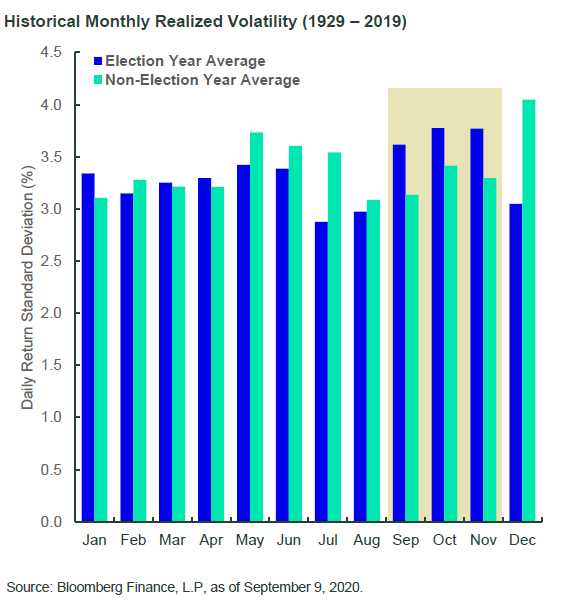
Let’s start with volatility (chart below). Taking a look back to 1929 you’ll see that the election year realized volatility exceeds non-election year volatility in September-November by a rather dramatic amount as measured by daily standard deviation in returns. I can’t say whether the current September 2020  volatility is caused or simply correlated to this phenomena. With U.S. stocks down over 7% 9/1-9/23 there’s plenty going on in the world to not simply chalk this up to election hysteria.
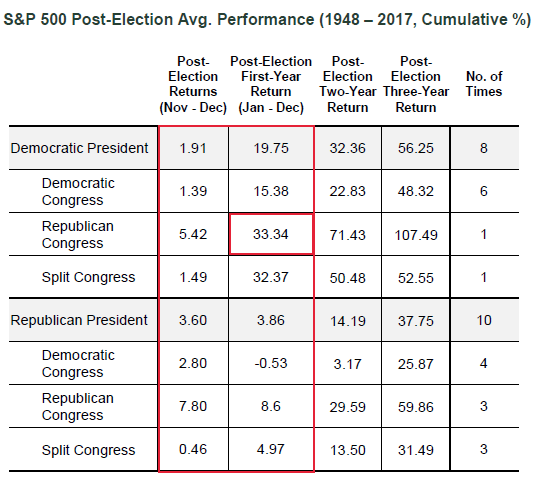
Now that volatility is out of the way, let’s talk returns, starting with short term returns. It is abundantly clear what investors prefer, and it isn’t what you’d think. The President is less significant than the balance of power. Returns tend to be best with a split congress, or in the best performing case a Democrat for President with a Republican congress. Why might that be? Gridlock. Investors love the status quo, but more so corporations love the predictability that comes with it. The ability to invest, forecast, and produce without the prospects of a changing playing field often lends itself to unimpeded growth.
We all learned in 2016 that polling is VERY fallible. Here we find ourselves again with a rapidly changing landscape of polling results, and most of which seem to be consolidating into the margin for error. Meaning both the Presidential and the Congressional races can go any which way. If we were betting, we’d likely expect a blue wave (Biden win and Democrats take over the Senate). Most of this is because incumbents just simply don’t win while in a recession, it’s only happened once in the last 100 years. The bad news, a Democratic sweep is actually one of the worst outcomes for investment markets historically over the corresponding 2 years (blue below) post election. The good news, you can barely tell a difference after 4 years (light blue below) regardless of who is in office, Presidential or Congressional.
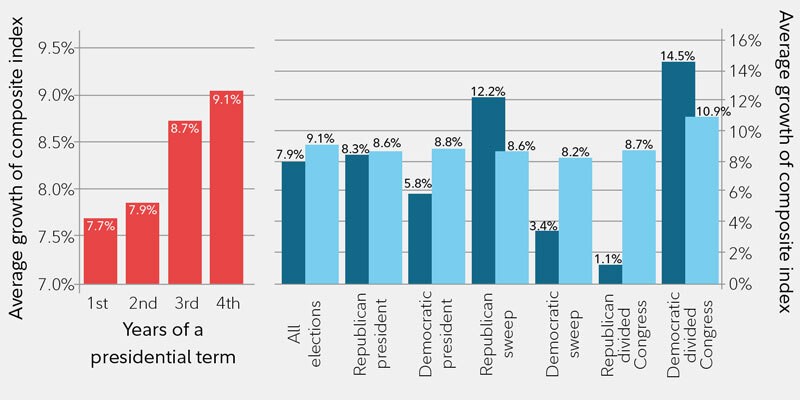
Source: FMRCo

So what do we do now? Proceed with caution. Obviously this election is unparalleled in so many ways, and because of that we can’t solely rely on historical data to give us permission to proceed with blinders on. Having said that, you can make a bullish case for U.S. and Global securities regardless of who wins. What types of companies and which geographies you favor might look very different however. Each party has a different impact on tax code, currency stability, trade relations, etc. It’s important to construct your portfolio with these varied outcomes in mind and not be married to one outcome to succeed.

If you want to review your current investment posture as we head toward the stretch of election season 2020, please don’t hesitate to reach out to our team.

Blake Street, CFA, CFP®

Wealth Advisor, Warren Street Wealth Advisors

Investment Advisor Representative, Warren Street Wealth Advisors, LLC., a Registered Investment Advisor

The information presented here represents opinions and is not meant as personal or actionable advice to any individual, corporation, or other entity. Any investments discussed carry unique risks and should be carefully considered and reviewed by you and your financial professional. Nothing in this document is a solicitation to buy or sell any securities, or an attempt to furnish personal investment advice. Warren Street Wealth Advisors may own securities referenced in this document. Due to the static nature of content, securities held may change over time and current trades may be contrary to outdated publications. Form ADV available upon request 714-876-6200.

https://warrenstreetwealth.com/wp-content/uploads/2020/10/element5-digital-2i7Dn2uMEQE-unsplash-scaled.jpg 2560 1709 Blake Street https://warrenstreetwealth.com/wp-content/uploads/2026/10/Warren-Street-Wealth-Advisors.png Blake Street2020-10-02 11:16:002020-10-02 18:16:36Will Your Vote Move the Market?

10 Things to Do Right Now While Markets are (Not Really) Tanking

March 27, 2018/in Basic, Education, General, Investing, Retirement/by Blake Street
Read more
https://warrenstreetwealth.com/wp-content/uploads/2018/03/bull-v-bear.jpg 569 807 Blake Street https://warrenstreetwealth.com/wp-content/uploads/2026/10/Warren-Street-Wealth-Advisors.png Blake Street2018-03-27 07:32:502021-06-07 17:44:1310 Things to Do Right Now While Markets are (Not Really) Tanking

The Retirement Mindgame

March 12, 2018/in Basic, Education, Financial Planning, Investing, Retirement, Taxes/by Cary Facer
Read more
https://warrenstreetwealth.com/wp-content/uploads/2014/11/Warren_Street_Horiz_CMYK-01.png 300 300 Cary Facer https://warrenstreetwealth.com/wp-content/uploads/2026/10/Warren-Street-Wealth-Advisors.png Cary Facer2018-03-12 17:23:302019-03-20 21:39:22The Retirement Mindgame

4 Money Blunders That Could Leave You Poorer

January 27, 2015/in Financial Planning/by Cary Facer

Not to do listA “not-to-do” list for the new year & years to follow.

Provided by: Warren Street Wealth Advisors


How are your money habits? Are you getting ahead financially, or does it feel like you are running in place?


It may come down to behavior. Some financial behaviors promote wealth creation, while others lead to frustration. Certainly other factors come into play when determining a household’s financial situation, but behavior and attitudes toward money rank pretty high on the list.


How many households are focusing on the fundamentals? Late in 2014, the Denver-based National Endowment for Financial Education (NEFE) surveyed 2,000 adults from the 10 largest U.S. metro areas and found that 64% wanted to make at least one financial resolution for 2015. The top three financial goals for the new year: building retirement savings, setting a budget, and creating a plan to pay off debt.1


All well and good, but the respondents didn’t feel so good about their financial situations. About one-third of them said the quality of their financial life was “worse than they expected it to be.” In fact, 48% told NEFE they were living paycheck-to-paycheck and 63% reported facing a sudden and major expense last year.1


Fate and lackluster wage growth aside, good money habits might help to reduce those percentages in 2015. There are certain habits that tend to improve household finances, and other habits that tend to harm them. As a cautionary note for 2015, here is a “not-to-do” list – a list of key money blunders that could make you much poorer if repeated over time.


Money Blunder #1: Spend every dollar that comes through your hands. Maybe we should ban the phrase “disposable income.” Too many households are disposing of money that they could save or invest. Or, they are spending money that they don’t actually have (through credit cards).


You have to have creature comforts, and you can’t live on pocket change. Even so, you can vow to put aside a certain number of dollars per month to spend on something really important: YOU. That 24-hour sale where everything is 50% off? It probably isn’t a “once in a lifetime” event; for all you know, it may happen again next weekend. It is nothing special compared to your future.


Money Blunder #2: Pay others before you pay yourself. Our economy is consumer-driven and service-oriented. Every day brings us chances to take on additional consumer debt. That works against wealth. How many bills do you pay a month, and how much money is left when you are done? Less debt equals more money to pay yourself with – money that you can save or invest on behalf of your future and your dreams and priorities.


Money Blunder #3: Don’t save anything. Paying yourself first also means building an emergency fund and a strong cash position. With the middle class making very little economic progress in this generation (at least based on wages versus inflation), this may seem hard to accomplish. It may very well be, but it will be even harder to face an unexpected financial burden with minimal cash on hand.


The U.S. personal savings rate has averaged about 5% recently. Not great, but better than the low of 2.6% measured in 2007. Saving 5% of your disposable income may seem like a challenge, but the challenge is relative: the personal savings rate in China is 50%.2


Money Blunder #4: Invest impulsively. Buying what’s hot, chasing the return, investing in what you don’t fully understand – these are all variations of the same bad habit, which is investing emotionally and trying to time the market. The impulse is to “make money,” with too little attention paid to diversification, risk tolerance and other critical factors along the way. Money may be made, but it may not be retained.


Make 2015 the year of good money habits. You may be doing all the right things right now and if so, you may be making financial strides. If you find yourself doing things that are halting your financial progress, remember the old saying: change is good. A change in financial behavior may be rewarding.


Warren Street Wealth Advisors

190 S. Glassell St., Suite 209

Orange, CA 92866

714-876-6200 – office


This material was prepared by MarketingPro, Inc., and does not necessarily represent the views of the presenting party, nor their affiliates. This information has been derived from sources believed to be accurate. Please note – investing involves risk, and past performance is no guarantee of future results. The publisher is not engaged in rendering legal, accounting or other professional services. If assistance is needed, the reader is advised to engage the services of a competent professional. This information should not be construed as investment, tax or legal advice and may not be relied on for the purpose of avoiding any Federal tax penalty. This is neither a solicitation nor recommendation to purchase or sell any investment or insurance product or service, and should not be relied upon as such. All indices are unmanaged and are not illustrative of any particular investment.


Citations.

1 – denverpost.com/smart/ci_27275294/financial-resolutions-2015-four-ways-help-yourself-keep [1/7/15]

2 – tennessean.com/story/money/2014/12/31/tips-getting-financially-fit/21119049/ [12/31/14]

https://warrenstreetwealth.com/wp-content/uploads/2026/10/Warren-Street-Wealth-Advisors.png 0 0 Cary Facer https://warrenstreetwealth.com/wp-content/uploads/2026/10/Warren-Street-Wealth-Advisors.png Cary Facer2015-01-27 17:39:422015-01-27 17:39:424 Money Blunders That Could Leave You Poorer
Page 3 of 3123

Recent Posts

  • What Role Is AI Investment Playing in the Economy and My Portfolio?October 27, 2026 - 4:13 pm

    Explore the role of AI investment in driving current U.S. economic growth, potential risks of a spending slowdown, and strategies for positioning your investment portfolio in an evolving market.

  • Beyond the Ballot Box: Midterms and Markets in PerspectiveOctober 22, 2026 - 10:18 am

    An analysis of how the 2026 midterm elections intersect with market dynamics, historical post-election stock performance, and emerging political and regulatory risks surrounding AI data center infrastructure.

  • Navigating Health Insurance Enrollment SeasonSeptember 24, 2026 - 3:20 pm

    As health insurance open enrollment season arrives, reviewing your options is key to making sound financial and healthcare decisions. Learn what factors to evaluate beyond monthly premiums—such as deductibles, out-of-pocket maximums, HSA contribution limits, and special enrollment rules—to select the coverage that best fits your budget and healthcare needs.

  • 5% and Counting: Is the US Treasury Back?September 15, 2026 - 3:30 pm

    With 10-Year US Treasury yields breaching 5%, explore the key economic drivers behind the surge and what higher interest rates mean for stocks and bond portfolios.

Categories

  • Basic
  • Chevron
  • Education
  • Financial Planning
  • General
  • Intermediate
  • Investing
  • Quarterly Economic Update
  • Retirement
  • Taxes
  • Uncategorized

Contact Us

(714) 876-6200

hello@warrenstreetwealth.com

Warren Street Wealth Advisors, LLC
200 Spectrum Center Drive, Suite 300,
Irvine, CA 92618

As a Registered Investment Advisor, Warren Street Wealth Advisors, LLC is required to file form ADV to report our business practices and conflicts of interest. Please call to request a copy at 714-876-6200.

IMPORTANT DISCLOSURE INFORMATION

Stay Connected

© Copyright 2026 - Warren Street Wealth Advisors, LLC - 200 Spectrum Center Drive, Suite 300, Irvine, California 92618 - Enfold Theme by Kriesi
  • Link to Facebook
  • Link to Instagram
  • Link to LinkedIn
  • Link to Youtube
  • Link to Yelp
  • Link to X
  • Link to Mail
Scroll to top Scroll to top Scroll to top