• Who We Serve
    • Business Owners
    • Individuals & Families
    • Fortune 500 and Large Company Employees
    • New Media
    • Oil & Gas Industry
    • SoCal Edison
  • Services
    • Financial Planning & Retirement
    • Investment Management
    • Tax Planning & Preparation
    • Estate Planning
  • About Us
  • Resources
    • Blog
    • Events
      • Health & Wealth
    • Frequently Asked Questions
  • Partnerships
    • Next Street Tax
    • TownSquare Capital
  • Contact Us
  • Schedule
    • New Clients
    • Current Clients
  • Login
  • Menu Menu

Tag Archive for: federal reserve

5% and Counting: Is the US Treasury Back?

September 15, 2026/in Investing/by Phillip Law, CFA

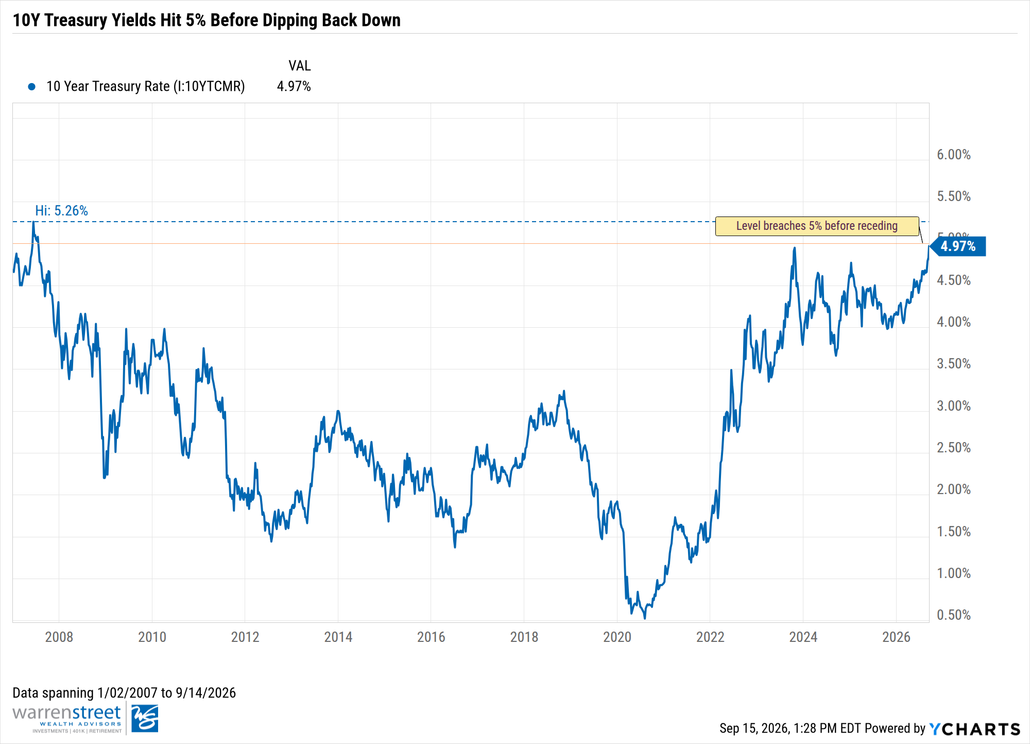
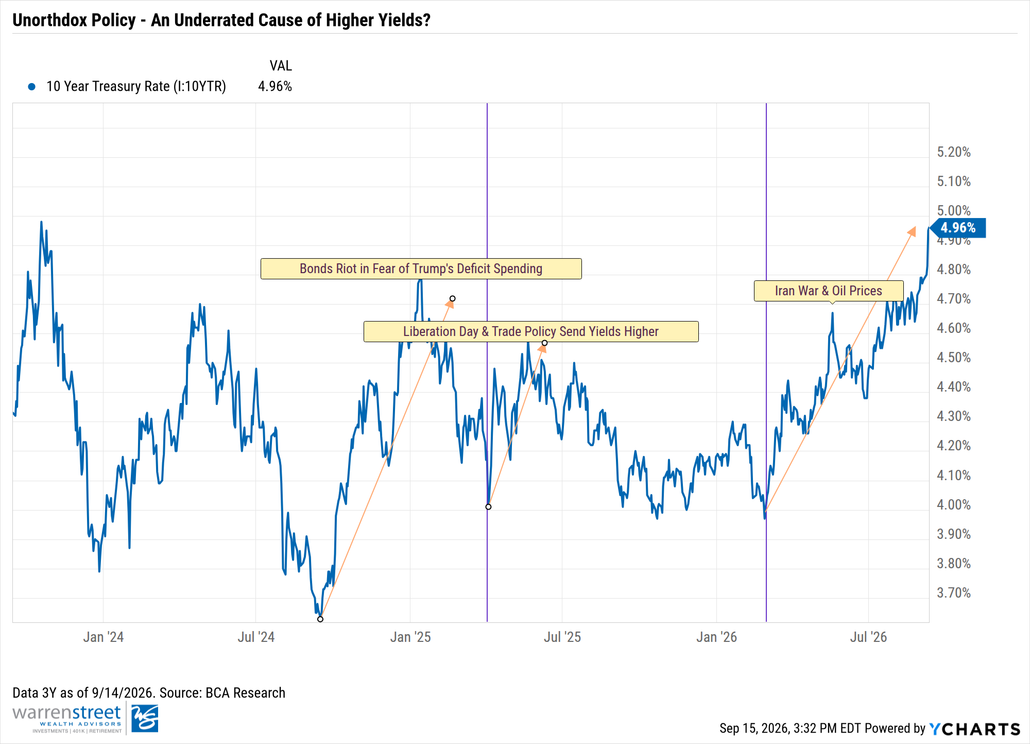
One of the most prominent headlines in financial media today surrounds a less sexy asset class: US government bonds (a.k.a. Treasuries). Think about a Treasury as an IOU where you’re loaning money to the US government, with the goal of collecting interest and principal. More recently, yields on the 10-Year US Treasury have breached 5% – a key threshold that influencers and journalists are touting as “critical level” for risk assets. So what’s genuinely pushing these yields higher, and what do we make of it?

While the 5% level is the highest we’ve seen in nearly 20 years, rates only become truly restrictive when an economy isn’t growing, the private sector is already overleveraged, and resources sit underutilized. None of that describes the US’ position today, but the timing of this surge does feel eerie (alongside conversations around AI doom), linked to a myriad of factors:

  • Fed credibility → Central bank credibility has been a lingering concern since President Trump’s public feud with former Fed Chair Jerome Powell, and newly appointed Chair Kevin Warsh’s shaky press conferences didn’t help. Fortunately, Warsh was able to calm market nerves recently by committing more durably to the Fed’s inflation mandate, even if it means raising short-term interest rates.
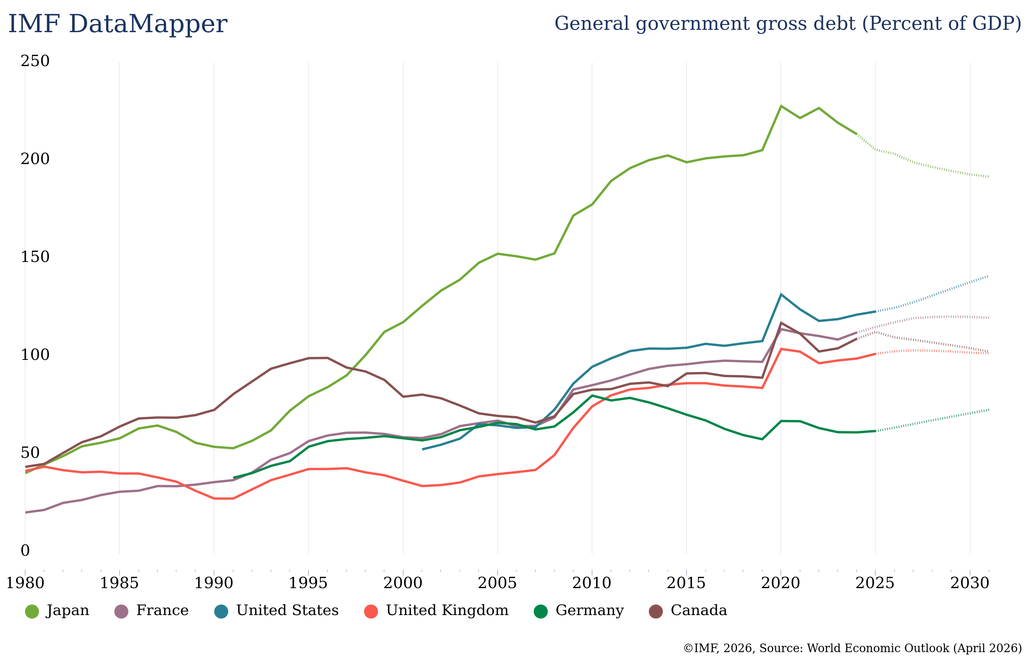
  • Fiscal Debt Sustainability → US Debt levels are high, something we share with other developed nations. While we believe that Treasuries remain the cleanest dirty shirt in the hamper (amongst the debt of other nations), persistent deficits and associated interest expense do raise concerns around long-term fiscal sustainability.
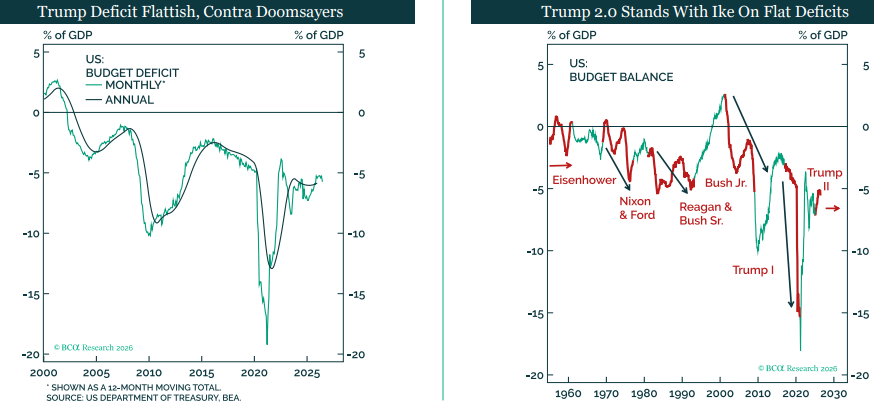
    • What’s overlooked is that the rate of deficit growth is surprising to the downside. Higher bond yields and political pushback have capped government spending to an extent. Yes, absolute debt levels are high, but given that markets are about rate of change and surprises, could investors be overindexing on absolute debt levels as a cause?
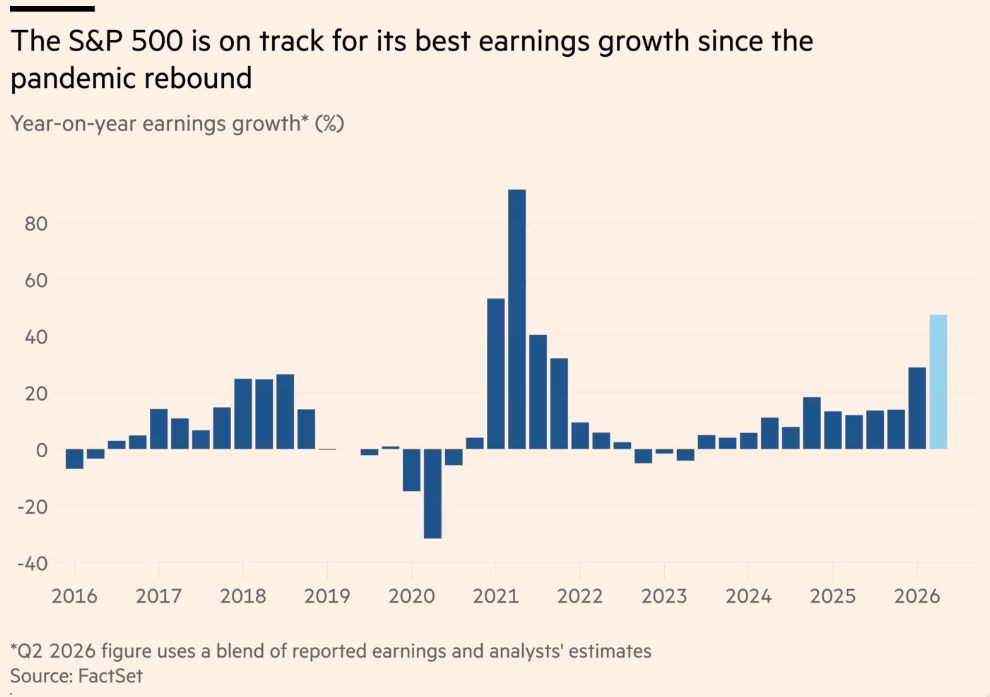
  • Real (Strong) Growth → Strong economic growth naturally commands higher yields since investors have more attractive places to put their capital. Nominal GDP is outpacing cost of borrowing per BCA Research, manufacturing and services activity are in expansionary territory, and corporate profits are on a tear (the S&P 500 reported a whopping ~50% year-over-year (YoY) earnings growth last quarter).
  • Foreigners (not) Fleeing Treasuries– while there’s been some rebalancing across international balance sheets (to fund national security interests or to rotate into other US bond instruments), we have yet to observe a widespread pullback from Treasuries on international balance sheets or an increase in the pace of selling.
  • Unorthodox Fiscal Policy→ you’ll notice we didn’t list inflation as a primary contributor. While inflation is definitely a driver, we believe unorthodox fiscal policy with idiosyncratic impacts on global supply chains is a more relevant culprit. Be it trade wars and forced reshorting of supply chains or waging war against our largest enemy in the middle east (next to a critical resource chokepoint), these instances have resulted in higher prices and driven yields upwards. A more stable policy path could ease both.
  • New Competition for Capital→ AI Hyperscalers like Google are issuing debt to fund AI buildouts – forcing Treasuries to face real competition for investor dollars. 

Investment Implications:

What About for Stocks?

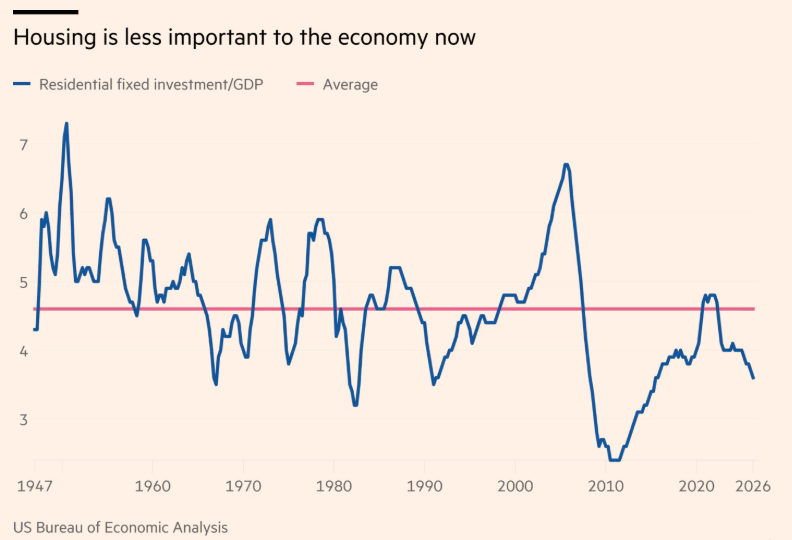
The classic worry is that higher yields suppress stock returns by making borrowing more expensive for home ownership and corporations, while also creating a more attractive entry point for bonds and thus pulling money out of equities. We’ve yet to see that happen. Housing was already soft to begin with, and AI-debt has been rate-insensitive throughout the AI buildout (which also supports the economy through hiring of roofers, electricians, and HVAC teams). Real economic growth estimates for 2026 remain around 2.0% across major institutions.

Meanwhile, the relative value trade-off between stocks and bonds have yet to force a rotation, especially if profit growth across corporate America continues to hold strong (expected to be 28.8% YoY for Q3 2026). The catalyst could be lying in wait, but as of this publication, strong fundamentals have yet to fully curve equity appetites.

What About Treasuries in a Portfolio?

Personally, I believe there’s reasons to be excited to be a bond investor today. Bonds have always played a core role in a portfolio: capital preservation and income generation. Now, longer term bonds can deliver income above inflation, cushion against downside, and diversify against equity risk.


There may be more volatility ahead – especially if the Iran war escalates or if Washington sends confusing signals ($5,000 GOP Checks?), but the US government is finally paying you to hold its debt. Yes, Washington’s balance sheet has its flaws, but global sovereign debt is a relative game. If the world gets messy, I’d feel more at home (no pun intended) owning income-producing US treasuries – backed by the taxing authority of the world’s strongest superpower and the world’s most liquid market – compared to other sovereign debt.

Phillip Law, CFA

Phillip Law, CFA

Senior Portfolio Manager

Warren Street Wealth Advisors, LLC., a Registered Investment Advisor

The information presented here represents opinions and is not meant as personal or actionable advice to any individual, corporation, or other entity. Any investments discussed carry unique risks and should be carefully considered and reviewed by you and your financial professional. Nothing in this document is a solicitation to buy or sell any securities, or an attempt to furnish personal investment advice. Warren Street Wealth Advisors and/or its clients may hold positions in the securities mentioned. Holdings may change at any time without notice. Due to the static nature of content, securities held may change over time and current trades may be contrary to outdated publications. Form ADV available upon request 714-876-6200.

https://warrenstreetwealth.com/wp-content/uploads/2026/09/Blog-Thumbnail.png 1080 1080 Phillip Law, CFA https://warrenstreetwealth.com/wp-content/uploads/2014/11/Warren_Street_logo-01.svg Phillip Law, CFA2026-09-15 15:30:042026-09-15 16:29:365% and Counting: Is the US Treasury Back?

Beyond the Magnificent Seven: A 2026 Midyear Check-In

July 29, 2026/in Investing/by Phillip Law, CFA

Back in January, we published our 2026 Outlook under the title “Beyond AI & Mega-Cap Tech.” Our argument was simple: real diversification was working and could add value beyond the AI trade which was concentrated to a handful of household names (namely the Magnificent Seven, which includes Microsoft, Amazon, and other big tech names). Six months later, we observe that the AI trade has indeed packed its bag, picked up a passport, and traveled to other asset categories including small caps and emerging markets.

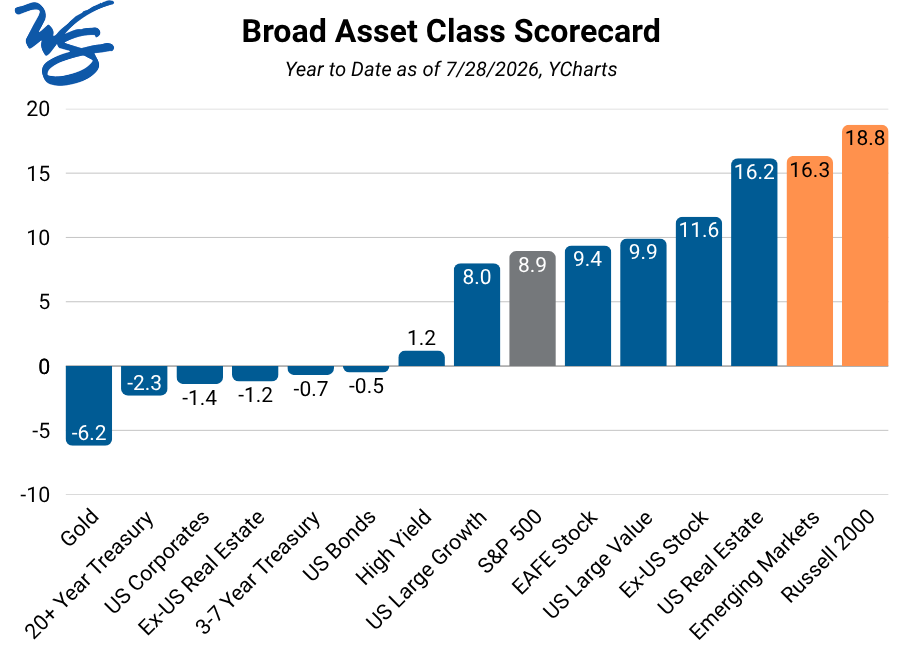
As of late July, small caps and emerging markets are leading the pack. The Russell 2000 (small cap index) is up 18.8% year-to-date while emerging markets 16.3% — all outpacing the S&P 500’s respectable 8.9%. Investors rotated into other corners of the same AI story, with small caps and EM carrying their own AI-adjacent demand related to chips, data centers, and power. 

The AI Trade, Domestically: Rotated, But With More Vulnerability

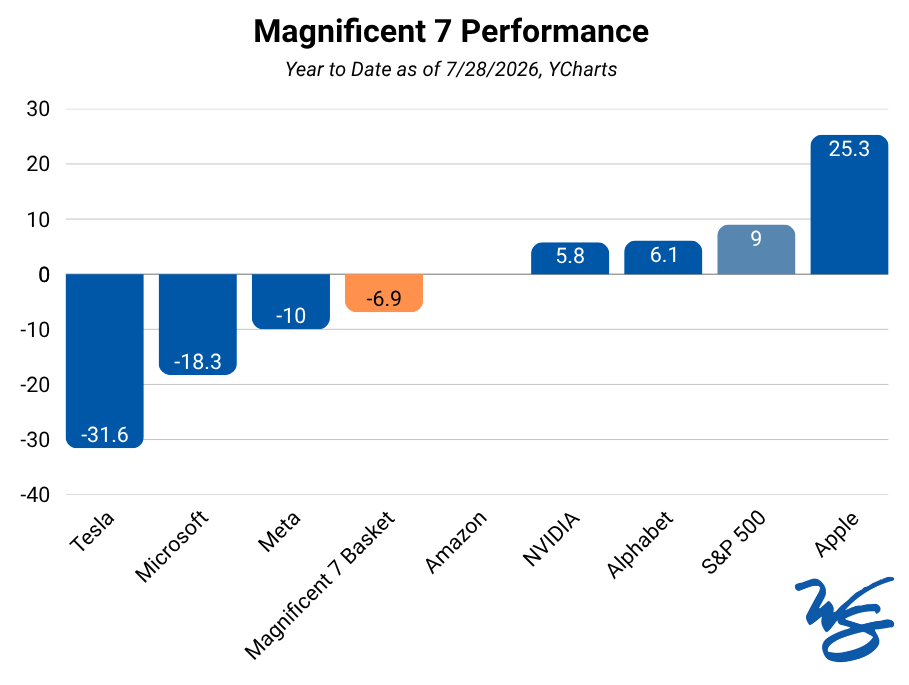
The Magnificent Seven, as a basket, is down 6.9% year-to-date. Hyperscalers (i.e., the biggest spenders on AI infrastructure) including Microsoft (-18.3%), Meta (-10%), and Amazon have struggled in 2026. Only Apple (+25.3%), Alphabet (+6.1%), and Nvidia (+5.8%) are green — and none are this year’s real winners in tech.

That title belongs to the memory and storage names behind the AI buildout: Micron and other chip manufacturers (i.e., CPUs, Memory, etc) are leading the trade, even after “taking a breath” off early-summer highs. Data center demand for memory has minted bigger winners than the household names that started the AI story.

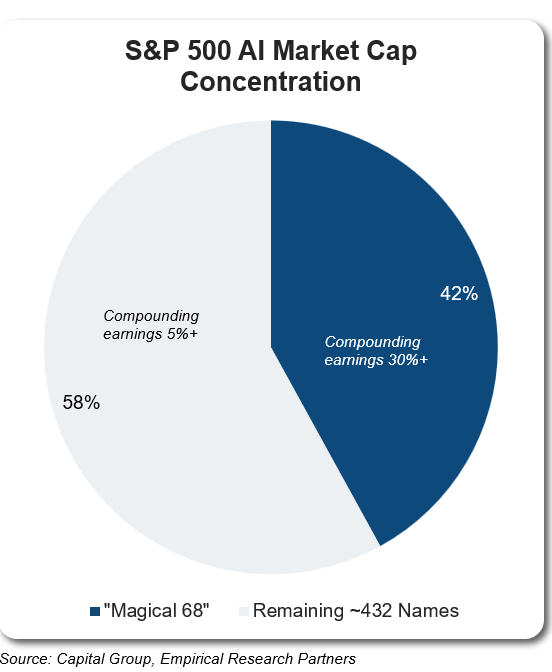
Research cited by Capital Group and Empirical Research Partners shows 68 AI-linked stocks (a.k.a. “Magical 68”) now make up 42% of the S&P 500’s market cap and are compounding earnings north of 30% vs. roughly 5%+ for non-AI stocks – evidence that backlogs are being structurally rewritten to meet supply-constrained demand. In fact, the semiconductors industry alone has also grown from roughly 6–7% of the index three years ago to nearly 20% today.

The bigger question remains whether that demand holds up. Chips are being sold into datacenters built for AI service demands assumed to keep compounding for years – a slowdown, or is absorbed faster than expected – today’s earnings – and the valuations riding on them – could reprice just as fast as they arrived. 

The AI Trade, Internationally: Same Movie, Different Language

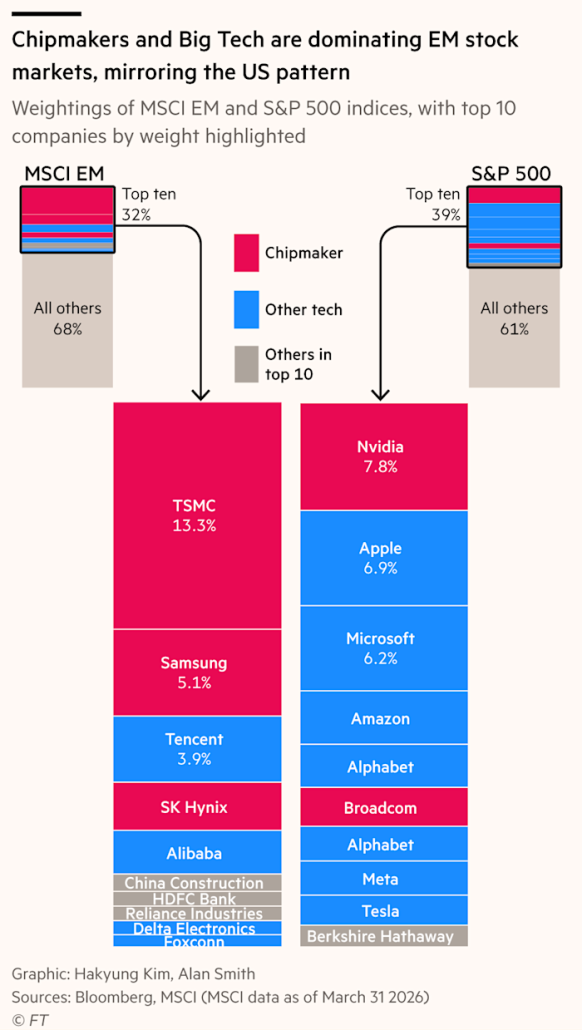
Emerging markets caught the same bug. The MSCI EM Index — up 16% YTD — now carries a heavier tech weighting than the S&P 500, essentially making EM an AI trade. Investors adding EM for diversification may just be buying semiconductors or memory chips in a different currency.

It’s worth noting that EM’s recent outperformance traces back to a handful of AI-linked chip names. Taiwan and South Korea now make up roughly 45% of the benchmark — nearly double their weight a year ago, and above the dot-com peak. Taiwan’s market cap alone exceeds China’s, despite an economy a fraction of the size, with forward earnings (i.e., market cap to cash earnings) running several standard deviations above trend. Put plainly, the diversification benefit of market-cap weighted EM is thinner than it once was and is linked to the fragility of the AI supply chain.

Kevin Warsh and the Inflation Watch

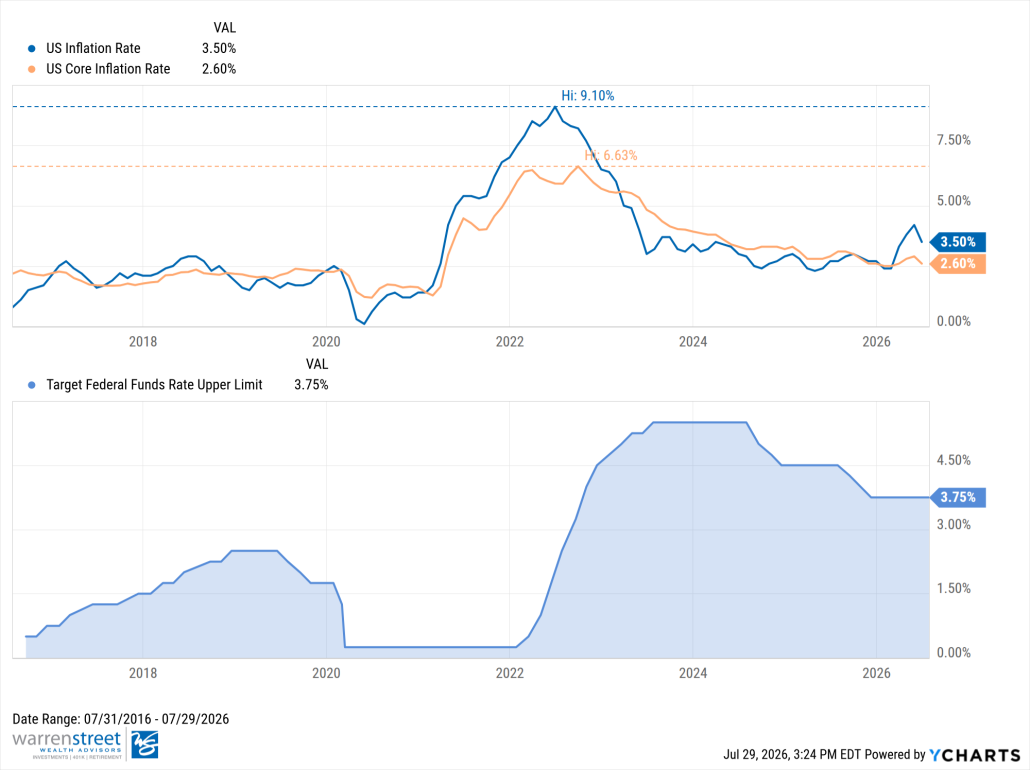
Inflation is sending mixed signals, with core prices (excluding food and energy) running near 2.5%, but the headline number — what you actually feel at the pump and grocery store — is up 3.5% year-over-year due to tensions in the Middle East (the Federal Reserve’s target is ~2%). Consumer spending remains resilient and AI-related business investment is creeping into higher prices. Despite these pressures, cooling wage growth and anchored long-term inflation expectations make it less likely that this turns into a longer-lasting, demand-driven problem.

Kevin Warsh, the Fed’s new chair, wasted no time setting a firmer tone. At his first meeting, he scrapped the Fed’s usual forward guidance and signaled a tougher stance, holding rates steady while making clear that further rate hikes — not cuts — could be on the table. That represents a sizable shift from earlier this year, where markets expected two rate cuts; year; now they’re pricing in the possibility of an interest rate hike. 

There’s a less obvious ripple effect worth knowing about: the AI boom is increasingly funded by borrowed money, not just cash on hand. Big tech companies have issued roughly $130 billion in bonds so far this year to fund AI infrastructure, already surpassing all of last year’s total, with the broader AI debt market on track to exceed $500 billion in 2026. If interest rates rise, that borrowing gets more expensive — which could eventually squeeze the profits and stock valuations behind the AI trade that’s driven so much of the market’s gains.

Investment Implications

We recognize the risks building in the AI ecosystem, but the technology remains genuinely transformative, with substantial earnings potential and runway left in the build-out. Rather than timing an exit from one of the market’s most powerful themes, we’ve repositioned equity exposure to manage these imbalances more deliberately.

On the U.S. side, we’ve paired core market-cap-weighted exposure with a Quality tilt (JQUA), favoring companies with stronger balance sheets, durable free cash flow, and healthy returns on equity. This is a more disciplined way to own the AI trade — capturing upside while screening out the accounting and accrual adjustments that can inflate earnings tied to the theme.

On the EM side, we’ve balanced our pure-growth exposure (XSOE) with a value- and income-oriented fund (EYLD), tilting toward cash-generative businesses focused on dividends, buybacks, and debt paydown. This preserves our exposure to developing-market growth while reducing sensitivity to EM’s biggest AI-related vulnerabilities over a multi-year horizon.

The AI story likely has room to run, but we expect turbulence as investors scrutinize return on investment, large language model providers limit token usage, and frontier-model competitors emerge (e.g., Kimi K3). We view these positioning shifts as a thoughtful way to stay invested in AI while diversifying risk and return within an increasingly concentrated market.

Phillip Law, CFA

Phillip Law, CFA

Senior Portfolio Manager

Warren Street Wealth Advisors, LLC., a Registered Investment Advisor

The information presented here represents opinions and is not meant as personal or actionable advice to any individual, corporation, or other entity. Any investments discussed carry unique risks and should be carefully considered and reviewed by you and your financial professional. Nothing in this document is a solicitation to buy or sell any securities, or an attempt to furnish personal investment advice. Warren Street Wealth Advisors and/or its clients may hold positions in the securities mentioned. Holdings may change at any time without notice. Due to the static nature of content, securities held may change over time and current trades may be contrary to outdated publications. Form ADV available upon request 714-876-6200.

https://warrenstreetwealth.com/wp-content/uploads/2026/07/Beyond-the-Magnificent-Seven-A-2026-Midyear-Check-In.png 1080 1080 Phillip Law, CFA https://warrenstreetwealth.com/wp-content/uploads/2014/11/Warren_Street_logo-01.svg Phillip Law, CFA2026-07-29 15:40:252026-07-30 10:30:31Beyond the Magnificent Seven: A 2026 Midyear Check-In

Recent Posts

  • Navigating Health Insurance Enrollment SeasonSeptember 24, 2026 - 3:20 pm

    As health insurance open enrollment season arrives, reviewing your options is key to making sound financial and healthcare decisions. Learn what factors to evaluate beyond monthly premiums—such as deductibles, out-of-pocket maximums, HSA contribution limits, and special enrollment rules—to select the coverage that best fits your budget and healthcare needs.

  • 5% and Counting: Is the US Treasury Back?September 15, 2026 - 3:30 pm

    With 10-Year US Treasury yields breaching 5%, explore the key economic drivers behind the surge and what higher interest rates mean for stocks and bond portfolios.

  • Beyond the Magnificent Seven: A 2026 Midyear Check-InJuly 29, 2026 - 3:40 pm

    The AI rally has packed its bags: mega-cap tech has stalled while small caps and emerging markets lead 2026 gains. From chip supply chains and rising corporate debt to Federal Reserve policy shifts under Chair Kevin Warsh, we analyze where market risks are building and how we’re positioning portfolios for the road ahead.

  • Meet the Team: Victor Campos, CPA, CFP®July 21, 2026 - 9:05 am

    Get to know Victor Campos, the newest Lead Advisor at Warren Street. Victor utilizes his extensive background as both a Certified Public Accountant (CPA) and Certified Financial Planner™ (CFP®) to deliver holistic financial strategies for our clients. Check out the full interview to discover how his background, values, and dual credentials make him a massive asset to your financial journey.

Categories

  • Basic
  • Chevron
  • Education
  • Financial Planning
  • General
  • Intermediate
  • Investing
  • Quarterly Economic Update
  • Retirement
  • Taxes
  • Uncategorized

Contact Us

(714) 876-6200

hello@warrenstreetwealth.com

Warren Street Wealth Advisors, LLC
200 Spectrum Center Drive, Suite 300,
Irvine, CA 92618

As a Registered Investment Advisor, Warren Street Wealth Advisors, LLC is required to file form ADV to report our business practices and conflicts of interest. Please call to request a copy at 714-876-6200.

IMPORTANT DISCLOSURE INFORMATION

Stay Connected

© Copyright 2026 - Warren Street Wealth Advisors, LLC - 200 Spectrum Center Drive, Suite 300, Irvine, California 92618 - Enfold Theme by Kriesi
  • Link to Facebook
  • Link to Instagram
  • Link to LinkedIn
  • Link to Youtube
  • Link to Yelp
  • Link to X
  • Link to Mail
Scroll to top Scroll to top Scroll to top