Tag Archive for: investing returns

Oil, Conflict, and Your Portfolio: What We’re Watching

Before we dive into the facts, we want to take a moment to recognize that before we are advisors or investment analysts, we are human. Our hearts go out to the families and individuals affected. We hold that reality close as we do our job of helping you navigate what it means for your financial future.

Part of that job is cutting through the noise, so let’s talk about what’s happening, what it means, and what we’re doing about it.

What’s Happening

The conflict entered its second week with crude oil briefly crossing $110 per barrel. Energy infrastructure in the region sustained damage, and the world turned its attention to the Strait of Hormuz — the narrow waterway through which roughly 20% of global oil supply flows — and whether it would remain open for business.
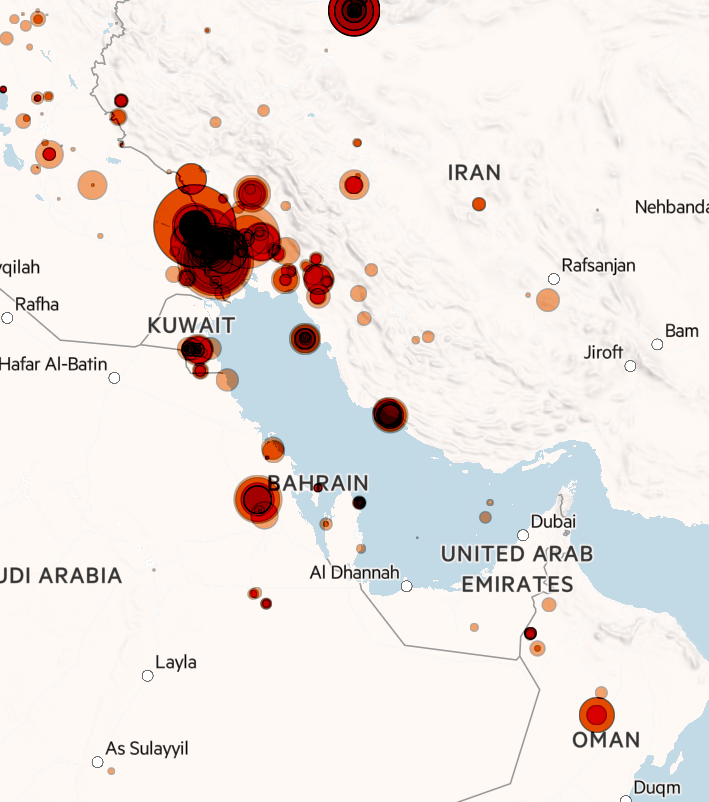
The View from fire-detecting satellites:
Fire anomalies detected by infrared sensors on 7-8 March. Circles are sized by fire radiative power, darker circles mean several fires in close proximity

Sources: FT Analysis, Nasa Firms. Fires reported are either in locations with no history of regular burns or are unusually bright.

We don’t have a crystal ball for what will happen next, but there are three questions we’re watching closely:

  1. Will there be more lasting damage to energy infrastructure?
  2. What does the endgame look like in terms of leadership and capabilities on both sides?
  3. Can a compromise be reached that keeps oil flowing through the gulf?

And Then Oil Dropped $20

Here’s the thing about geopolitical risk: it tends to be loud and unpredictable.

As I’m writing this, oil has pulled back from $110+ per barrel to below $90 — after President Donald Trump suggested the potential for a swift conclusion to the conflict. Meanwhile, the Strait of Hormuz is seeing vessel traffic increase, recovering from post-attack lows with inbound and outbound ship movements gradually rising. 
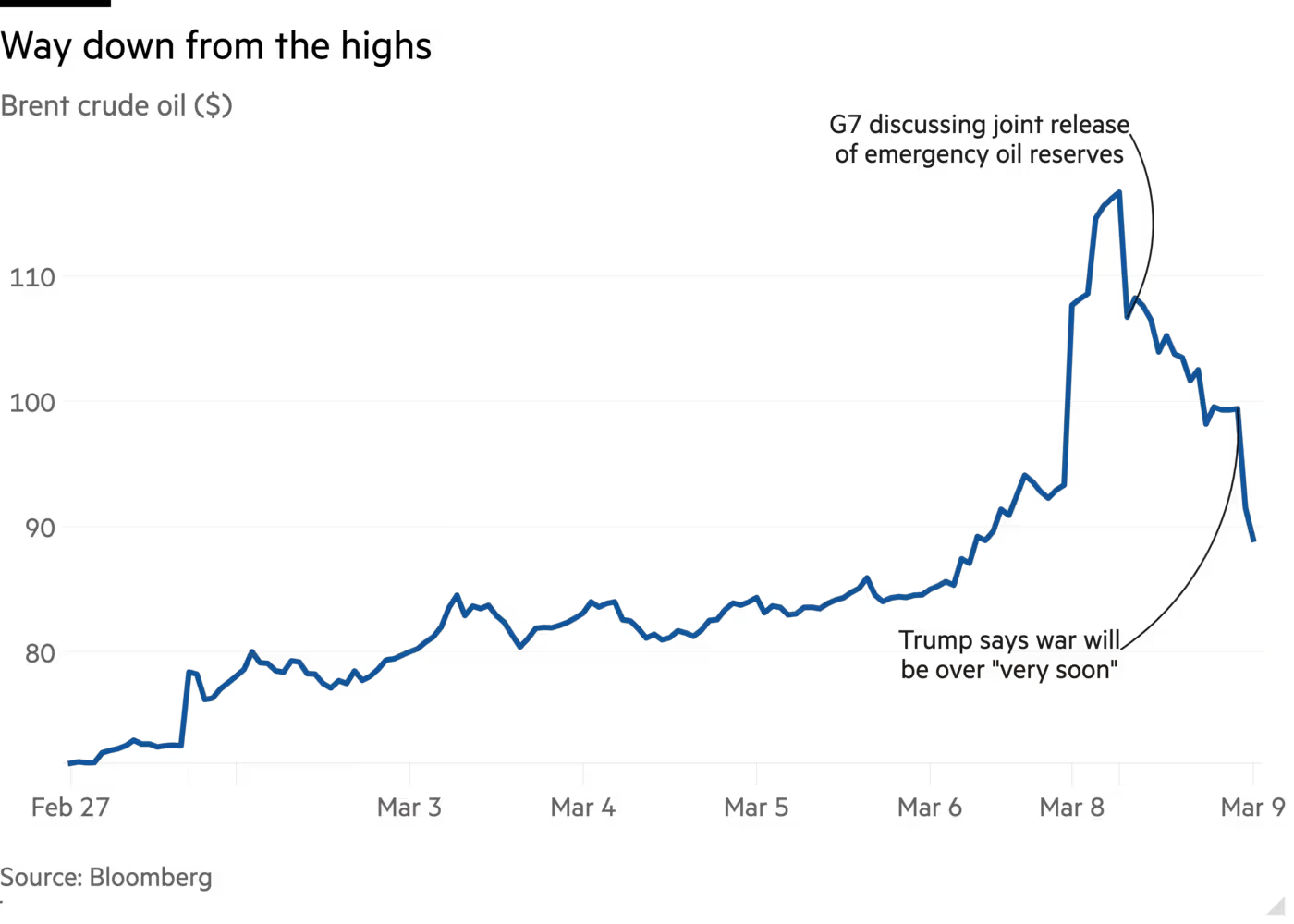
While it’s too soon to declare a resolution, the swift oil price drop following comments from President Trump shows the market was pricing in a major supply shock that hasn’t materialized. This underscores why we avoid trading headlines, which often lead to emotional decisions mistaken for analysis. Our consistent advice for geopolitical headlines remains: stay diversified, stay disciplined, and trust your portfolio strategy.

History Has Seen This Before

Here’s something worth sitting with. Looking at the past 20 major military conflicts and their impact on the S&P 500 over the last 75 years, the average decline from the initial shock to the market bottom was around 6%, and in 19 out of 20 cases, markets returned to pre-event levels in an average of just 28 days.
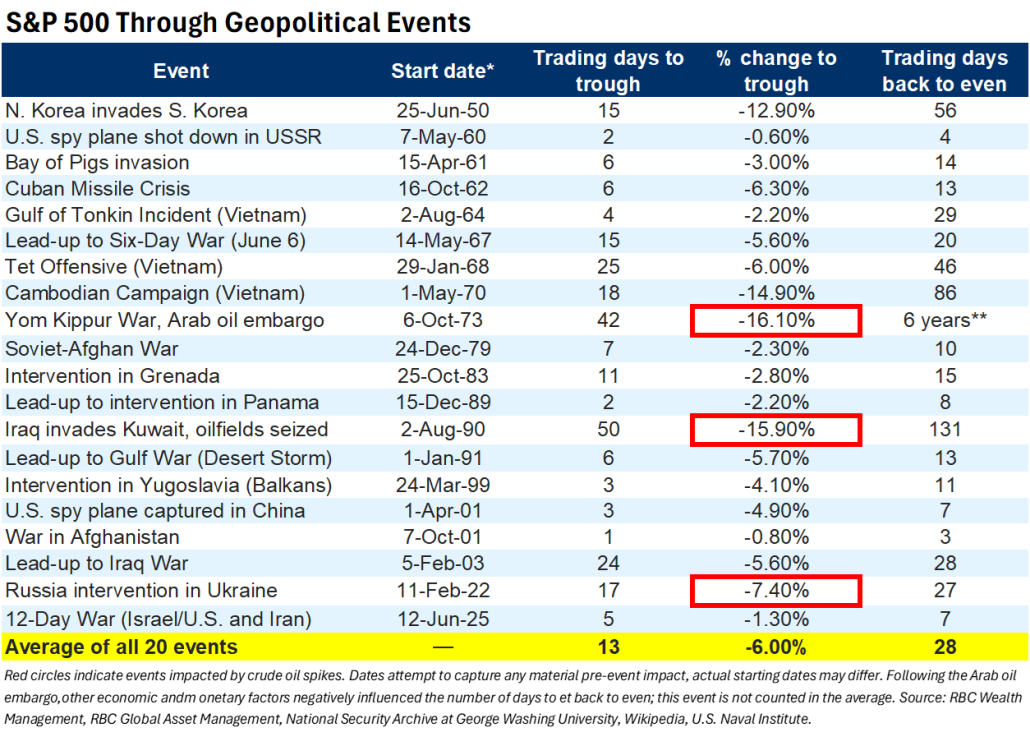
The two biggest exceptions — the 1973 Yom Kippur War and Iraq’s 1990 invasion of Kuwait — both involved sustained oil supply disruptions that pushed stocks down 15–16%. The 1973 episode scarred a generation of investors who sold out of equities and missed the enormous bull run of the 1980s.

The lesson isn’t that conflicts don’t matter. It’s that panicking out of a well-structured portfolio tends to hurt more than the conflict itself does.

This Isn’t 1973

Clients who lived through the Yom Kippur War might flinch from the prospect of re-living around-the-block gas lines, federally imposed speed reductions, or darkened cities to conserve energy. We understand the instinct, but there are major differences today.

In 1973, the U.S. was heavily dependent on imported oil. Every extra dollar at the pump was more money in the pockets of Middle Eastern countries. Today, the U.S. is a net energy exporter. Higher oil prices are painful for consumers, yes — but every extra dollar is more cash in the pockets of domestic energy producers. It’s a redistribution within the economy, not a pure drain out of it.

As for inflation, Energy makes up only about 6% of today’s U.S. inflation basket.  There also headwinds blowing against the case for a 1970’s stagflation landscape, including:

  1. Shelter Lags: Shelter costs (33% of the basket) are declining as lagging rent data catches up to reality, which will apply downward pressure on inflation prints.
  2. Technological Progress: AI and technology-driven productivity is quietly acting as a deflationary force as consumers and businesses increase adoption.
  3. Calming Tariff Tantrums: After the recent IEEPA tariff ruling, the effective tariff rate has also come down meaningfully to 9.1%.
  4. Fundamental economic strength: We acknowledge the recent jobs report’s weakness, but also recognize other areas in the economy remain healthy. Corporate profits are expected to grow at high single to double digits in 2026. Tax refunds from last year’s One Big Beautiful Bill (OBBB) haven’t fully hit consumer accounts yet.

The Fed will likely pause at upcoming meetings, but that’s very different from the kind of policy circumstances that defined the stagflation era.

Weeks, Not Months?

Both sides have strong incentives to reach a compromise quickly. Iran can’t export oil under prolonged conditions and is subject to existential economic pressure. In the U.S., $4+ gas heading into a midterm summer is its own political tax. December oil futures were already trading in the low $70s before today’s pullback, suggesting the market never fully bought the doomsday scenario. Inflation breakeven rates have stayed surprisingly calm throughout.

Even after hostilities quiet down, there’s likely a period of elevated shipping costs and more cautious tanker behavior through the region. Think of it as a persistent risk premium rather than a single clean resolution — but a manageable one, not an economy-altering one.

What We’re Doing

We’re not making dramatic moves based on headlines and that’s by design. We are however, sticking to our operating procedure of:

  1. Rebalancing – different parts of our clients’ portfolios have generally weathered the volatility well, but some may have drifted off target. Rebalancing is a disciplined move back toward those levels, not a market call, but a long-term wealth strategy of selling strength and buying weakness.
  2. We built the “Diversifiers” strategy in client’s retirement portfolios for moments like this. It’s doing its job and reminding us that traditional stock-bond portfolios don’t always move in opposite directions when inflation is in the picture.
  3. If markets sell off further in an extreme scenario, we have the flexibility to tilt asset classes within our portfolios.

We’ll continue monitoring the conflict while staying with our standard operating procedure, but what we won’t do is trade headlines. The oil price chart of the last two weeks makes that case better than we ever could.

WSWA

Warren Street Wealth Advisors

Warren Street Wealth Advisors, LLC., a Registered Investment Advisor

The information presented here represents opinions and is not meant as personal or actionable advice to any individual, corporation, or other entity. Any investments discussed carry unique risks and should be carefully considered and reviewed by you and your financial professional. Nothing in this document is a solicitation to buy or sell any securities, or an attempt to furnish personal investment advice. Warren Street Wealth Advisors may own securities referenced in this document. Due to the static nature of content, securities held may change over time and current trades may be contrary to outdated publications. Form ADV available upon request 714-876-6200.

Sources:

Beyond the Market: Understanding Your Investment Performance

Sometimes, it pays to strive for greener grass. But as an investor, second-guessing a stable strategy can leave you in the weeds. Trading in reaction to excitement or fear tricks you into buying high (chasing popular trends) and selling low (fleeing misfortunes), while potentially incurring unnecessary taxes and transaction costs along the way. 

Still, what do you do if you’re unsure about how your investments stack up?

Compared to the Stocks du Jour?

It’s easy to be dazzled by popular individual stocks or sectors that have been earning more than you have and wonder whether you should get in on the action. 

You might get lucky and buy in ahead of the peaks, ride the surges while they last, and manage to jump out before the fads fade. Unfortunately, even experts cannot foresee the countless coincidences that can squash a high-flying holding or send a different one soaring. To succeed at this gambit, you must correctly—and repeatedly—decide when to get in, and when to get out … in markets where unpredictable hot hands can run anywhere from days to years. 

Remember, too, just by investing your money in the global stock market overall and sitting tight, you’ll probably already own some of today’s hot holdings. You’ll also automatically hold some of the next big winners, before they surge (effectively buying low).  

Rather than comparing your investments to the latest sprinters, be the tortoise, not the hare. Get in, stay in, and focus on your own finish line. It’s the only one that matters.

Compared to “The Market”?

What if your investments seem to be performing differently not just from the high-flyers, but from the entire market? Maybe you’re seeing reports of “the market” returning a different amount than what you are experiencing. 

Remember, when a reporter, analyst, or other experts discusses market performance, they’re usually citing returns from the S&P 500 Index, the DJIA, or a similar proxy. These popular benchmarks often represent one asset class: U.S. large-cap stocks. As such, it’s highly unlikely your own portfolio will always be performing anything like this single source of expected returns. 

Most investors instead prefer to balance their potential risks and rewards. For example, if your portfolio is a 50/50 mix of stocks and bonds, you should expect it to underperform an all-stock portfolio over time. But it also should deliver more dependable (if still not guaranteed) returns in the end, along with a relatively smoother ride along the way. 

Even if you’re more heavily invested in stocks than bonds, a well-diversified stock portfolio will typically include multiple sources of risks and returns, such as U.S., international, and emerging market stocks; small- and large-cap stocks; value and growth stocks; and other underrepresented sources of expected return. 

Thus, we advise against comparing your portfolio’s performance to “the market.” Usually, any variance simply means your well-structured, globally diversified portfolio is working as planned. 

In Summary

Admittedly, it can be easier said than done to avoid inappropriate performance comparisons across shifting times and unfolding events. But your portfolio should be structured to reflect your financial goals and your ability to tolerate the risks involved in pursuing your desired level of long-term growth. 

In roaring bull and scary bear markets alike, we team up with you to address these critical questions about your investments. That way, you can accurately assess where you stand and where you’d like to go from here. 

Please reach out to your advisor if you’d like to discuss further. We are always here for you!

WSWA

Warren Street Wealth Advisors

Warren Street Wealth Advisors, LLC., a Registered Investment Advisor

The information presented here represents opinions and is not meant as personal or actionable advice to any individual, corporation, or other entity. Any investments discussed carry unique risks and should be carefully considered and reviewed by you and your financial professional. Nothing in this document is a solicitation to buy or sell any securities, or an attempt to furnish personal investment advice. Warren Street Wealth Advisors may own securities referenced in this document. Due to the static nature of content, securities held may change over time and current trades may be contrary to outdated publications. Form ADV available upon request 714-876-6200.

Periodic Table of Investing

Periodic Table of Investing

Dust off your memories of high school chemistry and think of your investment returns and your investment risks as two separate and distinct members of the periodic table. Certain elements (in this case, securities) are prone to interact when mixed, while others may remain neutral. Each element (security) will always have its own separate and unique profile and characteristics.

Starting with carbon, one of the world’s most important elements, I’d equate carbon to U.S. stocks. Regardless of age, every investor we work with has likely benefited from or utilized this element and will continue to do so in some capacity going forward.

Argon, the world’s least reactive element, tends to be more akin to Treasury Bonds or cash, not responding negatively to volatility much, if at all.

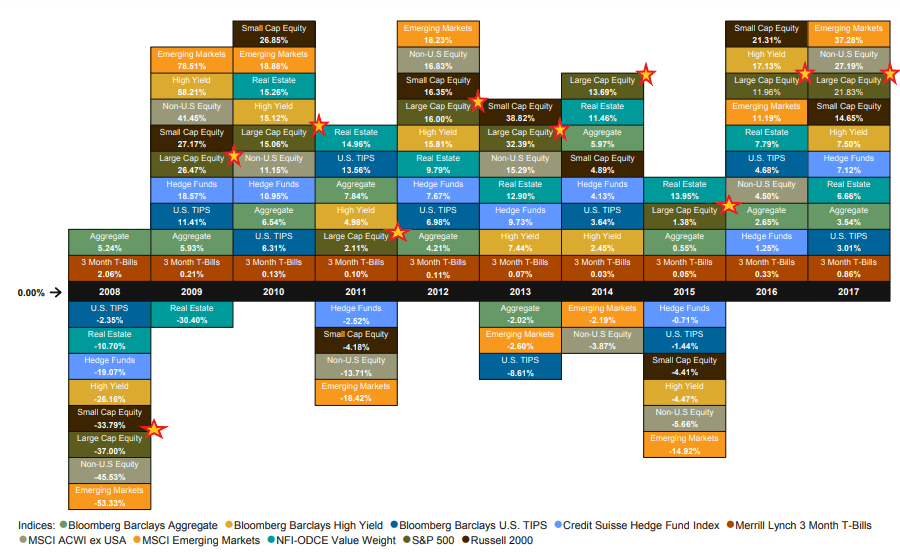
I’m far from the first person to think of investments in this way, in-fact there is deep history in what many refer to as the “Callan Chart” or “Periodic Table of Returns”. Below you’ll see a large majority of the world’s major asset classes and their returns relative to zero:

Callan from Zero

https://www.callan.com/periodic-table/

The most striking thing from this chart is that after a disastrous 2008 for everything except U.S. Bonds (argon), the only asset class that is yet to have a negative year is Large Cap ($10B+) U.S. Stocks (starred).

Winners and Losers

SPY vs ACWI vs EEM

Charlie Bilello via Twitter

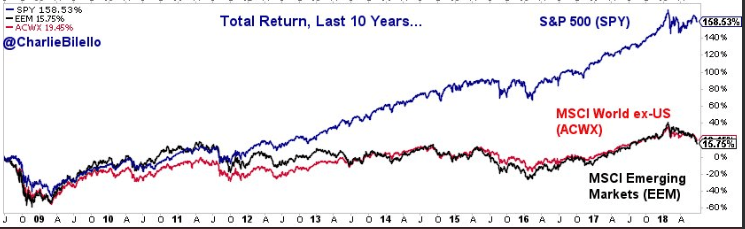
This freedom from negative returns and the compounding of large year-to-year gains has led to outsized outperformance from Large U.S. stocks. Over the last 10 years, Large U.S. stocks have produced cumulative total returns of 158%. Developed Foreign Country stocks have produced 19% and Emerging Markets only 16%.

Two takeaways from this are: the power of compounding positive returns but even more important is the force of losses and the time it takes to make them up. In addition, one recurring theme of study and practice in investing is that asset prices move in cycles. While U.S. outperformance seems like an unbreakable cycle, it’s just a matter of time.

Trading Places

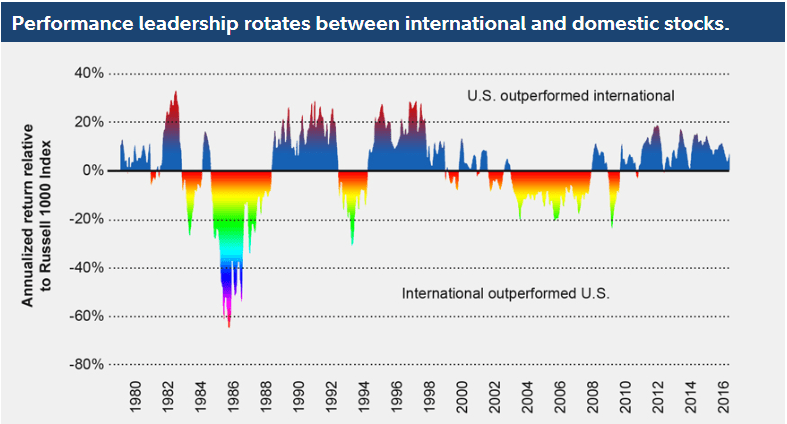
Take a look below at how U.S. and international stock market leadership has traded off over time. Most recently international stocks outperformed from 2003-2009, and the U.S. finds itself on its longest stretch of outperformance since 1979.
Performance Leadership

We have been incrementally positioning our clients’ portfolios for this eventual inflection since 2015. Last year we looked right, this year thus far we look wrong. Personally, I just consider myself patient as I wait for a multi-year trend to unfold.

Whether it’s high prices and valuation concerns or much of the low hanging fruit in our U.S. economic recovery is out of the way, we have a firm conviction in our posture of reducing U.S. stock market exposure. Having said that, we do not have a proverbial crystal ball, therefore we diversify and avoid throwing all of our eggs into the international basket.

Don’t Give up on Bonds

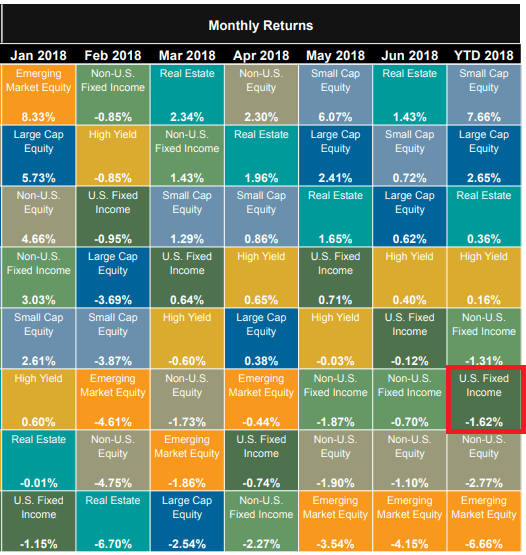
In addition, we haven’t given up on bonds, which have been tough to own this year, with U.S. Bonds down on average -1.62%.


Callan Periodic Table

https://www.callan.com/periodic-table/


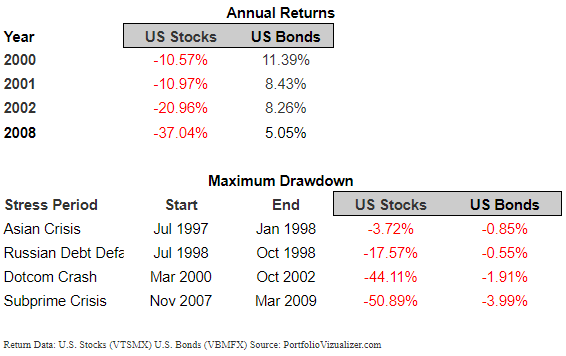
It’s important to keep in mind how bonds have performed during down years for the stock market, something that is potentially in the cards this far into an extended bull market.

bonds vs stocks

One does not need to own the entire U.S. bond market via an index fund or otherwise. We currently prefer shorter term bonds, typically corporate bonds, and even in some cases inflation protected bonds. With a recent uptick in short-term government bonds, they aren’t nearly as painful to hold as in years past when yields hovered near zero. The 2-year treasury currently yields 2.829%, at the time of writing this article.

Late Cycle Playbook

With a backdrop of rising inflation globally, rising rates here in the U.S., accommodative monetary policy globally, and stretched valuations in U.S. equity markets, we continue to prefer assets that tend to outperform late in the economic cycle and when the factors above are present.

These assets include:

  • International and Emerging Market stocks
  • Industrials, Metals, Energy
  • Shorter Term Bonds, TIPS

Signing Off

While we realize this year has been far less exciting than the last, we remain firm in our convictions on how we want to combine elements from the “Periodic Table of Returns” moving forward. We stand at the ready to buy into recent market weakness and will not capitulate to chasing what has done well. We appreciate your continued trust and patience while we navigate through what’s been an unstable first half of 2018. Don’t hesitate to contact our office should you have any questions or concerns about how we are approaching your investments.

Respectfully yours,

Blake Street, CFA, CFP®


Blake StreetBlake Street, CFA, CFP®
Chief Investment Officer
Founding Partner
Warren Street Wealth Advisors

Blake Street is an Investment Advisor Representative of Warren Street Wealth Advisors, a Registered Investment Advisor. Information contained herein does not involve the rendering of personalized investment advice, but is limited to the dissemination of general information. A professional advisor should be consulted before implementing any of the strategies or options presented.

Any investments discussed carry unique risks and should be carefully considered and reviewed by you and your financial professional. Past performance may not be indicative of future results. All investment strategies have the potential for profit or loss. Changes in investment strategies, contributions or withdrawals may materially alter the performance, strategy, and results of your portfolio. Historical performance results for investment indexes and/or categories, generally do not reflect the deduction of transaction and/or custodial charges or the deduction of an investment-management fee, the incurrence of which would have the effect of decreasing historical performance results. Economic factors, market conditions, and investment strategies will affect the performance of any portfolio and there are no assurances that it will match or outperform any particular benchmark. Nothing in this commentary is a solicitation to buy, or sell, any securities, or an attempt to furnish personal investment advice. We may hold securities referenced in the blog and due to the static nature of content, those securities held may change over time and trades may be contrary to outdated posts.