Tag Archive for: global stocks

Introducing Warren Street Global Equity ETF (WSGE) – An Informed Approach to Diversification

We’re thrilled to announce a major milestone for our firm and our clients: the launch of the Warren Street Global Equity ETF (NASDAQ: WSGE)!

This new Exchange-Traded Fund (ETF) is now available, bringing our disciplined investment philosophy to the public in a convenient, accessible format. This is an exciting step forward as we continue to provide sophisticated investment solutions while delivering on our fiduciary commitment.

The Warren Street Wealth Advisors team celebrates the launch with a visit to the NASDAQ MarketSite in Times Square, New York.

What is WSGE and Why Did We Create It?

The Warren Street Global Equity ETF (WSGE) is designed to be a smarter way to invest in the global stock market. The traditional choice has always been either a simple, broad index fund or a complicated, expensive actively managed fund. We created WSGE to give you the best of both worlds: global diversification with a smart strategy built to enhance returns.

Focus on You: The Key Client Benefits

While the investment strategy is robust, the most important reason we created WSGE is to provide direct, tangible benefits to you, our clients, and to uphold our fiduciary standard:

  • Embedded Tax Efficiencies: As an ETF, WSGE is structured to minimize capital gains distributions compared to traditional mutual funds. This powerful tax efficiency helps you keep more of your investment returns, making your portfolio work harder over the long term.
  • Economies of Scale: By bundling diverse global exposures and our proprietary strategy into a single vehicle, we achieve significant economies of scale. This approach reduces complexity and overall costs, effectively providing you with institutional-quality management at a lower expense.
  • Uniformity Across Clients: WSGE ensures every client benefits from the exact same research-driven exposure and proprietary factor tilts. This uniformity across clients leads to greater consistency, streamlined execution, and clearer reporting, regardless of account size.
  • Time Savings & Simplicity: The single-fund structure drastically simplifies trade execution, rebalancing, and overall portfolio maintenance. This provides time savings for both our advisory team and you, the client, allowing us to focus more on your comprehensive financial plan, retirement goals, and tax strategies.

Learn More

When you invest in WSGE, you’re accessing the same level of rigorous due diligence that defines Warren Street Wealth Advisors. We meticulously select the fund’s underlying investments, focusing on quality management, low cost, and alignment with our goals.

We are proud to bring this innovative solution to market and look forward to partnering with you on your journey toward long-term capital appreciation.

To learn more about the fund, view the prospectus, and review important disclosures, please visit warrenstreetetf.com.

Phillip Law, CFA

Senior Portfolio Manager, Warren Street Wealth Advisors

Investment Advisor Representative, Warren Street Wealth Advisors, LLC., a Registered Investment Advisor

The information presented here represents opinions and is not meant as personal or actionable advice to any individual, corporation, or other entity. Any investments discussed carry unique risks and should be carefully considered and reviewed by you and your financial professional. Nothing in this document is a solicitation to buy or sell any securities, or an attempt to furnish personal investment advice. Warren Street Wealth Advisors may own securities referenced in this document. Due to the static nature of content, securities held may change over time and current trades may be contrary to outdated publications. Form ADV available upon request 714-876-6200.
Important Information

The Fund’s investment objectives, risks, charges and expenses must be considered carefully before investing. This and other important information is contained in the prospectus, which may be obtained by following the links Prospectus and Summary Prospectus or by calling +1.714.876.6200. Please read the prospectus carefully before investing.

The Fund is actively-managed and is subject to the risk that the strategy may not produce the intended results. The Fund is new and has a limited operating history to evaluate.

Median 30 Day Spread: is a calculation of Fund’s median bid-ask spread, expressed as a percentage rounded to the nearest hundredth, computed by: identifying the Fund’s national best bid and national best offer as of the end of each 10 second interval during each trading day of the last 30 calendar days; dividing the difference between each such bid and offer by the midpoint of the national best bid and national best offer; and identifying the median of those values.

Basis Points (bps): A unit of measure used in quoting yields, changes in yields or differences between yields. One basis point is equal to 0.01%, or one one-hundredth of a percent of yield and 100 basis points equals 1%.

Equity Investing Risk. An investment in the Fund involves risks similar to those of investing in any fund holding equity securities, such as market fluctuations, changes in interest rates and perceived trends in stock prices. The values of equity securities could decline generally or could underperform other investments. In addition, securities may decline in value due to factors affecting a specific issuer, market or securities markets generally.

Fixed-Income Risk. The market value of fixed-income securities will change in response to interest rate changes and other factors, such as changes in the effective maturities and credit ratings of fixed-income investments. During periods of falling interest rates, the values of outstanding fixed-income securities and related financial instruments generally rise. Conversely, during periods of rising interest rates, the values of such securities and related financial instruments generally decline. Fixed-income investments are also subject to credit risk.

Large-Capitalization Companies Risk. Large-capitalization companies may trail the returns of the overall stock market. Large-capitalization stocks tend to go through cycles of doing better – or worse – than the stock market in general. These periods have, in the past, lasted for as long as several years.

Mid-Capitalization Companies Risk. Investing in securities of mid-capitalization companies involves greater risk than customarily is associated with investing in larger, more established companies. These companies’ securities may be more volatile and less liquid than those of more established companies. Often mid-capitalization companies and the industries in which they focus are still evolving and, as a result, they may be more sensitive to changing market conditions.

Depositary Receipt Risk. ADRs and GDRs are generally subject to the risks of investing directly in foreign securities and, in some cases, there may be less information available about the underlying issuers than would be the case with a direct investment in the foreign issuer. ADRs are U.S. dollar-denominated receipts representing shares of foreign-based corporations. GDRs are similar to ADRs but are shares of foreign-based corporations generally issued by international banks in one or more markets around the world.

Risk of Investing in Other ETFs. Because the Fund may invest in Underlying ETFs, the Fund’s investment performance is impacted by the investment performance of the selected Underlying ETFs. An investment in the Fund is subject to the risks associated with the Underlying ETFs that then-currently comprise the Fund’s portfolio. At times, certain of the segments of the market represented by the Fund’s Underlying ETFs may be out of favor and underperform other segments.

Focus Investing Risk. The Fund seeks to hold the stocks of approximately 40 companies. As a result, the Fund invests a high percentage of its assets in a small number of companies, which may add to Fund volatility.

Foreign Investment Risk. Returns on investments in foreign securities could be more volatile than, or trail the returns on U.S. securities. Investments in or exposures to foreign securities are subject to special risks,  including differences in information available about issuers of securities and investor protection standards. In addition, foreign securities denominated in other currencies could decline due to changes in local currency.

Factor-Based Investing Risk. There can be no assurance that the factor-based investment selection process employed by the Sub-Adviser will enhance the Fund’s performance. Exposure to the different investment cycles identified by the Sub-Adviser may detract from the Fund’s performance in some market environments.

ETFs may trade at a premium or discount to their net asset value. ETF shares may only be redeemed at NAV by authorized participants in large creation units. There can be no guarantee that an active trading market for shares will exist. The trading of shares may incur brokerage.

This material has been distributed for informational purposes only and should not be considered as investment advice or a recommendation of any particular security, strategy or investment product. We make no representation or warranty as to the accuracy or completeness of the information contained herein including third-party data sources. The views expressed are as of the publication date and subject to change at any time. No part of this material may be reproduced in any form, or referred to in any other publication without express written permission. References to other funds should not to be interpreted as an offer or recommendation of these securities.

An investment in the Fund involves risk, including possible loss of principal. Exchange-traded funds (ETFs) trade like stocks, are subject to investment risk, fluctuate in market value and may trade at prices above or below the ETF’s net asset value (NAV), and are not individually redeemable directly with the ETF. Brokerage commissions and ETF expenses will reduce returns. ETFs are subject to specific risks, depending on the nature of the underlying strategy of the Fund, which should be considered carefully when making investment decisions. For a complete description of the Fund’s principal investment risks, please refer to the prospectus.

Shares of the Funds Are Not FDIC Insured, May Lose Value, and Have No Bank Guarantee.

The Fund is distributed by PINE Distributors LLC. The Fund’s investment adviser is Empowered Funds, LLC, which is doing business as ETF Architect. Warren Street Wealth Advisors, LLC serve as the Sub-advisers to the Fund. PINE Distributors LLC is not affiliated with ETF Architect or Warren Street Wealth Advisors, LLC. Learn more about PINE Distributors LLC at FINRA’s BrokerCheck.

ETFAC-4941235-10/25

Fighter Planes and Market Turmoil

Have you been reading the daily headlines—watching markets stall, recover, and dip once again? If so, you may be wondering whether there’s anything you can do to avoid the motion sickness. 

If you already have a well-structured, globally diversified portfolio tailored for your goals and risk tolerances, our answer remains the same as ever: Your best course is to stay the course. Remember, our investment advice is aimed at helping you successfully complete your long-term financial journey. As “The Psychology of Money” author Morgan Housel has observed:  

“Bubbles do their damage when long-term investors playing one game start taking their cues from those short-term traders playing another.”

The Case of the Missing Bullet Holes

Have we ever told you the tale of the World War II fighter jets and their “missing” bullet holes? Today’s bumpy market ride seems like a good time to revisit this interesting anecdote about survivorship bias. 

The story stems from studies conducted during World War II on how to best fortify U.S. bomber planes against enemy fire. Initially, analysts focused on where the returning bombers’ hulls had sustained the most damage, assuming these were the areas requiring extra protection. Fortunately, before the planes were overhauled accordingly, statistician Abraham Wald improved on the evidence. He suggested, because the meticulously examined planes were the survivors, the extra fortification should be applied where they had fewer, not more bullet holes. 

How so? Wald explained, the surviving planes’ bullet-free zones were not somehow impervious to attack. Rather, when those zones were getting hit, those planes weren’t making it back at all. Survivorship bias had blinded earlier analyses to the defenses that mattered the most. 

Surviving Market Turbulence

You can think about the markets in similar fashion. For example, consider these recent predictions from a well-known market forecaster (emphasis ours): 

“Jeremy Grantham, the famed investor who for decades has been calling market bubbles, said the historic collapse in stocks he predicted a year ago is underway and even intervention by the Federal Reserve can’t prevent an eventual plunge of almost 50%.” 

ThinkAdvisor, January 20, 2022

At a glance, that sounds pretty grim. But read between the lines for a hidden insight: He was also predicting the same collapse a year ago??? Yes, he was: 

“Renowned investor Jeremy Grantham, who correctly predicted the Japanese asset price bubble in 1989, the dot-com bubble in 2000 and the housing crisis in 2008, is ‘doubling down’ on his latest market bubble call.” 

ThinkAdvisor, January 5, 2021

What if you had heeded Grantham’s forecasts a year ago, and left the market in January 2021? Time has informed us, you would have missed out on some of the strongest annual returns the U.S. stock market has delivered in some time. 

Now What?

If market volatility continues or worsens, brace yourself. You’re going to be bombarded with similar predictions. Few will be bold enough to foretell the exact timing, but the implications will be: (1) it’s going to happen soon, and (2) you should try to get out before it’s too late. 

Some of these forecasts may even end up being correct. Bear markets happen, so anyone who regularly forecasts their imminent arrival will occasionally get it right. Like a stopped clock. Or those continually looping infomercials on how “now” is the best time to load up on silver or gold. (Incidentally, many of these same precious metal purveyors are among those routinely predicting the end is near for efficient markets.)  

Bouts of market volatility are like the bullet holes we can see. They’re not pretty or fun. But interim volatility isn’t usually your biggest threat … attempting to avoid it is. The preparations we’ve already made may be less obvious, but they’re there—including tilting a portion of your portfolio into riskier sources of expected return for long-term growth, fortifying these positions with stabilizing fixed income, and shoring up the entire structure with global diversification. 

This brings us to the real question: What should you do about today’s news? Unless your personal financial goals have changed, your best course is probably the one you’re already on. That said, we remain available, as always, to speak with you directly. Don’t hesitate to be in touch with any questions or comments you may have. 

Phillip Law, Portfolio Analyst

Wealth Advisor, Warren Street Wealth Advisors

Investment Advisor Representative, Warren Street Wealth Advisors, LLC., a Registered Investment Advisor

The information presented here represents opinions and is not meant as personal or actionable advice to any individual, corporation, or other entity. Any investments discussed carry unique risks and should be carefully considered and reviewed by you and your financial professional. Nothing in this document is a solicitation to buy or sell any securities, or an attempt to furnish personal investment advice. Warren Street Wealth Advisors may own securities referenced in this document. Due to the static nature of content, securities held may change over time and current trades may be contrary to outdated publications. Form ADV available upon request 714-876-6200.
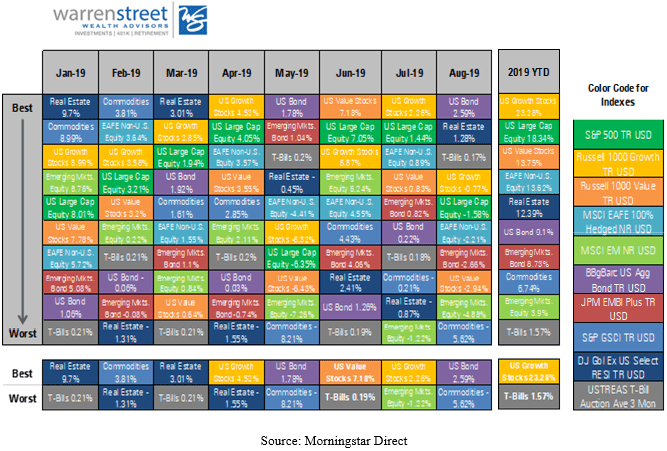
August market commentary

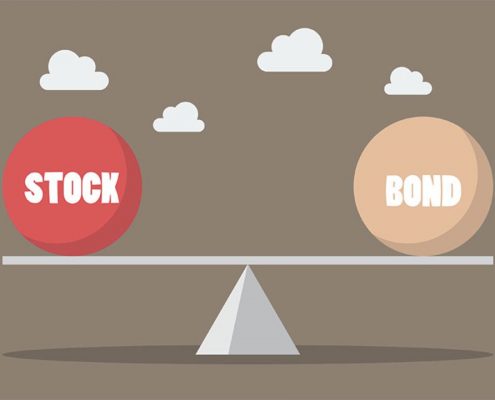
In an uncertain market environment, which is better?

The U.S. stock market feasts on recession fears before regaining its risk appetite in late August

Key Takeaways

  • President Trump added, then delayed, another tariff on Chinese goods, exacerbating trade tensions and concerns about the strength of the global economy. As talks with China resume, Britain’s new prime minister attempts to achieve a ‘hard Brexit’, and the Eurozone PMI index falls into contraction territory.
  • The U.S. economic menu included something for everyone: for the pessimist, softer than expected gain in overall jobs with only 130,000 payroll growth in August. For the optimist, the broader measure of civilian employment surged by 590,000. Manufacturing remains a worry as contraction in that sector continues. Despite the generally stable U.S. economy, the Fed cut rates by -0.25% in July and is expected to cut again in September.
  • Conclusion: Tariffs and political uncertainty are depressing an already delicate global appetite for risk. The U.S. is buffered by its large domestic market and expanding trade with alternative suppliers, but isn’t immune to a global slowdown. Lower interest rates may provide a brief energy boost, but won’t develop core strength in business investment. With no political solution in sight, prudent investors should diversify exposure to provide a steady diet of modest returns while avoiding the binge/purge cycle of ‘chasing yield’.

Stocks are near record levels, but investors are uneasy

4Q2019 repeats 4Q2018?

As reported in the Wall Street Journal on September 9, despite a buoyant stock market so far this month, some investors fear the market may repeat the ‘binge and purge’ cycle experienced in 2018.

Looking as far back as 1928, September is historically the worst month of the year.[1] Given that most of the tensions which led to the market tumble last year are still present – trade tensions, global manufacturing slowdown, falling growth of corporate profits, and political uncertainty at home and abroad – concern may be warranted. Combine these headwinds with diminishing marginal returns from accommodative monetary policy, and we might finally be nearing the end of the longest economic expansion in recent memory. Not that we’re calling for a recession! Just that the growth engines of the global economy are beginning to run out of fuel.

[1] https://www.wsj.com/articles/stocks-are-back-near-records-but-memories-of-2018-leave-investors-uneasy-11568021402

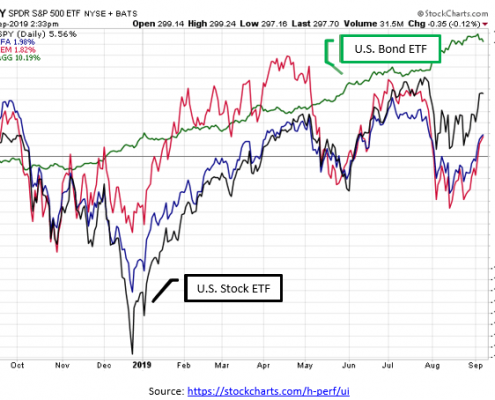
Bonds have been a dietary staple during stock market volatility in recent quarters.

Despite the S&P 500 posting a year-to-date return of nearly 20% as of August 31st, bonds have actually outpaced stocks for the trailing 12-months. The severe tumble of the stock market in late 2018 and again in late July/early August gobbled up more losses than the 2019 recovery has been able to replenish. This despite continuing strength in the U.S. economy and corporate earnings generally surprising on the upside of – admittedly cautious – analyst expectations.

The Fed’s rate cut at the end of July sparked an increase in recession fears, though economic data remains modestly positive.

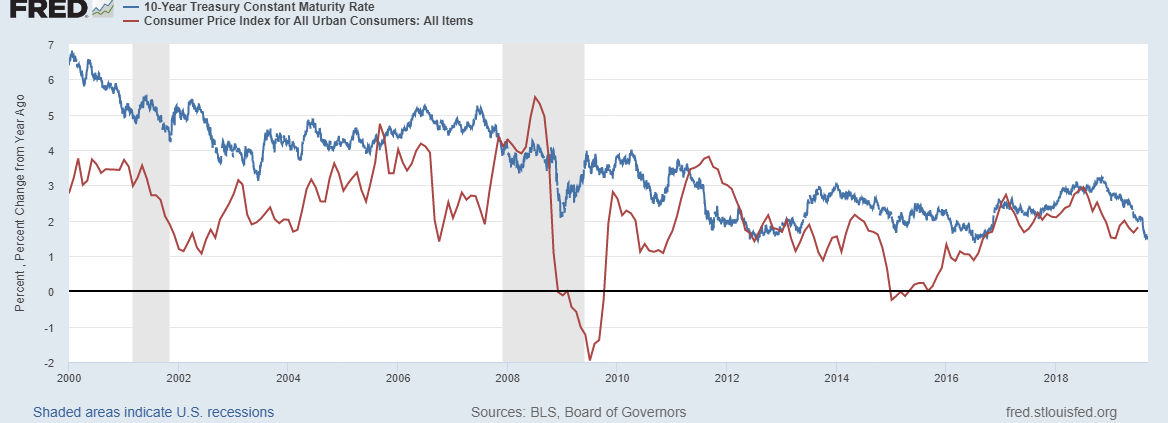
10-year Treasury yield barely above inflation

Decreasing short-term interest rates are unlikely to spark business appetites for borrowing or lending. While 2% short-term rates are great for speculators, they aren’t that much more enticing than 2.25% or 2.50% interest rates for strategic business investments. In fact, 10-year Treasury bond yields dropped so low in September that they provided no more than 0.25% returns above inflation. While marginal borrowers may consume more debt at these rates, long-term investors will need to look beyond the safest assets for a risk/reward balance that preserves purchasing power while promoting healthy growth.

Manufacturing businesses suffer from a restrictive diet of trade tariffs and global uncertainty.

While the U.S. economy overall remains on solid footing, trade-related businesses are hungry.

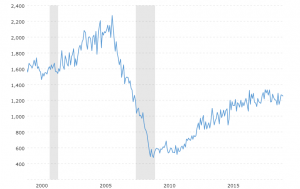
Housing starts stabilize

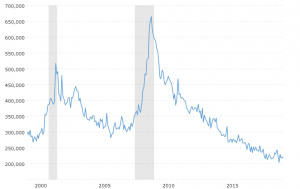
Jobless claims remain low

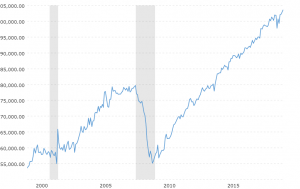
Retail sales rebound

Housing starts are stable, retail sales have rebounded, and initial claims for unemployment are the lowest in more than a decade…


…but U.S. manufacturers are in desperate need of an economic shot of Red Bull.

Rising global trade tensions in the wake of U.S. tariffs on steel, aluminum, and lumber imports, as well as those targeted specifically at China, are directly impacting manufacturing activity. According to the National Association for Business Economics (NABE)[1], 76% of goods-producing sector panelists and 42% of TUIC (transportation, utilities, information, communications) panelists reported negative net tariff impacts at their companies.

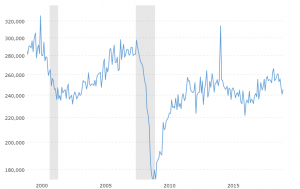
This impact is illustrated by the significant drop in durable goods orders over the past year or so.

Durable goods orders fall sharply

[2] https://nabe.com/NABE/Surveys/Business_Conditions_Surveys/July_2019_Business_Conditions_Survey_Summary.aspx

[Preceding charts source www.macrotrends.net]

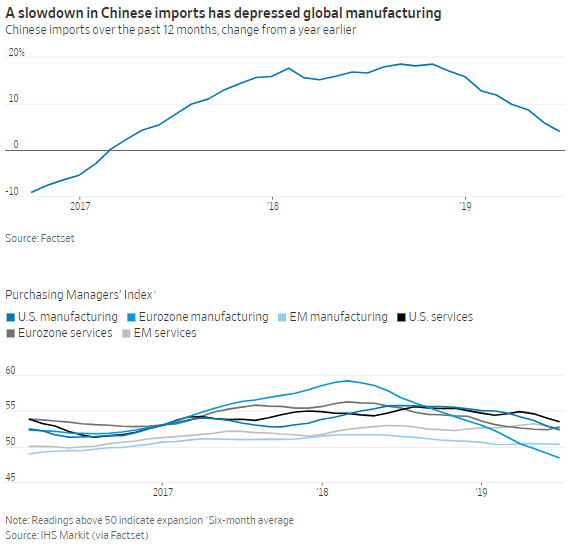
Increasing tariffs are not just eating the lunch of U.S. manufacturing companies. Global exporters are suffering greatly from decreased trade around the world. If we look back at the recovery from the Great Recession, emerging economies such as China are credited with helping the developed world get back on its feet. China in particular built roads, airports, and housing developments with abandon, which boosted earnings for global manufacturing companies, particularly steel and machinery.

But the Chinese economy has had its fill of infrastructure spending, reducing its appetite for imported goods going forward. Combined with the trade war between China and the U.S., exporters have lost a major customer. Eurozone manufacturers have already fallen into ‘contraction’ territory (PMI below 50), and the rest of the world isn’t much better.[3] And Fed Chairman Powell, if you’re listening, lower interest rates won’t have any effect on this trend! No matter how low rates go, businesses won’t go back to the buffet table when demand for their products is already satisfied.

[3] https://www.wsj.com/articles/chinas-power-to-boost-global-economy-is-fading-11564738205?mod=article_inline

Slowdown in China depresses global manufacturing

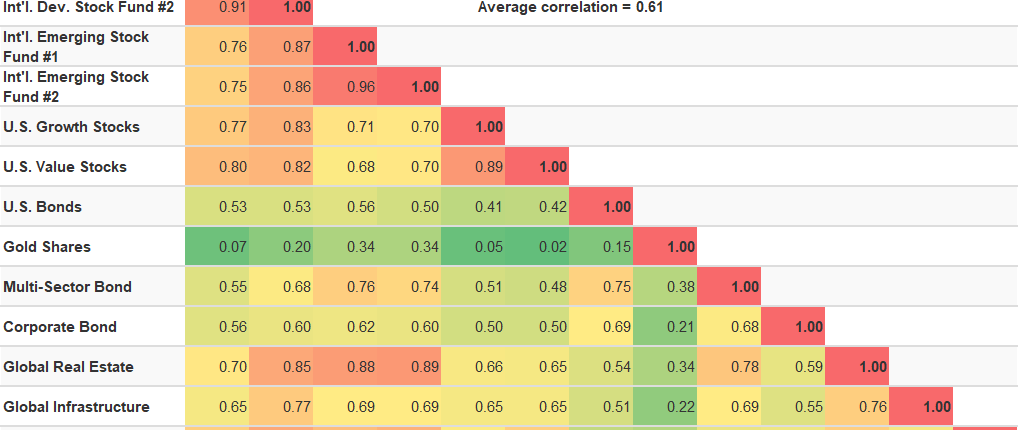
In an uncertain global economic environment with a reactionary U.S. stock market, diversification is even more important.

Barring major disruptions in trade negotiations, a disorderly ‘Brexit’, or increases in geopolitical unrest, the U.S. stock and bond markets could continue on their upward path for the rest of the year.

That being said, the chance of one of these elements going wrong is significant. Investors should continue to make healthy investment decisions to navigate this uncertain period. The best way to do this is to diversify.

Source: www.portfoliovizualizer.com

A balanced menu of stocks, bonds, and alternative asset classes such as natural resources can provide welcome reduction in volatility while still supporting the pursuit of gains suitable for most investors’ appetites. Which isn’t to say even the most well-diversified investors won’t experience some indigestion along the way! But putting your investment eggs in several market baskets can avoid catastrophic losses and help you achieve a healthy balance of risk and return over the long term.

Marcia Clark, CFA, MBA

Senior Research Analyst, Warren Street Wealth Advisors


DISCLOSURES

Investment Advisor Representative, Warren Street Wealth Advisors, LLC., a Registered Investment Advisor

The information presented here represents opinions and is not meant as personal or actionable advice to any individual, corporation, or other entity. Any investments discussed carry unique risks and should be carefully considered and reviewed by you and your financial professional. Nothing in this document is a solicitation to buy or sell any securities, or an attempt to furnish personal investment advice. Warren Street Wealth Advisors may own securities referenced in this document. Due to the static nature of content, securities held may change over time and current trades may be contrary to outdated publications.

Form ADV available upon request 714-876-6200

Periodic Table of Investing

Periodic Table of Investing

Dust off your memories of high school chemistry and think of your investment returns and your investment risks as two separate and distinct members of the periodic table. Certain elements (in this case, securities) are prone to interact when mixed, while others may remain neutral. Each element (security) will always have its own separate and unique profile and characteristics.

Starting with carbon, one of the world’s most important elements, I’d equate carbon to U.S. stocks. Regardless of age, every investor we work with has likely benefited from or utilized this element and will continue to do so in some capacity going forward.

Argon, the world’s least reactive element, tends to be more akin to Treasury Bonds or cash, not responding negatively to volatility much, if at all.

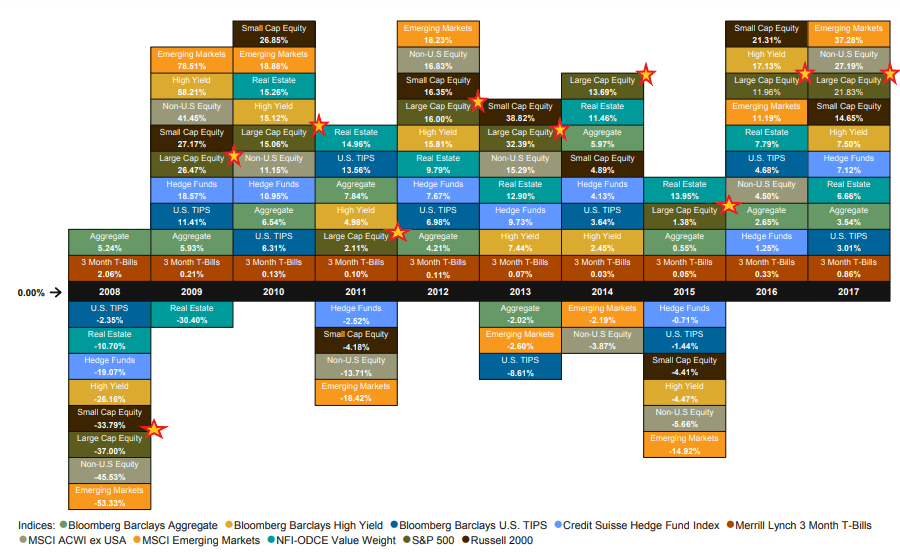
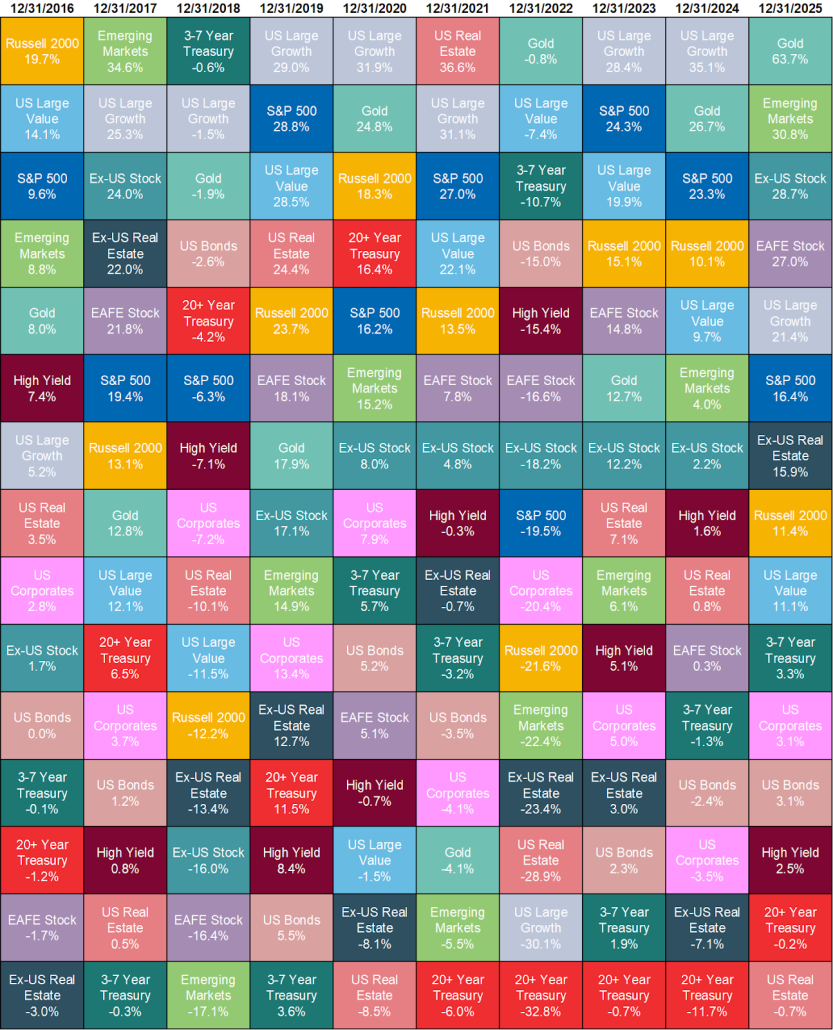
I’m far from the first person to think of investments in this way, in-fact there is deep history in what many refer to as the “Callan Chart” or “Periodic Table of Returns”. Below you’ll see a large majority of the world’s major asset classes and their returns relative to zero:

Callan from Zero

https://www.callan.com/periodic-table/

The most striking thing from this chart is that after a disastrous 2008 for everything except U.S. Bonds (argon), the only asset class that is yet to have a negative year is Large Cap ($10B+) U.S. Stocks (starred).

Winners and Losers

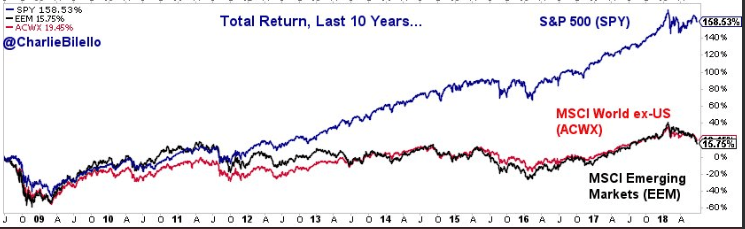
SPY vs ACWI vs EEM

Charlie Bilello via Twitter

This freedom from negative returns and the compounding of large year-to-year gains has led to outsized outperformance from Large U.S. stocks. Over the last 10 years, Large U.S. stocks have produced cumulative total returns of 158%. Developed Foreign Country stocks have produced 19% and Emerging Markets only 16%.

Two takeaways from this are: the power of compounding positive returns but even more important is the force of losses and the time it takes to make them up. In addition, one recurring theme of study and practice in investing is that asset prices move in cycles. While U.S. outperformance seems like an unbreakable cycle, it’s just a matter of time.

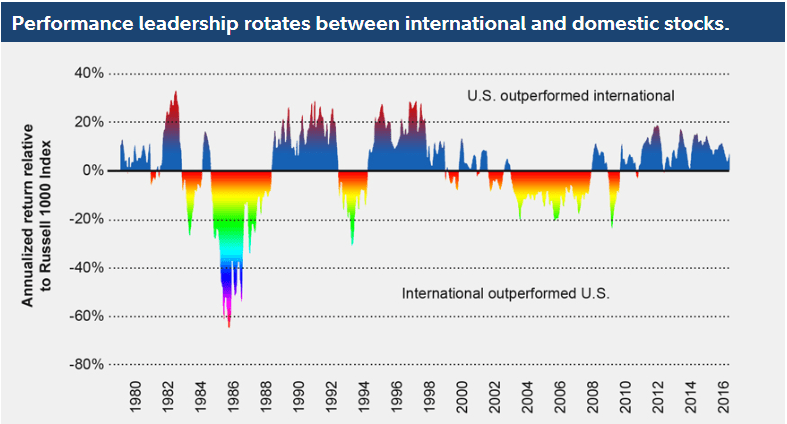
Trading Places

Take a look below at how U.S. and international stock market leadership has traded off over time. Most recently international stocks outperformed from 2003-2009, and the U.S. finds itself on its longest stretch of outperformance since 1979.
Performance Leadership

We have been incrementally positioning our clients’ portfolios for this eventual inflection since 2015. Last year we looked right, this year thus far we look wrong. Personally, I just consider myself patient as I wait for a multi-year trend to unfold.

Whether it’s high prices and valuation concerns or much of the low hanging fruit in our U.S. economic recovery is out of the way, we have a firm conviction in our posture of reducing U.S. stock market exposure. Having said that, we do not have a proverbial crystal ball, therefore we diversify and avoid throwing all of our eggs into the international basket.

Don’t Give up on Bonds

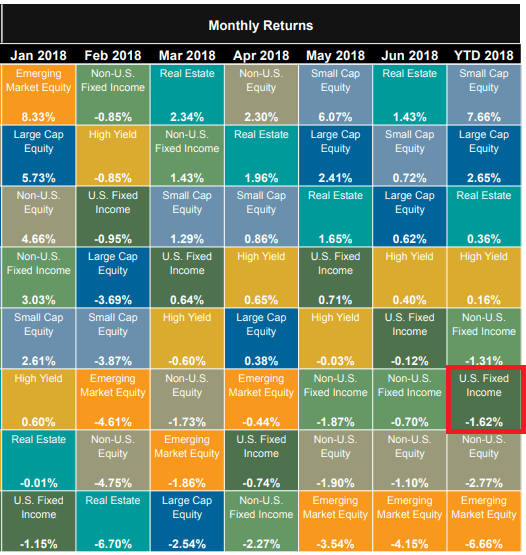
In addition, we haven’t given up on bonds, which have been tough to own this year, with U.S. Bonds down on average -1.62%.


Callan Periodic Table

https://www.callan.com/periodic-table/


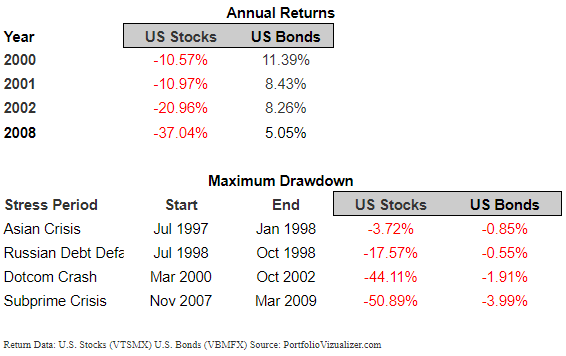
It’s important to keep in mind how bonds have performed during down years for the stock market, something that is potentially in the cards this far into an extended bull market.

bonds vs stocks

One does not need to own the entire U.S. bond market via an index fund or otherwise. We currently prefer shorter term bonds, typically corporate bonds, and even in some cases inflation protected bonds. With a recent uptick in short-term government bonds, they aren’t nearly as painful to hold as in years past when yields hovered near zero. The 2-year treasury currently yields 2.829%, at the time of writing this article.

Late Cycle Playbook

With a backdrop of rising inflation globally, rising rates here in the U.S., accommodative monetary policy globally, and stretched valuations in U.S. equity markets, we continue to prefer assets that tend to outperform late in the economic cycle and when the factors above are present.

These assets include:

  • International and Emerging Market stocks
  • Industrials, Metals, Energy
  • Shorter Term Bonds, TIPS

Signing Off

While we realize this year has been far less exciting than the last, we remain firm in our convictions on how we want to combine elements from the “Periodic Table of Returns” moving forward. We stand at the ready to buy into recent market weakness and will not capitulate to chasing what has done well. We appreciate your continued trust and patience while we navigate through what’s been an unstable first half of 2018. Don’t hesitate to contact our office should you have any questions or concerns about how we are approaching your investments.

Respectfully yours,

Blake Street, CFA, CFP®


Blake StreetBlake Street, CFA, CFP®
Chief Investment Officer
Founding Partner
Warren Street Wealth Advisors

Blake Street is an Investment Advisor Representative of Warren Street Wealth Advisors, a Registered Investment Advisor. Information contained herein does not involve the rendering of personalized investment advice, but is limited to the dissemination of general information. A professional advisor should be consulted before implementing any of the strategies or options presented.

Any investments discussed carry unique risks and should be carefully considered and reviewed by you and your financial professional. Past performance may not be indicative of future results. All investment strategies have the potential for profit or loss. Changes in investment strategies, contributions or withdrawals may materially alter the performance, strategy, and results of your portfolio. Historical performance results for investment indexes and/or categories, generally do not reflect the deduction of transaction and/or custodial charges or the deduction of an investment-management fee, the incurrence of which would have the effect of decreasing historical performance results. Economic factors, market conditions, and investment strategies will affect the performance of any portfolio and there are no assurances that it will match or outperform any particular benchmark. Nothing in this commentary is a solicitation to buy, or sell, any securities, or an attempt to furnish personal investment advice. We may hold securities referenced in the blog and due to the static nature of content, those securities held may change over time and trades may be contrary to outdated posts.