New Year, New Tax Considerations: What You Need to Know Before Filing Your 2025 Taxes

Filing your tax return may feel routine. But the devil is in the details, as they say, and those details have a pesky habit of shifting from year to year. The 2025 tax year is a good example: Rule changes this year include both incremental adjustments and larger shifts stemming from the One Big Beautiful Bill Act (OBBBA), passed in July. Understanding these changes now can help you maximize deductions, spot planning opportunities and avoid surprises when you file.

A Boost for Traditional Deductions

The OBBBA made several taxpayer-friendly provisions permanent, starting with a higher standard deduction. For 2025, the standard deduction rises to $15,750 for single filers, up from $15,000 in 2024. For married couples filing jointly, the deduction increases to $31,500, up from $30,000.

The legislation also expanded the Child Tax Credit, raising it to $2,200 per qualifying child, compared with $2,000 under prior law.

Brand New Tax Deductions

The OBBBA introduced several new deductions to be on the lookout for: 

  • Personal deduction for seniors: If you were born before Jan. 2, 1961, you can take a $6,000 deduction ($12,000 if married filing jointly) in addition to your standard or itemized deduction. This deduction is phased out if your modified adjusted gross income (MAGI) is between $75,000 ($150,000 for joint filers) and $175,000 ($250,000 for joint filers). 
  • Tax deduction for tips and overtime pay: The Trump administration has described these provisions as “no tax” on tips and overtime, but that framing oversimplifies how the new code works. In practice, there is now a deduction for voluntary cash or charged tips earned in industries where tipping is customary. From 2025 through 2028, eligible single filers can deduct up to $25,000 in tipped income, though the deduction begins to phase out for individuals with MAGI above $150,000.

    A similar deduction applies to a portion of qualified overtime pay from 2025 through 2028. In most cases, this refers only to the premium portion of overtime—for example, the extra “half” in “time-and-a-half” pay—rather than the worker’s full hourly wage. For single filers, the deduction is capped at $12,500 of eligible compensation for those with MAGI below $150,000. The deduction is phased out above that amount and is zeroed out once above $275,000.
  • Car loan interest deduction: If you financed the purchase of a new vehicle in 2025, you may be eligible to deduct up to $10,000 in interest paid on that loan. But here’s the fine print: The vehicle must be for personal use, and it must have been built in the United States. To determine if your car fits the bill, look at your vehicle identification number (VIN). Cars built in the United States will have a VIN that starts with a 1, 4 or 5. The cap also phases out for single filers with MAGI above $100,000.

    In future years, lenders will be required to report auto loan interest payments directly to both taxpayers and the IRS. For this year, you may need to do a little digging through your loan statements, or you can request a summary of interest paid from your lender.

Gift and Estate Tax Exemptions

The OBBBA gave some much-needed clarity to a crucial estate planning rule. The lifetime estate and gift tax exemption was previously scheduled to sunset at the end of the year, which would have reduced the exemption from nearly $14 million to about $6 million. Instead, the higher exemption has been made permanent. Here’s where things stand now:

  • The estate and gift tax exemption is $13.99 million for 2025 and is scheduled to rise to $15 million in 2026.
  • The annual gift tax exclusion is $19,000 per recipient in 2025 and will remain at that level in 2026.

While it’s too late to make a tax-free gift for 2025, now is a good time to begin planning gifting strategies for 2026.

Tax Reporting on Cryptocurrency 

Beginning in 2025, the IRS now requires that crypto transactions are reported. If you sold or exchanged digital assets on a platform such as Coinbase, you should receive a Form 1099-DA. a new tax form created specifically for digital assets. Capital gains taxes may apply to crypto sales and trades. It’s also worth noting that digital currencies may be taxed as ordinary income if you receive them as payment.

It’s Not Too Late to Fund Your IRA

Your window for 2025 401(k) contributions closed at the end of the year. But if you want to pad your traditional or Roth IRA with 2025 contributions, you can do so up until the April 15 filing deadline. The contribution limit for IRAs is $7,000, but you can save an additional $1,000 if you’re 50 or older.

Planning Ahead Matters 

The impact of these changes depends on your income, filing status and long-term goals. Take time now to review your situation, gather the right documentation and coordinate tax decisions with your broader financial plan to make most of the current rules. And if you have any questions, we’re here to help bring clarity and confidence as you head into the filing season.

Ernest Jones, CPA

Director of Tax, Warren Street Wealth Advisors

Investment Advisor Representative, Warren Street Wealth Advisors, LLC., a Registered Investment Advisor

This is for informational purposes only and is not meant to be construed as tax advice. Please consult your accountant for advice or to review any recommendation herein. The information presented here represents opinions and is not meant as personal or actionable advice to any individual, corporation, or other entity. Any investments discussed carry unique risks and should be carefully considered and reviewed by you and your financial professional. Nothing in this document is a solicitation to buy or sell any securities, or an attempt to furnish personal investment advice. Warren Street Wealth Advisors may own securities referenced in this document. Due to the static nature of content, securities held may change over time and current trades may be contrary to outdated publications. Form ADV available upon request 714-876-6200.


How Much Do I Need to Retire in 2026?

A few years ago, ads from financial services companies asked, “What’s your number?” The “number” represented the amount of money you needed to retire comfortably. There are, of course, various approaches to estimating your retirement “number,” all of which are influenced by your goals and factors, such as your expected retirement age and the lifestyle you hope to maintain in retirement. So, while this question may have been an effective way to spark conversations about retirement, we believe that it doesn’t paint the complete picture.

Retirement isn’t just about reaching a specific monetary goal. It also involves creating a comprehensive strategy that looks to optimize your various savings vehicles, each playing a different role in your retirement income approach. It also means factoring in healthcare costs, thinking about the legacy you wish to leave, and being flexible enough to adapt to life’s unexpected twists and turns. Ultimately, your strategy needs to consider how your assets will work together to fund the retirement you envision.

An essential part of orchestrating your retirement income strategy is determining which assets to take and in which order. 

There is no one-size-fits-all answer, but some general guidelines can help when you are starting to think about a withdrawal strategy.

For example, one approach to consider is withdrawing money from taxable accounts first, then tax-deferred, then tax-exempt. By using taxable money first, you can avoid paying taxes as long as possible with tax-deferred investments. And your tax-exempt accounts remain tax-exempt for a longer period. Ultimately, your decision will be influenced by a wide range of other considerations, including withdrawal fees, surrender charges, and other costs that may be associated with each specific account. But when possible, consider using the power of tax deferral and tax exemption to your advantage. 

Regardless of your age or financial position, having a well-thought-out retirement strategy is one of the most critical actions you can take. If you would like to review your current strategy, please contact our office. We’re here for you!

Emily Balmages, CFP®

Director of Financial Planning, Warren Street Wealth Advisors

Investment Advisor Representative, Warren Street Wealth Advisors, LLC., a Registered Investment Advisor

The information presented here represents opinions and is not meant as personal or actionable advice to any individual, corporation, or other entity. Any investments discussed carry unique risks and should be carefully considered and reviewed by you and your financial professional. Nothing in this document is a solicitation to buy or sell any securities, or an attempt to furnish personal investment advice. Warren Street Wealth Advisors may own securities referenced in this document. Due to the static nature of content, securities held may change over time and current trades may be contrary to outdated publications. Form ADV available upon request 714-876-6200.

Five Behavioral Finance Resolutions for a Better Financial Year

As the old year draws to a close and a new one begins, millions of Americans will once again make New Year’s resolutions. For many, these resolutions focus on health or wealth, and when it comes to financial resolutions, the usual suspects tend to surface: spend less, save more and pay down debt.

These are, of course, worthwhile goals. But this year, consider adding another set of resolutions that go beyond budgeting and focus on the behavioral tendencies that shape—and sometimes sabotage—financial decision-making. In the year ahead, consider the following behavioral resolutions to help you make sound financial choices.

Dial Down Your Emotions

Emotions often move faster than logic. They can override rational thinking and push you toward decisions that may feel good in the moment but undermine long-term financial health. This year, resolve to take emotion out of investing. 

Separating feelings from financial choices can help you sidestep several potentially damaging behavioral biases, including loss aversion. This is the tendency for investors to fear losses more than they value gains. This bias can lead to panic selling in volatile markets, potentially causing you to lock in losses and miss market rebounds. Alternatively, it could cause you to hold onto losing positions far too long, making you unwilling to cut your losses even when it is financially beneficial to do so. 

Emotional investing can also fuel home bias, the instinct to stick with what’s familiar to you. Maybe that’s a certain company or an industry you know well. Or maybe it’s focusing on U.S. stocks to the exclusion of shares of international companies. Instead, practice viewing your investments not as extensions of your preferences or identity, but simply as the tools that are helping you reach your long-term objectives. 

Get a Second Opinion

Every once in a while, you may be tempted to alter your long-term financial plan. Before pulling the trigger, it pays to seek a second opinion. Expert counsel can help rein in a pair of common behavioral biases: overconfidence and confirmation bias

Overconfidence bias is the tendency for investors to believe they know more than they do or can predict outcomes with greater accuracy than is likely possible. The danger here is it might lead to risky behaviors like trying to time the market or going big on what they think is a can’t-miss investment opportunity. 

Meanwhile, confirmation bias is the tendency to seek out only information that supports existing beliefs. This can land you in an echo chamber where it’s hard to tell whether an investment decision is a good idea or not. 

Seeking outside advice helps you pressure-test ideas, reveal assumptions you may have missed and move forward with greater clarity.

Keep an Open Mind

Financial markets evolve constantly. Rigid thinking increases the risk of missing potential opportunities or holding onto investments that are no longer serving you.

Keeping an open mind helps you stay adaptable and able to reevaluate long-held assumptions and adjust when new information emerges. This helps counter status quo bias, the impulse to stick with the current situation purely because it’s familiar and what’s already happening. It also helps avoid anchoring, the tendency to rely too heavily on the first piece of information encountered. For example, investors might anchor to the original price of a stock, using it as a benchmark for future decisions—such as when to buy and sell—rather than focusing on other, more relevant information.

Look at Things From Different Angles

How information is presented can dramatically shift how we interpret it. The same facts can feel very different depending on how they’re presented. Marketers, pundits and headline writers understand this well; it’s one of the ways they can make news seem sensational.

But before accepting something as true, especially in finance, it’s useful to examine it from multiple angles. Seek out contrarian viewpoints, reframe the story and ask yourself what the opposite case might look like.

This approach helps guard against framing bias, where decisions are influenced by how information is presented rather than what the information actually says. For example, a fund described as having a “5% chance of loss” might feel riskier than one described as having a “95% chance of success,” even though both statements describe the same probability.

Stepping back, asking questions and challenging your first interpretation can lead to better, more balanced decisions.

Start a Media Diet

Today’s information ecosystem is noisy, fragmented and optimized to snag your attention. Headlines are crafted to provoke emotion, and social media feeds tend to amplify the sensational. 

A media diet can help restore balance. You don’t have to disengage entirely, but you may want to limit exposure to influencers offering unvetted advice, sticking instead to outlets with strong editorial standards. Part of a healthy media diet also involves resisting the urge to check the market every day. Your long-term strategy doesn’t require play-by-play updates.

A healthier personal media environment helps curb availability bias, where recent or highly publicized events distort your perception of risk. It also combats recency bias, which leads investors to overweight the latest market movements. And by lowering exposure to trending narratives, it limits the pull of herding—the impulse to follow the crowd, chasing whatever big name is dominating the week’s headlines.

Mastering Your Mindset

Good financial decision-making is largely about controlling behavioral impulses. Being more deliberate about how you think—less emotional, more open-minded and more balanced in how you consume information—can put you in a better position to stay focused on what truly matters: your long-term goals and the plan designed to help you meet them. 

If you ever have any questions or want to talk more about how to put these principles into practice, reach out, and we’d be happy to talk. 

Veronica Cabral

Wealth Advisor, Warren Street Wealth Advisors

Investment Advisor Representative, Warren Street Wealth Advisors, LLC., a Registered Investment Advisor

The information presented here represents opinions and is not meant as personal or actionable advice to any individual, corporation, or other entity. Any investments discussed carry unique risks and should be carefully considered and reviewed by you and your financial professional. Nothing in this document is a solicitation to buy or sell any securities, or an attempt to furnish personal investment advice. Warren Street Wealth Advisors may own securities referenced in this document. Due to the static nature of content, securities held may change over time and current trades may be contrary to outdated publications. Form ADV available upon request 714-876-6200.

Claiming Social Security: What’s a Break-Even?

When you’re deciding when to start claiming Social Security benefits, you’re facing a trade-off. Claim as early as age 62, and you’ll receive a larger number of smaller payments. Delay as late as age 70, and you’ll receive a smaller number of larger payments. To weigh your options, it’s helpful to find your “break-even” point—the age at which waiting longer to claim Social Security will result in a greater lifetime benefit. 

Picking the Right Horse

To begin, here’s a little scenario to help illustrate what a break-even is. Imagine a race between two horses—Early Bird (No. 62) and Late Breaker (No. 70). Late Breaker is a faster horse than Early Bird, no question. So to keep the competition interesting, Early Bird gets a half-lap head start. 

We know that, given enough time, Late Breaker will eventually catch up to Early Bird. Let’s call that moment the break-even. If the race ends any time after that break-even point, Late Breaker is a sure thing. If the race ends any time before the break-even, all the smart money is on Early Bird.

We can think of the way Social Security benefits accumulate in a similar way. Claiming early gives you a head start in accumulating benefits, but they come at a slower pace. Claiming later can earn you bigger checks, but it will take time before it catches up to the total accumulated benefits of claiming earlier. If you live past that break-even point, you will ultimately receive more income by claiming later. If you don’t, you will receive more by claiming earlier.

A Concrete Example

In reality, there are more than two horses in a race, and there are more than two options for when to start claiming Social Security benefits. In fact, you can choose any point after you reach your early retirement age of 62. For every year between the ages of 62 and 70, your monthly benefits will increase. (You can wait longer than age 70, but your benefits won’t continue to grow.) Any two points between ages 62 and 70 will have their own break-even.

Let’s consider three scenarios:

  • 1. You claim your benefits at age 62.
  • 2. You wait until full retirement age (67 for anyone born in 1960 or later) to claim. 
  • 3. You wait until age 70 to claim.

If you claim at 62—60 months before you reach full retirement age (FRA)—your checks will be 30% smaller than your full Social Security benefit. If your full monthly benefit is $2,000, your checks will be pared back to $1,400.

If you claim at full retirement age (67), you will receive the full $2,000 every month. 

If you delay your claims until age 70, your checks will be 24% larger than your full benefit. Instead of $2,000, you receive $2,480.  

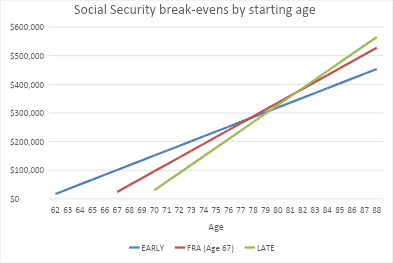
If you chart the accumulated benefits of those three scenarios on a line graph, you’ll find the break-evens where the lines intersect:

You’ll notice that the break-even between claiming at 62 and claiming at 67 is around age 78. Meanwhile, the break-even between claiming at 67 and claiming at 70 is around age 82, and the break-even between claiming at 62 and claiming at 70 is around age 80.

There’s a lot of math to consider—including a key variable we haven’t discussed: how long you expect to live. If you expect to live past 78, claiming benefits at full retirement age may be worth more over time than claiming at 62. If you expect to live past 83, then claiming benefits at age 70 may be worth more over time than claiming at 67. If you expect to live past 80, then claiming benefits at age 70 may be worth more over time than claiming at 62. 

Of course, none of us can predict our life expectancy with any certainty. But we can make some educated guesses based on factors like our current health and our family medical history. For instance, if both of your parents lived well into their 90s, you might have more confidence in your own life expectancy.

Other Important Considerations

Break-evens are a useful tool in deciding when to start claiming Social Security benefits, but they aren’t the only factor. For example, you may prefer to have more money in the early part of your retirement so you can spend more on the experiences money can buy. Coming out ahead in the final tally may be less important to you.

Depending on your specific circumstances, there may be strategic reasons to claim early or claim late—say, to reduce your tax burden or to fill in a necessary income gap. These reasons make this decision about more than simply pitting your expected longevity against different break-even points.

We don’t expect you to calculate break-evens for every possible scenario. Understanding the concept of break-even will help you take a more informed approach to this important decision on your retirement journey. We’re happy to work with you to do the math for different claiming strategies and how they might fit in with your larger financial picture and retirement goals. As always, the best choice is the one that makes the most sense for you.

Justin D. Rucci, CFP®

Wealth Advisor, Warren Street Wealth Advisors

Investment Advisor Representative, Warren Street Wealth Advisors, LLC., a Registered Investment Advisor

The information presented here represents opinions and is not meant as personal or actionable advice to any individual, corporation, or other entity. Any investments discussed carry unique risks and should be carefully considered and reviewed by you and your financial professional. Nothing in this document is a solicitation to buy or sell any securities, or an attempt to furnish personal investment advice. Warren Street Wealth Advisors may own securities referenced in this document. Due to the static nature of content, securities held may change over time and current trades may be contrary to outdated publications. Form ADV available upon request 714-876-6200.
Your Year-End Financial Planning Checklist

As the year draws to a close, it’s the perfect time to review your financial situation and set yourself up for a strong start in the new year. Year-end financial planning can help you optimize your tax situation, review your investment performance, and make sure you’re on track to meet your long-term goals.

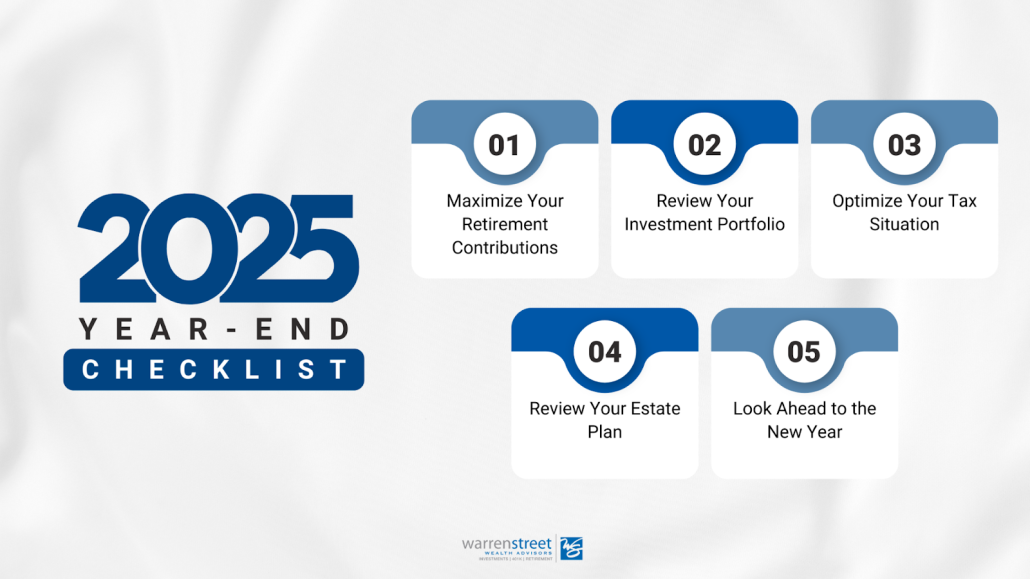
Here’s a checklist to guide you through the process:

1. Maximize Your Retirement Contributions:

  • 401(k) or 403(b): If you haven’t already, now is the time to max out your employer-sponsored retirement plan. For 2025, the contribution limit is $23,500, with an additional $7,500 catch-up contribution for those age 50 and over. For those aged 60 to 63, you can contribute up to $11,250 as a “super catch-up”, for a total of $34,750.
  • IRA: Contribute to your traditional or Roth IRA. The 2025 limit is $7,000, with a $1,000 catch-up contribution for those age 50 and over. Remember, you have until the tax-filing deadline in April 2026 to make these contributions. 
  • Solo 401(k) or SEP IRA: If you’re a small business owner or self-employed, consider making contributions to these plans to reduce your taxable income.

2. Review Your Investment Portfolio:

  • Rebalance: Check your asset allocation to ensure it aligns with your risk tolerance and financial goals. If one asset class has significantly outperformed, you may need to sell some of it and buy into an underperforming one to get back to your target allocation.
  • Tax-Loss Harvesting: This is a strategy that involves selling investments at a loss to offset capital gains and up to $3,000 of ordinary income. This can be a great way to reduce your tax bill, but be mindful of the wash-sale rule. If you are a client of ours, we do this automatically.

3. Optimize Your Tax Situation:

  • Charitable Giving: Donations to qualified charities are tax-deductible. Consider making year-end contributions, or even donating appreciated stock to avoid capital gains tax.
  • Flexible Spending Account (FSA): Use up the funds in your FSA before the year-end deadline. You could lose any money left in the account.
  • Health Savings Account (HSA): If you have an HSA, you can contribute up to $4,300 for an individual or $8,550 for a family in 2025. HSAs offer a triple tax advantage: tax-deductible contributions, tax-free growth, and tax-free withdrawals for qualified medical expenses.
  • Deductible Expenses: Gather receipts and documentation for potential tax deductions, such as property taxes, mortgage interest, and medical expenses.

4. Review Your Estate Plan:

  • Wills and Trusts: Ensure your will and trust documents are up to date and reflect your current wishes.
  • Beneficiaries: Check the beneficiary designations on your retirement accounts, life insurance policies, and annuities. These designations supersede your will, so it’s crucial to make sure they’re accurate.
  • Power of Attorney: Confirm that you have a durable power of attorney and a healthcare proxy in place.

5. Look Ahead to the New Year:

  • Budget Review: Analyze your spending from the past year to identify areas where you can save more.
  • Financial Goals: Revisit your short-term and long-term financial goals and make a plan to achieve them.
  • Meet with Your Financial Advisor: A comprehensive year-end review is the perfect opportunity to discuss your progress and make any necessary adjustments with your financial advisor.

By taking the time to review these key areas, you’ll not only gain a clearer picture of your current financial health but also lay the groundwork for a successful and prosperous new year.

Veronica Cabral

Wealth Advisor, Warren Street Wealth Advisors

Investment Advisor Representative, Warren Street Wealth Advisors, LLC., a Registered Investment Advisor

The information presented here represents opinions and is not meant as personal or actionable advice to any individual, corporation, or other entity. Any investments discussed carry unique risks and should be carefully considered and reviewed by you and your financial professional. Nothing in this document is a solicitation to buy or sell any securities, or an attempt to furnish personal investment advice. Warren Street Wealth Advisors may own securities referenced in this document. Due to the static nature of content, securities held may change over time and current trades may be contrary to outdated publications. Form ADV available upon request 714-876-6200.

What Should I Do With an Inherited IRA?

Inheritances come in all shapes and sizes, whether an heirloom left to you by a loved one or a life-changing financial windfall. Regardless of the form it takes, figuring out what to do next can be a crucial question. This is especially true with inherited IRAs, which can be very well funded, but also come with very specific and complicated rules you must follow to unlock the assets within them. 

This guide will walk you through the basics of what to do. From there, we can review your personal situation together to help ensure you don’t overlook anything important.

What Kind of Beneficiary Are You?

When you inherit an IRA, the very first step is to figure out what type of beneficiary you are. Here’s why: There are three main types, and the rules around key issues like withdrawal requirements will differ depending on which type you are. 

You will fall into one of the following categories:

Designated beneficiary. You are the person named as the beneficiary on the retirement account itself.

Eligible designated beneficiary. You are a designated beneficiary who is also any one of the following:

  • Spouse or minor child of the account owner.
  • Someone not more than 10 years younger than the account owner. (Someone whose age is equal to or greater than the age of the account owner minus 10.)
  • Someone who meets the IRS’s definition of chronically ill or disabled.

Nondesignated beneficiary. You are not named as the beneficiary on the retirement account itself, but you may inherit the IRA through a will or estate.

Another important step you might have to take early: If the owner of the account you inherit was taking required minimum distributions (RMDs)—the mandatory withdrawals from tax-deferred retirement account that start when the account owner reaches age 73—you’ll need to make that withdrawal before the end of the current calendar year. If you don’t, you’ll risk triggering a 25% penalty on the amount of that distribution. 

Options for Your Inherited IRA

When you inherit an IRA, you have several choices for how to handle that account.

Disclaim it: If for any reason you don’t want to accept the IRA—such as avoiding tax consequences from additional income—you can refuse it by disclaiming it. If you decide to take this route, you must disclaim within nine months of the account owner’s death. The IRA will then be passed to an alternate beneficiary or to the estate.

Take a lump-sum: You can opt to withdraw all the funds of the IRA at once. If it’s a traditional IRA, the IRS will tax the withdrawal as income, which may bump you into a higher tax bracket. If it’s a Roth IRA, the withdrawal is tax-free, but the account must be at least five years old to avoid incurring a 10% penalty.

Withdraw assets over time: If you don’t want to take a lump sum, you can keep the assets in an inherited IRA, where they can continue to grow tax deferred. This is where things get a bit more complicated depending on what type of beneficiary you are. 

If you’re a designated beneficiary (but not an eligible designated beneficiary), you must empty the inherited IRA within 10 years to avoid penalties on undistributed amounts. The clock starts ticking a year after the original owner’s death. So if the original owner died in 2024, you’d have until December 31, 2034 to empty the account. Also, if the original account owner had already started taking RMDs, you’ll have to continue taking them based on your own life expectancy each year to avoid penalties. (Don’t worry about calculating your own life expectancy. The IRS does that for you through its life expectancy tables, and we can work with you to make sure you get it right.)

If you’re an eligible designated beneficiary, you generally aren’t subject to the 10-year rule. You’ll have to take RMDs, but you can calculate the amount based on your own life expectancy and hold onto the inherited IRA indefinitely. An exception to this is minor children. For them, the 10-year rule will kick in at age 21.

If you’re a nondesignated beneficiary inheriting the IRA through a will or an estate, your requirements are determined by the account owner’s age. If the account owner hadn’t reached the age where distributions were required, you must empty the account within five years. If the account owner had begun taking RMDs, you will continue to take RMDs based on the same timeline.

Transferring funds to your own IRA: If you are a surviving spouse, you have the option to roll the assets from an inherited IRA into an IRA in your own name. If the original account owner hadn’t taken an RMD for the current year, you’ll have to take that RMD on their behalf before moving the funds.

Let Us Simplify the Process for You

Inheriting an IRA, like receiving any inheritance, can feel both meaningful and overwhelming. It’s a reminder that someone cared for you, but it comes with important financial decisions. 

Making the right choices around an inherited IRA can help you avoid big tax bills and penalties. But of all the things there are to know about inherited IRAs, the most important is that you don’t have to figure those choices out alone. We’re here to help you understand your options and move forward with a tax-efficient strategy that supports your financial goals. 

Veronica Cabral

Wealth Advisor, Warren Street Wealth Advisors

Investment Advisor Representative, Warren Street Wealth Advisors, LLC., a Registered Investment Advisor

The information presented here represents opinions and is not meant as personal or actionable advice to any individual, corporation, or other entity. Any investments discussed carry unique risks and should be carefully considered and reviewed by you and your financial professional. Nothing in this document is a solicitation to buy or sell any securities, or an attempt to furnish personal investment advice. Warren Street Wealth Advisors may own securities referenced in this document. Due to the static nature of content, securities held may change over time and current trades may be contrary to outdated publications. Form ADV available upon request 714-876-6200.
Should I Be Using a Health Savings Account?

Choosing a health care plan at work can be a bit of a headache—charts comparing premiums, copays and deductibles isn’t exactly light reading. One option you might have encountered in this process is the high-deductible health plan (HDHP). The name might sound intimidating. After all, who really wants to pay high deductibles? But when paired with a health savings account (HSA), an HDHP can be a powerful tool to help you save for your health care now and your future.

What is an HDHP?

An HDHP is a type of health insurance plan that comes with lower monthly premiums but higher out-of-pocket costs. In other words, you’ll pay less each month, but you’ll be on the hook for more when you actually visit a doctor. These plans shift more financial risk to you in exchange for upfront savings—and they often come with access to an HSA.

An HSA allows you to set aside pre-tax money to pay for qualified medical expenses like doctor visits, prescriptions, dental care and vision services. Unlike a flexible spending account (FSA), which is “use it or lose it,” the money in an HSA is yours to keep. It rolls over from year to year, stays with you if you change jobs and often has investment options.

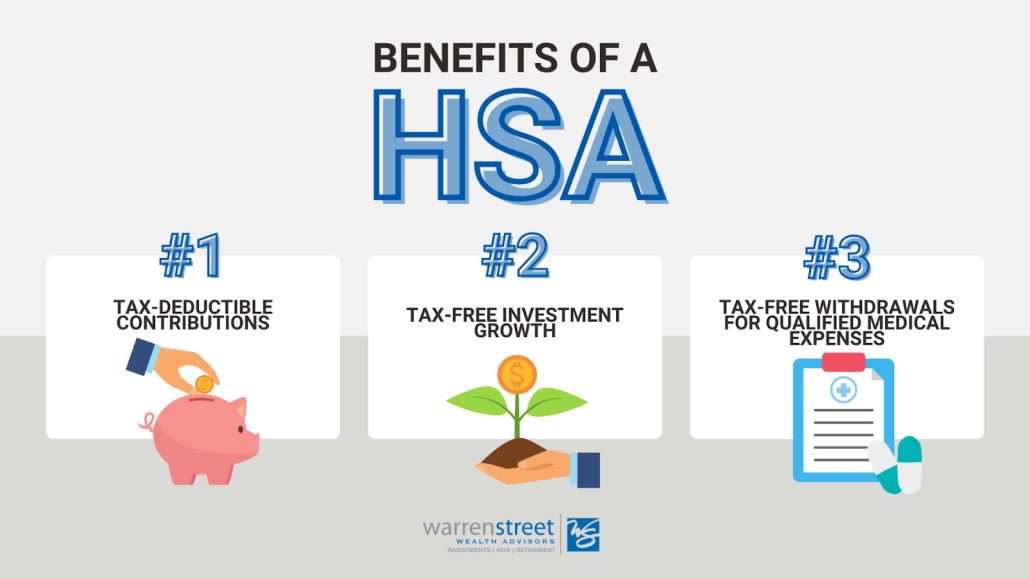
What makes HSAs especially appealing are their triple tax benefits:

  • Tax-deductible contributions.
  • Tax-free growth on investments inside the HSA.
  • Tax-free withdrawals at any time if the money is used for qualified medical expenses.

These features make HSAs one of the most tax-efficient savings vehicles available. But there’s another way to get more from your HSA: It can serve as a powerful retirement savings vehicle. 

Should You Use a High-Deductible Health Plan?

Before we get to the benefits of an HSA as an investment vehicle, how do you decide whether to use an HDHP in the first place? Choosing between a traditional plan and an HDHP depends on a few key factors.

First, compare the total potential cost under each plan. That means looking at monthly premiums, deductibles, coinsurance and out-of-pocket maximums. HDHPs typically offer significantly lower monthly premiums but come with higher deductibles. If you’re generally healthy and don’t expect to need much medical care, this tradeoff could work in your favor.

But be honest with yourself about your cash flow. If you had a sudden medical emergency, would you be able to cover the high out-of-pocket costs until your insurance kicks in? For people with chronic health conditions or frequent doctor visits, a traditional plan might offer more predictable costs.

Using an HSA as a Retirement Account

Once you’ve maxed out your traditional retirement accounts, an HSA becomes an excellent next stop. HSA contribution limits are $4,300 for self-only coverage and $8,550 for family coverage in 2025. You can leave that money in cash or invest it. You can, of course, use it to pay for qualified out-of-pocket medical expenses at any time. But you can also leave it in the account untouched, letting it grow and enjoy the power of tax-advantaged compounding—just as you would with an IRA or 401(k). 

Health care is one of the biggest expenses in retirement. So building a tax-free fund dedicated to future medical needs makes a lot of sense. According to recent estimates, a 65-year-old retiring in 2024 can expect to spend around $165,000 on health care in retirement—and that number is only expected to rise.

Here’s the kicker: When you turn 65, you aren’t limited to using your HSA for medical expenses. You can make withdrawals for non-medical expenses, and these will simply be taxed as income, just like withdrawals from a traditional IRA or 401(k). In short, your HSA can function like a traditional retirement account with the added perk of tax-free withdrawals for medical expenses at any age.

Your HSA as Part of Your Investment Strategy

Your HSA is a financial asset, whether it’s sitting in cash or invested in the market. As such, it can play an important role in your strategies for long-term asset allocation, diversification and rebalancing. Managed well, it can contribute meaningfully to your future financial security.

You can manage your HSA investments on your own. Or, depending on your HSA provider, we may be able to manage the assets within the account on your behalf. Even if direct management isn’t possible, we’re here to help you evaluate your options, choose appropriate investments and determine how best to incorporate your HSA into your long-term plan.

If you’re not sure whether an HDHP and HSA are right for you, let’s talk. Together, we can evaluate your health needs, cash flow and retirement goals to determine the best path forward.

Bryan Cassick, MBA, CFP®

Wealth Advisor, Warren Street Wealth Advisors

Investment Advisor Representative, Warren Street Wealth Advisors, LLC., a Registered Investment Advisor

The information presented here represents opinions and is not meant as personal or actionable advice to any individual, corporation, or other entity. Any investments discussed carry unique risks and should be carefully considered and reviewed by you and your financial professional. Nothing in this document is a solicitation to buy or sell any securities, or an attempt to furnish personal investment advice. Warren Street Wealth Advisors may own securities referenced in this document. Due to the static nature of content, securities held may change over time and current trades may be contrary to outdated publications. Form ADV available upon request 714-876-6200.

Financial Planning for Open Enrollment: A Guide to Making Smart Choices

Open enrollment is your annual opportunity to review and select your employee benefits for the upcoming year. While it might seem like just another task on your to-do list, the choices you make now can have a significant impact on your health and finances. Don’t simply “roll over” last year’s elections without a review. A proactive approach will ensure your benefits align with your needs and goals. 

Analyzing Your Health Insurance Options

Start by assessing your current situation. Think about your health needs from the past year: how many doctor’s visits did you have? What were your prescription costs? Do you anticipate any major life changes, such as getting married or having a baby? These factors will help you choose the right plan.

Understanding Key Terms

Before diving into plan specifics, it’s crucial to understand a few key terms:

  • Premium: The fixed monthly cost you pay for your insurance plan.
  • Deductible: The amount you pay out of pocket before your insurance coverage begins.
  • Copay: A fixed amount you pay for a doctor’s visit or prescription after your deductible is met.
  • Coinsurance: A percentage of costs you pay for covered services after the deductible is met.
  • Out-of-Pocket Maximum: The maximum amount you will pay in a year before the plan covers 100% of costs.

Comparing Plan Types: PPO vs. HDHP

The two most common types of health plans are a Preferred Provider Organization (PPO) and a High-Deductible Health Plan (HDHP).

  • A PPO typically has a lower deductible but higher premiums. It also offers more flexibility for seeing out-of-network doctors. This type of plan is generally best for people who use a lot of medical services, as the costs are more predictable.
  • An HDHP has a higher deductible but lower premiums. While you’ll pay more upfront for care, this type of plan makes you eligible for a Health Savings Account (HSA). An HDHP is often a great choice for generally healthy individuals or those who can comfortably afford the higher upfront costs if a major health event were to occur.

To help with your decision, compare the total estimated annual cost of each plan. For example, calculate the premiums plus potential out-of-pocket costs for a year with no major health events versus a year with a major surgery. This simple exercise can reveal which plan offers the most financial sense for your situation.

Maximizing Your Tax-Advantaged Accounts

In addition to health insurance, open enrollment is your chance to enroll in or update contributions to valuable tax-advantaged accounts.

Flexible Spending Accounts (FSA)

An FSA allows you to use pre-tax dollars for qualified medical or dependent care expenses, which lowers your taxable income. The key rule to remember is “use it or lose it”—funds typically do not roll over from one year to the next. Carefully estimate your upcoming year’s expenses to avoid forfeiting any money.

Health Savings Accounts (HSA)

An HSA is a powerful financial tool with a triple tax advantage:

  1. Contributions are pre-tax.
  2. Funds grow tax-free.
  3. Withdrawals for qualified medical expenses are tax-free.

Unlike an FSA, an HSA is portable, meaning the account belongs to you even if you change jobs. This makes it an excellent long-term savings tool. After age 65, you can withdraw funds for any reason without penalty, although non-medical withdrawals are subject to income tax. Remember, an HSA is only available if you are enrolled in an HDHP.

Reviewing Other Important Benefits

Don’t stop at health insurance; open enrollment is the perfect time to review your other benefits.

Retirement Contributions

Check your retirement contributions to your 401(k) or 403(b). If your employer offers a matching contribution, be sure you’re contributing at least enough to get the full match—it’s free money! Consider increasing your contribution rate by at least 1% each year. Small, consistent increases can make a huge difference over time.

Life and Disability Insurance

  • Life Insurance: Review your coverage needs based on your dependents and debts. Your employer may provide basic coverage, but you might need supplemental, voluntary coverage to fully protect your loved ones.
  • Disability Insurance: This benefit protects your income if you are unable to work due to illness or injury. Review your short-term and long-term disability options to ensure your income is protected.

Final Steps and Action Plan

Making your benefit selections requires a few final steps to ensure you’re fully prepared.

  1. Check Beneficiaries: In case of a major life change like a marriage or divorce, update the beneficiaries on all your accounts (retirement, life insurance) to ensure your assets go to the right people.
  2. Gather Your Information: Have all your plan documents, a list of your regular doctors, and an estimate of last year’s medical expenses ready. This information will help you make a more accurate and informed choice.
  3. Make Your Choices and Submit: Be mindful of the deadline and submit your final selections on time.

By taking the time to review your options and make informed decisions, you can ensure your benefits package is working for you and your financial well-being. Be sure to reach out to your advisor to discuss any of these items in more detail.

Justin D. Rucci, CFP®

Wealth Advisor, Warren Street Wealth Advisors

Investment Advisor Representative, Warren Street Wealth Advisors, LLC., a Registered Investment Advisor

The information presented here represents opinions and is not meant as personal or actionable advice to any individual, corporation, or other entity. Any investments discussed carry unique risks and should be carefully considered and reviewed by you and your financial professional. Nothing in this document is a solicitation to buy or sell any securities, or an attempt to furnish personal investment advice. Warren Street Wealth Advisors may own securities referenced in this document. Due to the static nature of content, securities held may change over time and current trades may be contrary to outdated publications. Form ADV available upon request 714-876-6200.
The Power of Purpose in Retirement

Retirement is a major life shift, one that impacts more than just your schedule. It can reshape your sense of identity, daily habits and even your health. In fact, research has shown that retirement can raise the risk of heart disease and other medical issues by up to 40%. The reason? Experts point to a loss of purpose and reduced social connection, both of which can take a toll on mental and physical well-being.

Without a plan for how to spend your time meaningfully, the transition can bring unexpected emotional challenges.

The Risks of Unstructured Retirement

Many retirees begin this new chapter with a “honeymoon phase”—a period marked by the novelty of free time, relaxation or long-awaited travel plans. But this initial high can eventually fade.

When the excitement of sleeping in and checking items off the bucket list wears off, retirees can find themselves facing unexpected emotional challenges. Common struggles include boredom, loss of routine, identity shifts and social isolation. In fact, 24% of older adults are considered to be socially isolated. Isolation can also have a ripple effect on health: It’s associated with a 50% increase in risk of developing dementia and increased risk of premature mortality.  

Designing a Retirement with Purpose

To avoid some of the potential pitfalls of an unstructured retirement, it’s important to think carefully—and proactively—about purpose. What do you want this next phase of life to look and feel like? Beyond financial planning, consider how you’ll meet the deeper needs your pre-retirement life—including work and raising kids—may have fulfilled: structure, identity, accomplishment, social connection and a sense of meaning.

What brings you pleasure and meaning? What have you always wanted to try or learn? Pursuing these activities can provide purpose and help ensure retirement’s not just a long vacation, but a rewarding chapter of your life.

Feeling stuck here? Try asking close friends or family what they see light you up. Often, others can reflect back passions or strengths that are hard to see on your own. 

Staying Connected and Active

Relationships and physical routines matter more than ever when you retire. Staying active, both physically and socially, offers measurable health benefits. Regular physical activity lowers risks, including the likelihood of dementia, heart disease, stroke and eight types of cancer. 

People-centered activity is important, too. Look for ways to stay engaged, whether through volunteering, mentoring, part-time work, creative pursuits or community involvement. Older volunteers, aged 55 and up, who gave 100 hours or more each year were two-thirds less likely to report poor health than non-volunteers. 

Spending more time with family is a high priority for many retirees and can be a great way to fulfill social needs. But make sure that vision is shared. Open conversations with loved ones about time together, expectations and boundaries can help align plans and avoid disappointment down the road.

The Retirement Identity Shift

In many ways, it’s hard to define what retirement is. After all, it’s not a single moment but a series of transitions. For instance, rather than an abrupt shift to not working at all, you may consider bridge employment—usually part-time work in a temporary position or as a consultant in your field or in a different industry. This can offer a gradual shift into retirement, providing continued income and engagement as you adjust. 

As your vision for retirement evolves, keep us in the loop. We’d love to hear what you’re planning—and we’re here to help ensure your financial strategy stays aligned with your goals.

Emily Balmages, CFP®

Director of Financial Planning, Warren Street Wealth Advisors

Investment Advisor Representative, Warren Street Wealth Advisors, LLC., a Registered Investment Advisor

The information presented here represents opinions and is not meant as personal or actionable advice to any individual, corporation, or other entity. Any investments discussed carry unique risks and should be carefully considered and reviewed by you and your financial professional. Nothing in this document is a solicitation to buy or sell any securities, or an attempt to furnish personal investment advice. Warren Street Wealth Advisors may own securities referenced in this document. Due to the static nature of content, securities held may change over time and current trades may be contrary to outdated publications. Form ADV available upon request 714-876-6200.