• Who We Serve
    • Business Owners
    • Individuals & Families
    • Fortune 500 and Large Company Employees
    • New Media
    • Oil & Gas Industry
    • SoCal Edison
  • Services
    • Financial Planning & Retirement
    • Investment Management
    • Tax Planning & Preparation
    • Estate Planning
  • About Us
  • Resources
    • Blog
    • Events
      • Health & Wealth
    • Frequently Asked Questions
  • Partnerships
    • Next Street Tax
    • TownSquare Capital
  • Contact Us
  • Schedule
    • New Clients
    • Current Clients
  • Login
  • Menu Menu

Tag Archive for: savings account

College Payment Strategies: Where Should the Money Come From?

January 13, 2026/in Education, Financial Planning, General/by Veronica Cabral, CFP®

Everyone knows college is expensive. This year, the average tuition and fees for a private college is nearly $45,000 per year. The price tag for some schools might be more than double that amount when factoring in the total cost of attendance.

The good news is that many families don’t end up paying the full sticker price. Grants, scholarships and financial aid packages can help bring down costs. But once those are factored in, what’s the best way to cover the rest?

Consider All Your Options

First, take stock of possible funding sources. These may include 529 college savings plans, taxable brokerage accounts, traditional savings accounts, cash from current income, gifts from family members and loans. Each comes with their own rules and tax treatment. Which sources you tap—and in what order—matters. 

  • 529 plan: Contributions to a 529 college savings plan grow tax-deferred. Withdrawals are tax-free when they’re used to cover qualified education expenses—anything else will likely come with an income tax hit and a 10% penalty on the earnings portion of the withdrawal. The good news is that qualified education expenses cover more than just tuition. You can use tax-free withdrawals to pay for room and board, textbooks, computers and more. One important note: 529 plans owned by parents are treated as parental assets and may reduce financial aid awards. 
  • Brokerage account: When you sell assets to make a withdrawal from a brokerage account, any profit is subject to capital gains tax. Long-term capital gains are taxed at preferential rates, but even so, brokerage account funds are generally less tax-efficient(but much more flexible) than 529 plans in covering education expenses. Your brokerage account balance is also factored into financial aid eligibility. 
  • Savings account: Interest earned on a savings account is taxed as ordinary income. Withdrawals don’t create taxable events. Like brokerage accounts, savings accounts can reduce financial aid eligibility, more so if held by the student.
  • Current income: Making payments from your income doesn’t offer a direct tax advantage, but it can help you avoid tapping into accounts you’d rather not touch. Income is a major factor in financial aid determinations.
  • Gift from a family member: Family members can gift up to $19,000 ($38,000 for married couples) per recipient in 2026 with no tax consequences. Gifts received can affect financial aid if they’re deposited into an account owned by the student or a parent. Family members can also pay tuition directly, avoiding the annual gift tax exclusion limit and any impact on financial aid decisions for students and parents. 
  • Student loans: Parents have access to student loans in the form of Federal Direct Parent Plus Loans and private student loans, both of which can help bridge the gap when savings, income and other resources aren’t enough. Federal loans may offer lower interest rates than private loans. As a parent, you can deduct up to $2,500 in student loan interest from your taxes every year. 

Conventional Wisdom Around Payment Strategies

As a rule of thumb, first take advantage of any “free” money such as scholarships and grants before deciding which source of funding to draw from. Next, consider drawing from taxable accounts before tapping into tax-deferred accounts. The goal here is to let your tax-deferred assets grow as much as possible so they can take advantage of the miracle of compound growth. When these sources of income are exhausted, you may turn to federal or private student loans, which charge interest and can therefore be the most expensive way to pay for college.

Of course, rules of thumb are broad. The strategy that works for one family may not work for yours. That’s where we can help. Together, we can examine your complete financial picture to come up with a withdrawal plan that aligns with your situation and helps keep you on track toward your long-term goals. For instance, it may make more sense to take 529 withdrawals first if your taxable accounts are likely to trigger short-term capital gains, which are taxed at a much higher rate than long-term gains.

The American Opportunity Tax Credit is another factor to consider. Your tuition payments may qualify you for a maximum tax credit of $2,500, but any expenses covered from a 529 plan don’t count toward the tax credit. Making sure you pay tuition bills from more than your 529 can help ensure you maximize the “free” money from the tax credit. At the same time, the size of the credit phases out for higher earners, which can change the calculus depending on your income. 

Avoid Touching Your Retirement Savings

Securing your retirement is fundamentally more important than funding college. That’s because college is something that can be financed with loans if needed. Retirement is not.

Your best bet is to steer clear of using funds from your 401(k) or IRA accounts. While there is a provision allowing penalty-free withdrawals from IRAs for education expenses, it’s generally not worth it to make them. Withdrawing early from a retirement account can mean sacrificing years of tax-advantaged growth. And because these accounts are subject to annual contributions limits, the amount you withdraw can’t always be replaced quickly.

There are many different factors to consider and weigh when designing a college payment strategy. Fortunately, you don’t have to wade through them alone. If you’re wondering about ways to pay for college, reach out and we’ll help you find the approach that’s best for you.

Veronica Cabral

Wealth Advisor, Warren Street Wealth Advisors

Investment Advisor Representative, Warren Street Wealth Advisors, LLC., a Registered Investment Advisor

The information presented here represents opinions and is not meant as personal or actionable advice to any individual, corporation, or other entity. Any investments discussed carry unique risks and should be carefully considered and reviewed by you and your financial professional. Nothing in this document is a solicitation to buy or sell any securities, or an attempt to furnish personal investment advice. Warren Street Wealth Advisors may own securities referenced in this document. Due to the static nature of content, securities held may change over time and current trades may be contrary to outdated publications. Form ADV available upon request 714-876-6200.

https://warrenstreetwealth.com/wp-content/uploads/2026/01/image.png 900 1600 Veronica Cabral, CFP® https://warrenstreetwealth.com/wp-content/uploads/2014/11/Warren_Street_logo-01.svg Veronica Cabral, CFP®2026-01-13 07:42:002026-01-12 16:42:58College Payment Strategies: Where Should the Money Come From?

How Compound Returns Work: A Guide to Growing Your Money

October 17, 2024/in Basic, Education, Investing/by Bryan Cassick, MBA, CFP®

If you’re like most people, you need your investments to grow to achieve the life you want. Fortunately, there’s a simple yet powerful tool that can help you achieve that growth: compounding. Compounding is the process of earning returns on your past investment returns.

The Wonders of Compounding

Compounding can help your portfolio grow exponentially over time. Here’s a simplified example:

You invest $10,000 and earn a 10% return in the first year. By the end of the year, you have an additional $1,000, totaling $11,000. If you keep it invested and earn another 10% return the next year, your 10% return now produces $1,100 rather than $1,000.

The more your investments grow, the more you can reinvest for further growth.

You can pull a couple key levers to make the most of compounding. Using these strategies wisely can significantly boost your savings:

Give It Time

Time allows your investments to snowball. The longer you let your returns compound, the greater the snowball effect. Here’s an example why:

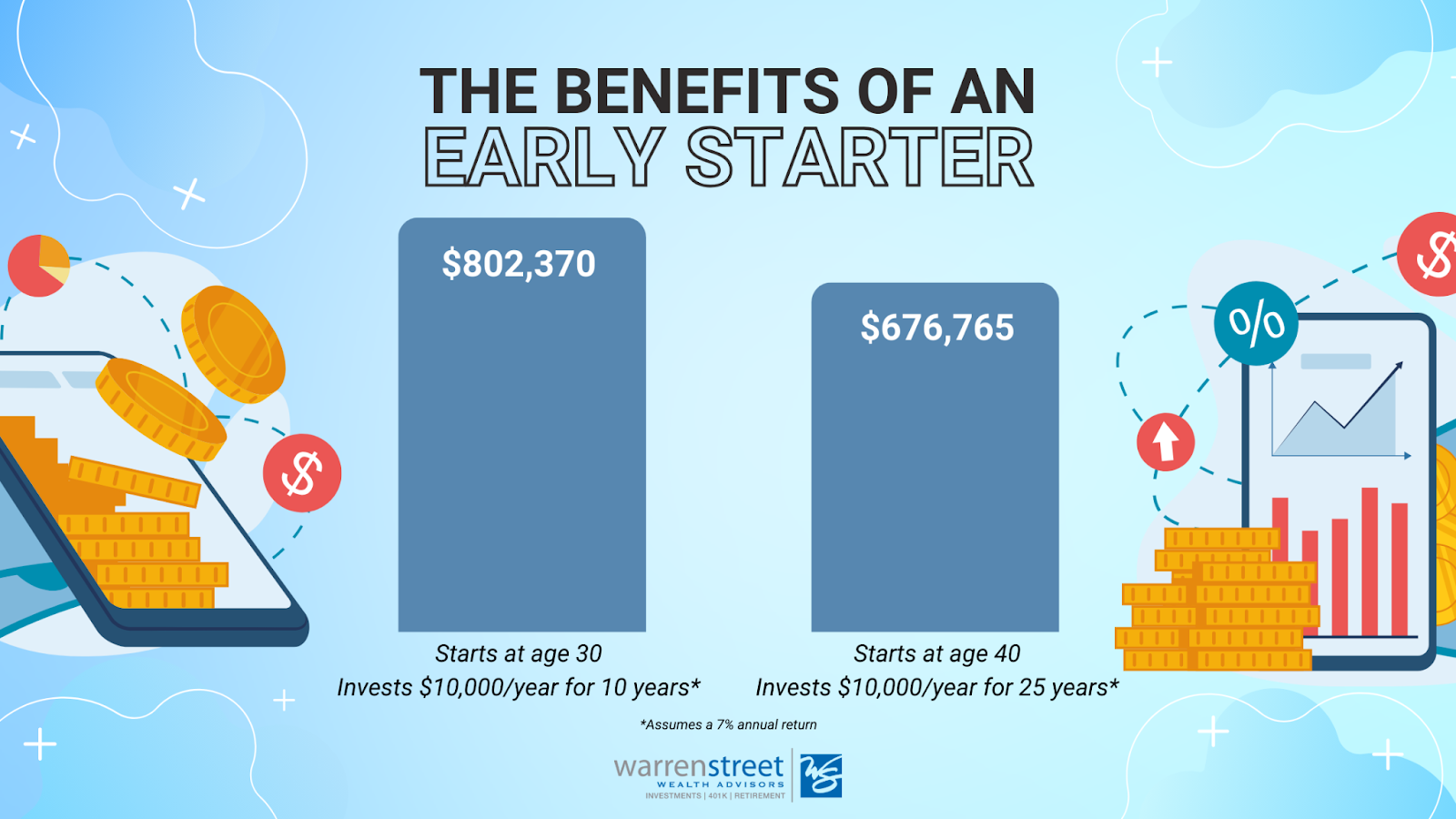
Investor 1: Starts at age 30, invests $10,000 annually for 10 years, earning a 7% annual return. They contribute a total of $100,000 and then stop adding money but let it grow.

  • Portfolio value at age 65: $802,370

Investor 2: Starts at age 40, invests $10,000 annually for 25 years, earning a 7% annual return. They contribute a total of $250,000.

  • Portfolio value at age 65: $676,765

Despite contributing $150,000 more, Investor 2 ends up with about $125,000 less than Investor 1. Starting early makes a huge difference.

Make the Most of Tax Advantages

Taxes can reduce compounding’s power. In a taxable account, interest, dividends, and capital gains trigger taxes that lower your annual return. Lower returns mean less money to grow the next year.

However, in tax-advantaged accounts like a 401(k), traditional IRA, or Roth IRA, you don’t pay taxes on gains while the money is in the account. This allows all your gains to keep working for you.

  • Traditional 401(k) and IRA: You contribute pre-tax money, it grows tax-deferred, and withdrawals after age 59 ½ are taxed at normal income tax rates.
  • Roth IRA: You contribute after-tax money, it grows tax-free, and withdrawals after age 59 ½ and a 5-year holding period are tax-free.

Control What You Can

Like most things in life, investing has many uncontrollable elements, so focus on what you can control. Start early, stay invested for the long term, and use tax-advantaged accounts to maximize compounding and work towards your long-term goals.

Bryan Cassick, MBA, CFP®

Wealth Advisor, Warren Street Wealth Advisors

Investment Advisor Representative, Warren Street Wealth Advisors, LLC., a Registered Investment Advisor

The information presented here represents opinions and is not meant as personal or actionable advice to any individual, corporation, or other entity. Any investments discussed carry unique risks and should be carefully considered and reviewed by you and your financial professional. Nothing in this document is a solicitation to buy or sell any securities, or an attempt to furnish personal investment advice. Warren Street Wealth Advisors may own securities referenced in this document. Due to the static nature of content, securities held may change over time and current trades may be contrary to outdated publications. Form ADV available upon request 714-876-6200.
https://warrenstreetwealth.com/wp-content/uploads/2024/08/Compounding-Return-Basics-101.png 1080 1080 Bryan Cassick, MBA, CFP® https://warrenstreetwealth.com/wp-content/uploads/2014/11/Warren_Street_logo-01.svg Bryan Cassick, MBA, CFP®2024-10-17 07:35:002024-10-15 06:58:33How Compound Returns Work: A Guide to Growing Your Money

Three Financial Priorities for Young Adults

May 12, 2022/in Education, Financial Planning, General/by Kirsten C. Cadden, CFP®

(or anyone just starting out)

Young adults, or anyone new to managing their own finances, often feel stuck when they think about money. In an age of unlimited access to information, advice, and opinions, deciding what to prioritize can feel paralyzing. At some point, all of us have asked the question “Where do I start?”

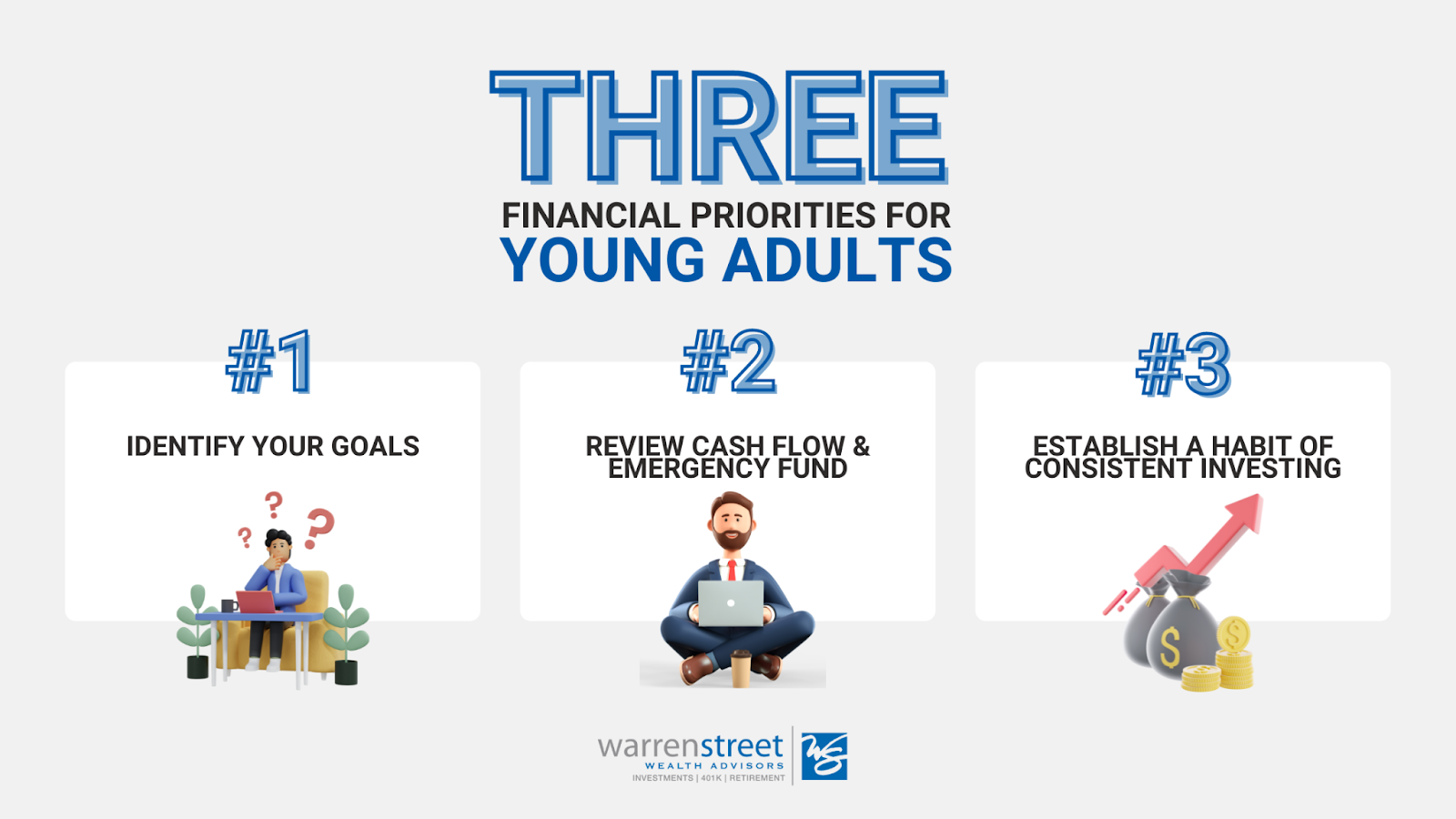
To help answer that question, we have identified three priorities for young adults to build a solid financial foundation. Individual circumstances will almost certainly require adaptation, so these three points are intentionally general and flexible so that you can apply them to your situation. 

1. Identify Your Goals

Good financial planning requires goals or targets. There is no singular definition of financial success; your needs, wants, and wishes determine what a successful path looks like.

Like all goals, financial goals should be realistic, flexible, and measurable. Goals may include paying off debt, retiring by a specific age, starting a business, buying a home, supporting loved ones, or any other specific expenses that are important to you. 

Attach a dollar amount to your goals. If you are not sure how much you might need for a certain goal, there are often simple online tools that can help, such as retirement calculators (like these from SmartAsset and NerdWallet) or home affordability calculators (like these from NerdWallet andZillow).   

You may not know all the specifics of a certain goal. For example, when retirement is 20 or 30 years down the road, you might not be able to identify exactly how much income you will need from your investments. Don’t let uncertainty deter you from setting the goal! You can start with an estimate and continue to refine it as your plans take shape.

2. Basic Financial Housekeeping: Cash Flow and Emergency Fund

Cash flow refers to money coming in and money going out. At a minimum, you should know what your income is each month and generally what expenses you have. Don’t worry about making changes at first; just write the information down so you know where you are starting. Then you can start tracking your spending and getting an idea of areas where you may need to make changes. 

A basic emergency fund should cover three to six months of expenses. This money should be kept easily accessible in cash — a regular bank savings account, a high-yield savings account, or an online savings account are all great options. When you use some of this money for an unforeseen necessary expense (such as a car repair, covering your bills during a time of unemployment, or a hospital bill), work to replenish your fund once you are able.

3. Establish a Habit of Consistent Investing

Once you have taken care of your basic financial housekeeping, it is time to look to the future. Even if your goals are still just far-off estimates, establishing good habits now will pay off when it is time to get more specific.

Below are a few examples of investment accounts that might fit your situation:

  • 401(k) or 403(b) plan: If your employer and/or your spouse’s employer offers a 401(k) or 403(b) plan, you can contribute pre-tax dollars and possibly receive contributions from your employer. It’s as close as you can get to free money!
  • IRA or Roth IRA: An IRA is a retirement savings account that is independent of your employer. You can contribute up to a set annual maximum and potentially receive tax benefits. Tax deductions and the ability to contribute to a Roth IRA have some conditions, so check the current IRS rules.
  • Individual or Joint brokerage account: A brokerage account is an investment account that is not specifically for retirement. There are no tax deductions for contributions you make, but there are also no rules about when you can access money in the account. This is a good option for general investing that may be used for anything. There are also no contribution limits for brokerage accounts, so if you are already contributing the maximum to a 401(k) or IRA, a brokerage account can allow for additional long-term savings. 

Keep It Simple

There is an endless supply of financial advice floating around, and knowing what advice to follow can be overwhelming. When in doubt, keep it simple! Focusing on these three starting points will allow you to tune out all the noise and set you up for financial success.

Do you feel like you are ready for steps 4, 5, and 6 in your financial plan? Maybe it’s time to work with a pro. Contact us at Warren Street Wealth Advisors to learn more about how we can help you achieve your financial goals.

Kirsten C. Cadden, CFP®

Associate Advisor, Warren Street Wealth Advisors

Investment Advisor Representative, Warren Street Wealth Advisors, LLC., a Registered Investment Advisor

The information presented here represents opinions and is not meant as personal or actionable advice to any individual, corporation, or other entity. Any investments discussed carry unique risks and should be carefully considered and reviewed by you and your financial professional. Nothing in this document is a solicitation to buy or sell any securities, or an attempt to furnish personal investment advice. Warren Street Wealth Advisors may own securities referenced in this document. Due to the static nature of content, securities held may change over time and current trades may be contrary to outdated publications. Form ADV available upon request 714-876-6200.

https://warrenstreetwealth.com/wp-content/uploads/2022/05/YoungAdults.png 1080 1080 Kirsten C. Cadden, CFP® https://warrenstreetwealth.com/wp-content/uploads/2014/11/Warren_Street_logo-01.svg Kirsten C. Cadden, CFP®2022-05-12 09:00:002024-11-07 09:30:29Three Financial Priorities for Young Adults

5 Options for Last Minute 2021 Tax Moves

February 24, 2022/in Basic, Financial Planning, General, Taxes/by Justin D. Rucci, CFP®

The 2021 calendar year might be over, but that doesn’t necessarily mean that you’re out of luck if you want to make any last-minute tax moves before you file your 2021 return. 

While your options may be somewhat limited after December 31st has passed, below are five options to think about as you get ready to file your 2021 taxes.

  1. Traditional IRA

You may still be able to make an IRA contribution for 2021, even as late as April 18th. In order to receive a deduction for your contribution, you’ll want to review your 2021 AGI (Adjusted Gross Income), ideally with a professional. The income limit phase-out range starts at $66,000 for individuals and $105,000 for married joint filers, with exceptions to these limits being available if you do not have access to a 401K or other retirement plan through work.

Another scenario where an IRA contribution can be beneficial is for a recent retiree. Some retirees will receive earned income from their previous employer in the calendar year following their retirement in the form of a prorated bonus or otherwise. This earned income allows the retiree to make an IRA contribution and take the deduction. If this applies to you, be sure to contact your advisor to discuss your options.

If you decide to make an IRA contribution, the maximum amount for 2021 is $6,000 per individual, or $7,000 for individuals age 50 and older.  

  1. SEP IRA & Small Business Plans

If you are self-employed you may be able to make a last-minute contribution to a retirement plan as well. The most common type of self-employed retirement plan is a SEP IRA, but depending on your tax situation, a Solo 401K, Defined Benefit plan, or other types of retirement plan may be beneficial for you.

The contribution limit for a SEP IRA in 2021 is $58,000, with no income limitations being applied. That said, the amount you will be able to contribute will be dictated by your self-employment income for the year, so work with your advisor and your tax professional to make sure the contributions are done properly to ensure you are maximizing the tax savings. 

  1. Roth IRA

If you are interested in a different type of tax-advantaged retirement savings vehicle, a Roth IRA may better suit your needs. While it does not provide an immediate tax deduction, it does allow you to invest funds in a tax-advantaged manner for the long term. If you meet the requirements at distribution time, all withdrawals will be tax-free.

There are income limits for who can contribute to a Roth IRA. AGI limits start at $125,000 for individuals and $198,000 for joint filers in 2021.

Contribution limits for a Roth IRA are the same as a Traditional IRA – $6,000 per individual, or $7,000 for individuals age 50 and over. This contribution limit is an aggregate for both IRA account types, so between a traditional IRA and a Roth IRA you cannot contribute more than the annual limit in total.

  1. Charitable Contributions & Deductions from 2021

2021 is the last year (pending future legislation) for the “above the line” charitable deduction. In other words, 2021 will be the last year that you will be able to take a deduction for a charitable contribution you made without having to itemize all of your deductions on Schedule A.  

In 2021 you can deduct up to $300 per individual, or $600 for joint filers for charitable contributions without itemizing.

If you made charitable contributions in 2021, now is the time to dig up those receipts and provide them to your tax professional.

If you think you may be able to itemize your deductions, be sure to also include mortgage interest, state taxes paid (property, sales, & income), and medical expenses in the information you provide to your tax preparer.

  1. Health Savings Account Contribution

If you participated in an HSA-eligible “high-deductible health plan” in 2021, you may be eligible to make a tax-deductible contribution to a Health Savings Account for 2021 up to the 2021 tax filing deadline (April 18, 2022).  Contribution limits are $3,600 for individuals and $7,200 for families, with a $1,000 catch-up contribution available for taxpayers age 55 and older.  Contributions to HSAs are tax-deductible and withdrawals are tax-free if the funds are used for qualified medical expenses.    

In conclusion, there are still some strategies that can be utilized when it comes to filing your 2021 taxes. If you have yet to make a decision on any of the above, there is still time before you file your return.

If you are interested in learning more about any of the above or taking any action, be sure to reach out to your advisor at Warren Street to get the conversation started.

Justin Rucci, CFP®

Wealth Advisor, Warren Street Wealth Advisors

Investment Advisor Representative, Warren Street Wealth Advisors, LLC., a Registered Investment Advisor

The information presented here represents opinions and is not meant as personal or actionable advice to any individual, corporation, or other entity. Any investments discussed carry unique risks and should be carefully considered and reviewed by you and your financial professional. Nothing in this document is a solicitation to buy or sell any securities, or an attempt to furnish personal investment advice. Warren Street Wealth Advisors may own securities referenced in this document. Due to the static nature of content, securities held may change over time and current trades may be contrary to outdated publications. Form ADV available upon request 714-876-6200.

Sources:

https://www.irs.gov/retirement-plans/ira-deduction-limits

https://www.irs.gov/retirement-plans/roth-iras

https://www.irs.gov/newsroom/special-300-tax-deduction-helps-most-people-give-to-charity-this-year-even-if-they-dont-itemize

https://www.irs.gov/retirement-plans/plan-sponsor/simplified-employee-pension-plan-sep

https://www.irs.gov/publications/p969

https://warrenstreetwealth.com/wp-content/uploads/2022/02/Blog-Thumbnail-1.png 1080 1080 Justin D. Rucci, CFP® https://warrenstreetwealth.com/wp-content/uploads/2014/11/Warren_Street_logo-01.svg Justin D. Rucci, CFP®2022-02-24 08:30:002022-06-30 11:03:115 Options for Last Minute 2021 Tax Moves

EIX Stock Falls on Wildfires in SoCal

December 6, 2017/in Basic, Education, General, Investing, Retirement/by Cary Facer
Read more
https://warrenstreetwealth.com/wp-content/uploads/2017/12/EIX.jpg 845 1680 Cary Facer https://warrenstreetwealth.com/wp-content/uploads/2014/11/Warren_Street_logo-01.svg Cary Facer2017-12-06 22:21:082018-11-14 17:47:20EIX Stock Falls on Wildfires in SoCal

Your Personal Annual Review

December 4, 2017/in Basic, Education, General/by Cary Facer
Read more
https://warrenstreetwealth.com/wp-content/uploads/2014/11/Warren_Street_logo-01.svg 0 0 Cary Facer https://warrenstreetwealth.com/wp-content/uploads/2014/11/Warren_Street_logo-01.svg Cary Facer2017-12-04 19:32:392024-06-03 10:53:18Your Personal Annual Review

Recent Posts

  • Meet Jennifer Horner, Operations & Compliance AssociateJune 5, 2026 - 11:11 am

    Meet Jennifer Horner, our new Operations & Compliance Associate at Warren Street. In this Q&A, learn about her crucial role in handling daily account transactions, keeping our firm secure, and how her core values of integrity and family align with our mission.

  • Meet Our Onboarding Coordinator: Isaiah Knox, MBAApril 28, 2026 - 7:02 am

    Meet Isaiah Knox, MBA, Warren Street’s Onboarding Coordinator! In this Q&A, learn how Isaiah ensures a seamless, supportive, and high-quality onboarding experience for new clients. Read about his client-first commitment and the role he plays within the team dedicated to your financial well-being at our firm.

  • On the War in Iran: Do Markets Not Care, and What’s Next?April 24, 2026 - 4:48 pm

    With 80 oil tankers stranded and a 9-million-barrel daily shortfall, why are markets hovering near all-time highs? In our April 2026 update, we dive into the “boxed-in” realities facing both the U.S. and Iran, the seven-step framework for “maximum pressure” negotiations, and why we’re choosing disciplined rebalancing over reactive shifts. Discover why the market is looking past the immediate conflict in what’s now a world of accelerated deglobalization.

  • Money Scripts—Part 2: How to Manage the ScriptMarch 20, 2026 - 9:26 am

    You’ve identified your money script—now what? In Part 2 of our series, we share expert strategies for “flipping the script.” From setting boundaries on status-driven spending to overcoming the paralysis of money avoidance, learn how to build a healthier, more balanced relationship with your finances. It’s time to stop reading from an old script and start writing a new one.

Categories

  • Basic
  • Chevron
  • Education
  • Financial Planning
  • General
  • Intermediate
  • Investing
  • Quarterly Economic Update
  • Retirement
  • Taxes
  • Uncategorized

Contact Us

(714) 876-6200

hello@warrenstreetwealth.com

Warren Street Wealth Advisors, LLC
200 Spectrum Center Drive, Suite 300,
Irvine, CA 92618

As a Registered Investment Advisor, Warren Street Wealth Advisors, LLC is required to file form ADV to report our business practices and conflicts of interest. Please call to request a copy at 714-876-6200.

IMPORTANT DISCLOSURE INFORMATION

Stay Connected

© Copyright 2026 - Warren Street Wealth Advisors, LLC - 200 Spectrum Center Drive, Suite 300, Irvine, California 92618 - Enfold Theme by Kriesi
  • Link to Facebook
  • Link to Instagram
  • Link to LinkedIn
  • Link to Youtube
  • Link to Yelp
  • Link to X
  • Link to Mail
Scroll to top Scroll to top Scroll to top