• Who We Serve
    • Business Owners
    • Individuals & Families
    • Fortune 500 and Large Company Employees
    • New Media
    • Oil & Gas Industry
    • SoCal Edison
  • Services
    • Financial Planning & Retirement
    • Investment Management
    • Tax Planning & Preparation
    • Estate Planning
  • About Us
  • Resources
    • Blog
    • Events
      • Health & Wealth
    • Frequently Asked Questions
  • Partnerships
    • Next Street Tax
    • TownSquare Capital
  • Contact Us
  • Schedule
    • New Clients
    • Current Clients
  • Login
  • Menu Menu

Tag Archive for: save

College Payment Strategies: Where Should the Money Come From?

January 13, 2026/in Education, Financial Planning, General/by Veronica Cabral, CFP®

Everyone knows college is expensive. This year, the average tuition and fees for a private college is nearly $45,000 per year. The price tag for some schools might be more than double that amount when factoring in the total cost of attendance.

The good news is that many families don’t end up paying the full sticker price. Grants, scholarships and financial aid packages can help bring down costs. But once those are factored in, what’s the best way to cover the rest?

Consider All Your Options

First, take stock of possible funding sources. These may include 529 college savings plans, taxable brokerage accounts, traditional savings accounts, cash from current income, gifts from family members and loans. Each comes with their own rules and tax treatment. Which sources you tap—and in what order—matters. 

  • 529 plan: Contributions to a 529 college savings plan grow tax-deferred. Withdrawals are tax-free when they’re used to cover qualified education expenses—anything else will likely come with an income tax hit and a 10% penalty on the earnings portion of the withdrawal. The good news is that qualified education expenses cover more than just tuition. You can use tax-free withdrawals to pay for room and board, textbooks, computers and more. One important note: 529 plans owned by parents are treated as parental assets and may reduce financial aid awards. 
  • Brokerage account: When you sell assets to make a withdrawal from a brokerage account, any profit is subject to capital gains tax. Long-term capital gains are taxed at preferential rates, but even so, brokerage account funds are generally less tax-efficient(but much more flexible) than 529 plans in covering education expenses. Your brokerage account balance is also factored into financial aid eligibility. 
  • Savings account: Interest earned on a savings account is taxed as ordinary income. Withdrawals don’t create taxable events. Like brokerage accounts, savings accounts can reduce financial aid eligibility, more so if held by the student.
  • Current income: Making payments from your income doesn’t offer a direct tax advantage, but it can help you avoid tapping into accounts you’d rather not touch. Income is a major factor in financial aid determinations.
  • Gift from a family member: Family members can gift up to $19,000 ($38,000 for married couples) per recipient in 2026 with no tax consequences. Gifts received can affect financial aid if they’re deposited into an account owned by the student or a parent. Family members can also pay tuition directly, avoiding the annual gift tax exclusion limit and any impact on financial aid decisions for students and parents. 
  • Student loans: Parents have access to student loans in the form of Federal Direct Parent Plus Loans and private student loans, both of which can help bridge the gap when savings, income and other resources aren’t enough. Federal loans may offer lower interest rates than private loans. As a parent, you can deduct up to $2,500 in student loan interest from your taxes every year. 

Conventional Wisdom Around Payment Strategies

As a rule of thumb, first take advantage of any “free” money such as scholarships and grants before deciding which source of funding to draw from. Next, consider drawing from taxable accounts before tapping into tax-deferred accounts. The goal here is to let your tax-deferred assets grow as much as possible so they can take advantage of the miracle of compound growth. When these sources of income are exhausted, you may turn to federal or private student loans, which charge interest and can therefore be the most expensive way to pay for college.

Of course, rules of thumb are broad. The strategy that works for one family may not work for yours. That’s where we can help. Together, we can examine your complete financial picture to come up with a withdrawal plan that aligns with your situation and helps keep you on track toward your long-term goals. For instance, it may make more sense to take 529 withdrawals first if your taxable accounts are likely to trigger short-term capital gains, which are taxed at a much higher rate than long-term gains.

The American Opportunity Tax Credit is another factor to consider. Your tuition payments may qualify you for a maximum tax credit of $2,500, but any expenses covered from a 529 plan don’t count toward the tax credit. Making sure you pay tuition bills from more than your 529 can help ensure you maximize the “free” money from the tax credit. At the same time, the size of the credit phases out for higher earners, which can change the calculus depending on your income. 

Avoid Touching Your Retirement Savings

Securing your retirement is fundamentally more important than funding college. That’s because college is something that can be financed with loans if needed. Retirement is not.

Your best bet is to steer clear of using funds from your 401(k) or IRA accounts. While there is a provision allowing penalty-free withdrawals from IRAs for education expenses, it’s generally not worth it to make them. Withdrawing early from a retirement account can mean sacrificing years of tax-advantaged growth. And because these accounts are subject to annual contributions limits, the amount you withdraw can’t always be replaced quickly.

There are many different factors to consider and weigh when designing a college payment strategy. Fortunately, you don’t have to wade through them alone. If you’re wondering about ways to pay for college, reach out and we’ll help you find the approach that’s best for you.

Veronica Cabral

Wealth Advisor, Warren Street Wealth Advisors

Investment Advisor Representative, Warren Street Wealth Advisors, LLC., a Registered Investment Advisor

The information presented here represents opinions and is not meant as personal or actionable advice to any individual, corporation, or other entity. Any investments discussed carry unique risks and should be carefully considered and reviewed by you and your financial professional. Nothing in this document is a solicitation to buy or sell any securities, or an attempt to furnish personal investment advice. Warren Street Wealth Advisors may own securities referenced in this document. Due to the static nature of content, securities held may change over time and current trades may be contrary to outdated publications. Form ADV available upon request 714-876-6200.

https://warrenstreetwealth.com/wp-content/uploads/2026/01/image.png 900 1600 Veronica Cabral, CFP® https://warrenstreetwealth.com/wp-content/uploads/2014/11/Warren_Street_logo-01.svg Veronica Cabral, CFP®2026-01-13 07:42:002026-01-12 16:42:58College Payment Strategies: Where Should the Money Come From?

How Compound Returns Work: A Guide to Growing Your Money

October 17, 2024/in Basic, Education, Investing/by Bryan Cassick, MBA, CFP®

If you’re like most people, you need your investments to grow to achieve the life you want. Fortunately, there’s a simple yet powerful tool that can help you achieve that growth: compounding. Compounding is the process of earning returns on your past investment returns.

The Wonders of Compounding

Compounding can help your portfolio grow exponentially over time. Here’s a simplified example:

You invest $10,000 and earn a 10% return in the first year. By the end of the year, you have an additional $1,000, totaling $11,000. If you keep it invested and earn another 10% return the next year, your 10% return now produces $1,100 rather than $1,000.

The more your investments grow, the more you can reinvest for further growth.

You can pull a couple key levers to make the most of compounding. Using these strategies wisely can significantly boost your savings:

Give It Time

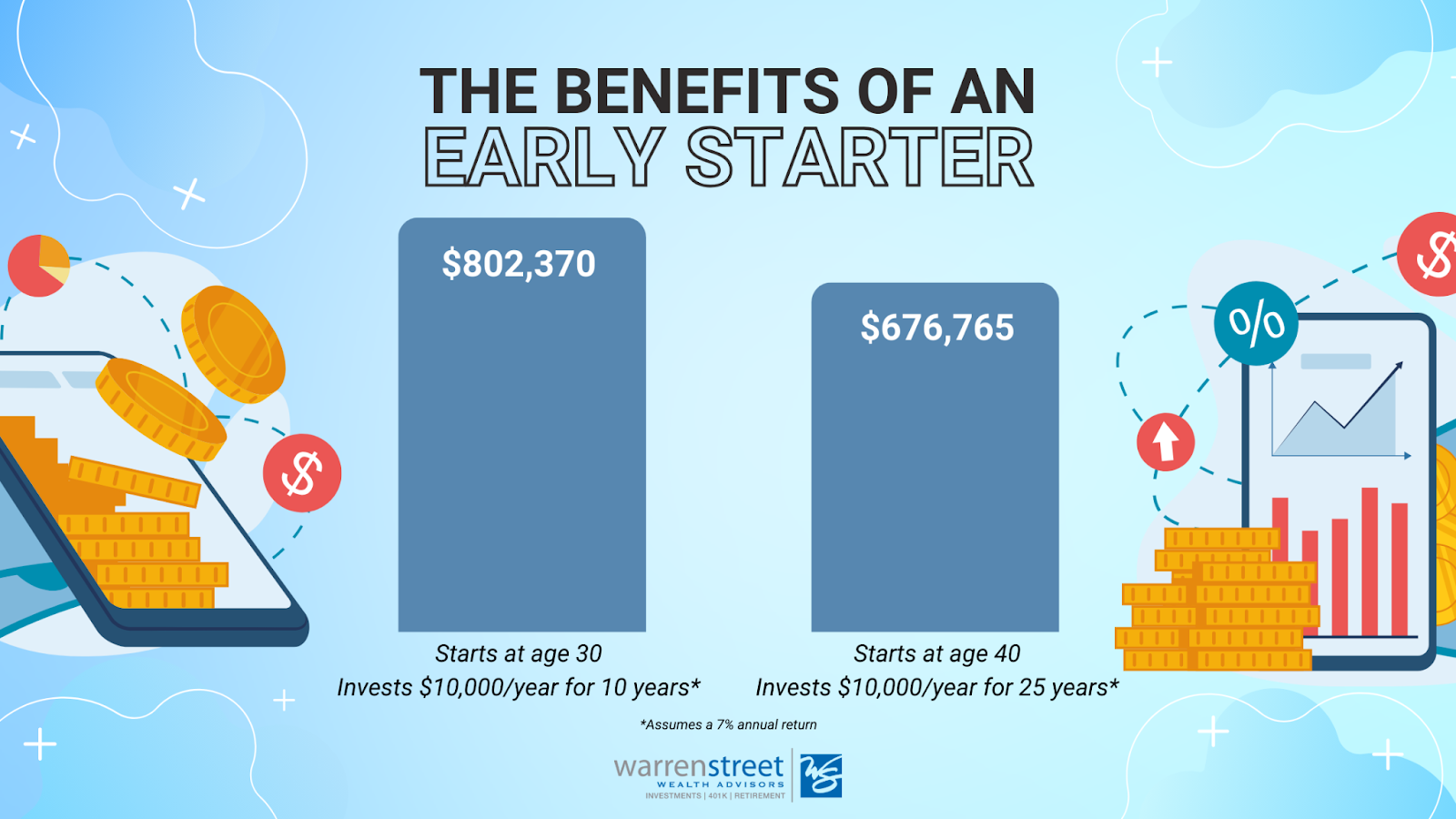
Time allows your investments to snowball. The longer you let your returns compound, the greater the snowball effect. Here’s an example why:

Investor 1: Starts at age 30, invests $10,000 annually for 10 years, earning a 7% annual return. They contribute a total of $100,000 and then stop adding money but let it grow.

  • Portfolio value at age 65: $802,370

Investor 2: Starts at age 40, invests $10,000 annually for 25 years, earning a 7% annual return. They contribute a total of $250,000.

  • Portfolio value at age 65: $676,765

Despite contributing $150,000 more, Investor 2 ends up with about $125,000 less than Investor 1. Starting early makes a huge difference.

Make the Most of Tax Advantages

Taxes can reduce compounding’s power. In a taxable account, interest, dividends, and capital gains trigger taxes that lower your annual return. Lower returns mean less money to grow the next year.

However, in tax-advantaged accounts like a 401(k), traditional IRA, or Roth IRA, you don’t pay taxes on gains while the money is in the account. This allows all your gains to keep working for you.

  • Traditional 401(k) and IRA: You contribute pre-tax money, it grows tax-deferred, and withdrawals after age 59 ½ are taxed at normal income tax rates.
  • Roth IRA: You contribute after-tax money, it grows tax-free, and withdrawals after age 59 ½ and a 5-year holding period are tax-free.

Control What You Can

Like most things in life, investing has many uncontrollable elements, so focus on what you can control. Start early, stay invested for the long term, and use tax-advantaged accounts to maximize compounding and work towards your long-term goals.

Bryan Cassick, MBA, CFP®

Wealth Advisor, Warren Street Wealth Advisors

Investment Advisor Representative, Warren Street Wealth Advisors, LLC., a Registered Investment Advisor

The information presented here represents opinions and is not meant as personal or actionable advice to any individual, corporation, or other entity. Any investments discussed carry unique risks and should be carefully considered and reviewed by you and your financial professional. Nothing in this document is a solicitation to buy or sell any securities, or an attempt to furnish personal investment advice. Warren Street Wealth Advisors may own securities referenced in this document. Due to the static nature of content, securities held may change over time and current trades may be contrary to outdated publications. Form ADV available upon request 714-876-6200.

https://warrenstreetwealth.com/wp-content/uploads/2024/08/Compounding-Return-Basics-101.png 1080 1080 Bryan Cassick, MBA, CFP® https://warrenstreetwealth.com/wp-content/uploads/2014/11/Warren_Street_logo-01.svg Bryan Cassick, MBA, CFP®2024-10-17 07:35:002024-10-15 06:58:33How Compound Returns Work: A Guide to Growing Your Money

Secure Act 2.0: Spending Today, Saving Tomorrow

January 18, 2023/in Education, General, Retirement/by Justin D. Rucci, CFP®

It can be hard to save for your future retirement when current expenses loom large. We advise proceeding with caution before using retirement savings for any other purposes, but SECURE 2.0 does include several new provisions to help families strike a balance. 

  • Student Loan Payments Count as Elective Deferrals (2024): If you’re paying off student debt and trying to save for retirement, your student loan payments will qualify as elective deferrals in your company plan. This means, whether you contribute to your company retirement plan or you make student loan payments, your employer can use either to make matching contributions to your retirement account. 
  • Transferring 529 Plan Assets to a Roth IRA (2024): This one is subject to a number of qualifying hurdles, but SECURE 2.0 establishes a path for families to transfer up to $35,000 of untapped 529 college saving plan assets into the beneficiary’s Roth IRA. With proper planning, this may help families “seed” their children’s or grandchildren’s retirement savings with their unspent college savings.
  • New Emergency Saving Accounts Linked to Employer Plans (2024): SECURE 2.0 has established a new employer-sponsored emergency savings account, which would be linked to your retirement plan account. Unless you are a “highly compensated employee” (as defined by the Act), you can use the account to save up to $2,500, with your contributions counting toward matching funds going into your main retirement plan account. 
  • Relaxed Emergency Plan Withdrawals (2024): SECURE 2.0 relaxes the ability to take a modest emergency withdrawal out of your retirement plan. Essentially, as long as you self-certify that you need the money, you can take up to $1,000 in a calendar year, without incurring the usual 10% penalty for early withdrawal. Once you’ve taken an emergency withdrawal, there are several hurdles before you’re eligible to take another one.
  • Additional Exceptions to the 10% Retirement Plan Withdrawal Penalty (Varied): SECURE 2.0 has established new exceptions to the 10% penalty otherwise incurred if you tap various retirement accounts too soon. For example, there are several new types of public safety workers who can access their company retirement plans penalty-free after age 50. Various exceptions are also carved out if you’re terminally ill or a domestic abuse victim, or if you use the assets to pay for long-term care insurance. The Act also has modified how retirement plan assets are to be used for Qualified Disaster Recovery Distributions. Many of the new exceptions are fairly specific, so check the fine print before you proceed. 
  • Relaxed Emergency Loans from Retirement Plans (2023): If you end up living in a Federally declared disaster area, SECURE 2.0 also increases your ability to borrow up to 100% of your vested plan balance up to $100,000, with a more generous pay-back window. 
  • Expanded Eligibility for ABLE Accounts (2026): ABLE accounts help disabled individuals save for disability expenses, while still collecting disability benefits. Before, you had to be disabled before age 26 to establish an ABLE account. That age cap increases to 46. 
  • A Tax Break for Disabled First Responders (2027): If you are a first responder collecting on a service-connected disability, at least a portion of your disability payments will remain tax-free, even once you reach full retirement age and begin taking a retirement pension. 

Next Steps

If you missed the first part of the blog series, we discussed key provisions in the newly enacted SECURE 2.0 Act of 2022, including updates that impact (1) savers/investors and (2) employers/plan sponsors. Check in next week for the last part of this blog series, where we share tax planning tips under this new Act. 

Justin D. Rucci, CFP®

Wealth Advisor, Warren Street Wealth Advisors

Investment Advisor Representative, Warren Street Wealth Advisors, LLC., a Registered Investment Advisor

The information presented here represents opinions and is not meant as personal or actionable advice to any individual, corporation, or other entity. Any investments discussed carry unique risks and should be carefully considered and reviewed by you and your financial professional. Nothing in this document is a solicitation to buy or sell any securities, or an attempt to furnish personal investment advice. Warren Street Wealth Advisors may own securities referenced in this document. Due to the static nature of content, securities held may change over time and current trades may be contrary to outdated publications. Form ADV available upon request 714-876-6200.

Reference Materials and Additional Reading:

  • Congress.gov, H.R.2617 – Consolidated Appropriations Act, 2023 (containing Division T – Secure 2.0 Act of 2022), December 29, 2022.
  • The Street, “How Will SECURE 2.0 Affect You?” Echo Huang, December 29, 2022
https://warrenstreetwealth.com/wp-content/uploads/2023/01/Secure-Act-2.0-Spending-Today-Saving-Tomorrow.png 1080 1080 Justin D. Rucci, CFP® https://warrenstreetwealth.com/wp-content/uploads/2014/11/Warren_Street_logo-01.svg Justin D. Rucci, CFP®2023-01-18 08:40:002023-01-18 08:47:02Secure Act 2.0: Spending Today, Saving Tomorrow

Secure Act 2.0: Summary for Individuals and Employers

January 9, 2023/in Education, General, Retirement/by Justin D. Rucci, CFP®

Who doesn’t enjoy tying up year-end loose ends? The original SECURE Act was signed into law on December 20th, 2019. Its “sequel,” the SECURE 2.0 Act, was similarly enacted at year-end on December 29th, 2022.

Both pieces of legislation seek to reform how Americans prepare for retirement while juggling current spending needs. How, when, or will each of us retire? How can government incentives, regulations, and safety nets help more people safely do so—or at least not get in the way? 

These are questions we’ve been asking as a nation for decades, across shifting socioeconomic climates. Throughout, a hard truth remains:

Employers and the government play a role in helping you save for and spend in retirement, but much of the preparation ultimately falls on you. 

Neither the original SECURE Act nor SECURE 2.0 has fundamentally changed this reality. SECURE 2.0 has, however, added far more motivational carrots than punishing sticks. Its guiding goal is right there in the name: Setting Every Community Up for Retirement Enhancement (SECURE). Following is an overview of its key components. 

Note: Implementation for each SECURE 2.0 provision varies from being effective immediately, to ramping up in future years. A few even apply retroactively. Many of its newest programs won’t effectively roll out until 2024 or later, giving us time to plan. We’ve noted with each provision when it’s slated to take effect. 

Saving More, Saving Better: Individual Savers

First, key provisions include several updates to encourage individual savers: 

  • Expanded Auto-Enrollment Requirements (2025): Because you’re more likely to save more if you’re automatically added to your company retirement plan program, auto-enrollment will be required for additional new retirement plans. Even with auto-enrollment, you can still opt out individually. Also, the Act has made a number of exceptions to the rules, including, as described here, “employers less than 3 years old, church plans, governmental plans, SIMPLE plans, and employers with 10 or fewer employees.” 
  • Higher Catch-Up Contributions (2024–2025): To accelerate retirement saving as you approach retirement age, SECURE 2.0 Act has increased annual “catch-up” contribution allowances for many retirement accounts (i.e., extra amounts allowed beyond the standard contribution limits); and, importantly, tied future increases to inflation. However, in many instances, the updates also require high-wage-earners ($145,000/year or higher) to direct their catch-up contributions to after-tax Roth accounts. 
  • Faster Plan Participation for Part-Time Employees (2024): If you’re a long-term, part-time employee, the SECURE Act of 2019 made it possible for you to participate in your employer’s retirement plan. With SECURE 2.0, you’ll be eligible to participate after 2 years instead of 3 years (after meeting other requirements). 
  • Saver’s Match for Low-Income Savers (2027): A Saver’s Credit for low-income families will be replaced by a more accessible Saver’s Match for those whose income levels qualify. While the credit offsets income on a tax form, the match will be a direct contribution into your retirement account, of up to $1,000 in government-paid matching funds.  
  • An Expanded Contribution Window for Sole Proprietors (2024): If you’re a sole proprietor, you’ll be able to establish a Solo 401(k) through the current year’s Federal income tax filing date, and still fund it with prior-year contributions. 
  • Potential Tax Error “Do Overs” (2025): To err is human, and often unintentional. As such, SECURE 2.0 has directed the IRS to apply an existing Employer Plans Compliance Resolutions System (EPCRS) to employer-sponsored plans and to IRAs. The details are to be developed, but as described here, the intent is to set up a system in which “most inadvertent failures to comply with tax-qualification rules would be eligible for self-correction.” 
  • Finding Former Plans (2024): It can be hard for company plan sponsors to keep in touch with former employees—and vice-versa. SECURE 2.0 has tasked the Dept. of Labor with hosting a national “lost and found” database to help you search for plan administrator contact information for former employees’ plans, in case you’ve left any retirement savings behind. 

Saving More, Saving Better: Employers

There also are provisions to help employers offer effective retirement plan programs: 

  • Better Retirement Plan Start-Up Incentives (2023): Small businesses can take retirement plan start-up credits to offset up to 100% of their plan start-up costs (versus a prior 50% cap). Also, businesses with no retirement plan can apply for start-up credits if they join a Multiple Employer Plan (MEP)—and this one applies retroactively to 2020.
  • A New “Starter 401(k)” Plan (2024): The Starter 401(k) provides small businesses that lack a 401(k) plan a simpler path to establishing one. Features will include streamlined regulatory and reporting requirements; auto-enrollment for all employees starting at 3% of their pay; a $6,000 annual contribution limit, rising with inflation; and a deferral-only structure, meaning the plan does NOT permit matching employer contributions.
  • Expanded SIMPLE Plan Contributions (2024): Under certain conditions, SECURE 2.0 allows for additional employer contributions to, and higher participant contribution limits for SIMPLE IRA plans. 
  • New Household Employee Plans (2023): Families can establish SEP IRA plans for their household employees, such as nannies or housekeepers.
  • Small Perks (2023): Until now, employers were prohibited from offering even small incentives to encourage employees to step up their retirement savings. Now, de minimis perks are okay, such as a gift card when a participant increases their deferral amount.

Next Steps

Stay tuned for the next part of this blog series, where we discuss strategies under the Secure 2.0 Act.

Justin D. Rucci, CFP®

Wealth Advisor, Warren Street Wealth Advisors

Investment Advisor Representative, Warren Street Wealth Advisors, LLC., a Registered Investment Advisor

The information presented here represents opinions and is not meant as personal or actionable advice to any individual, corporation, or other entity. Any investments discussed carry unique risks and should be carefully considered and reviewed by you and your financial professional. Nothing in this document is a solicitation to buy or sell any securities, or an attempt to furnish personal investment advice. Warren Street Wealth Advisors may own securities referenced in this document. Due to the static nature of content, securities held may change over time and current trades may be contrary to outdated publications. Form ADV available upon request 714-876-6200.

Reference Materials and Additional Reading:

  • Congress.gov, H.R.2617 – Consolidated Appropriations Act, 2023 (containing Division T – Secure 2.0 Act of 2022), December 29, 2022.
  • Kitces.com, “SECURE Act 2.0: Later RMDs, 529-to-Roth Rollovers, And Other Tax Planning Opportunities,” Jeffrey Levine, December 28, 2022
https://warrenstreetwealth.com/wp-content/uploads/2023/01/Secure-Act-2.0-Summary-for-Individuals-and-Employers.png 1080 1080 Justin D. Rucci, CFP® https://warrenstreetwealth.com/wp-content/uploads/2014/11/Warren_Street_logo-01.svg Justin D. Rucci, CFP®2023-01-09 09:25:002023-01-18 09:01:04Secure Act 2.0: Summary for Individuals and Employers

The Retirement Mindgame

March 12, 2018/in Basic, Education, Financial Planning, Investing, Retirement, Taxes/by Cary Facer
Read more
https://warrenstreetwealth.com/wp-content/uploads/2014/11/Warren_Street_Horiz_CMYK-01.png 300 300 Cary Facer https://warrenstreetwealth.com/wp-content/uploads/2014/11/Warren_Street_logo-01.svg Cary Facer2018-03-12 17:23:302019-03-20 21:39:22The Retirement Mindgame

4 Money Blunders That Could Leave You Poorer

January 27, 2015/in Financial Planning/by Cary Facer

Not to do listA “not-to-do” list for the new year & years to follow.

Provided by: Warren Street Wealth Advisors


How are your money habits? Are you getting ahead financially, or does it feel like you are running in place?


It may come down to behavior. Some financial behaviors promote wealth creation, while others lead to frustration. Certainly other factors come into play when determining a household’s financial situation, but behavior and attitudes toward money rank pretty high on the list.


How many households are focusing on the fundamentals? Late in 2014, the Denver-based National Endowment for Financial Education (NEFE) surveyed 2,000 adults from the 10 largest U.S. metro areas and found that 64% wanted to make at least one financial resolution for 2015. The top three financial goals for the new year: building retirement savings, setting a budget, and creating a plan to pay off debt.1


All well and good, but the respondents didn’t feel so good about their financial situations. About one-third of them said the quality of their financial life was “worse than they expected it to be.” In fact, 48% told NEFE they were living paycheck-to-paycheck and 63% reported facing a sudden and major expense last year.1


Fate and lackluster wage growth aside, good money habits might help to reduce those percentages in 2015. There are certain habits that tend to improve household finances, and other habits that tend to harm them. As a cautionary note for 2015, here is a “not-to-do” list – a list of key money blunders that could make you much poorer if repeated over time.


Money Blunder #1: Spend every dollar that comes through your hands. Maybe we should ban the phrase “disposable income.” Too many households are disposing of money that they could save or invest. Or, they are spending money that they don’t actually have (through credit cards).


You have to have creature comforts, and you can’t live on pocket change. Even so, you can vow to put aside a certain number of dollars per month to spend on something really important: YOU. That 24-hour sale where everything is 50% off? It probably isn’t a “once in a lifetime” event; for all you know, it may happen again next weekend. It is nothing special compared to your future.


Money Blunder #2: Pay others before you pay yourself. Our economy is consumer-driven and service-oriented. Every day brings us chances to take on additional consumer debt. That works against wealth. How many bills do you pay a month, and how much money is left when you are done? Less debt equals more money to pay yourself with – money that you can save or invest on behalf of your future and your dreams and priorities.


Money Blunder #3: Don’t save anything. Paying yourself first also means building an emergency fund and a strong cash position. With the middle class making very little economic progress in this generation (at least based on wages versus inflation), this may seem hard to accomplish. It may very well be, but it will be even harder to face an unexpected financial burden with minimal cash on hand.


The U.S. personal savings rate has averaged about 5% recently. Not great, but better than the low of 2.6% measured in 2007. Saving 5% of your disposable income may seem like a challenge, but the challenge is relative: the personal savings rate in China is 50%.2


Money Blunder #4: Invest impulsively. Buying what’s hot, chasing the return, investing in what you don’t fully understand – these are all variations of the same bad habit, which is investing emotionally and trying to time the market. The impulse is to “make money,” with too little attention paid to diversification, risk tolerance and other critical factors along the way. Money may be made, but it may not be retained.


Make 2015 the year of good money habits. You may be doing all the right things right now and if so, you may be making financial strides. If you find yourself doing things that are halting your financial progress, remember the old saying: change is good. A change in financial behavior may be rewarding.


Warren Street Wealth Advisors

190 S. Glassell St., Suite 209

Orange, CA 92866

714-876-6200 – office


This material was prepared by MarketingPro, Inc., and does not necessarily represent the views of the presenting party, nor their affiliates. This information has been derived from sources believed to be accurate. Please note – investing involves risk, and past performance is no guarantee of future results. The publisher is not engaged in rendering legal, accounting or other professional services. If assistance is needed, the reader is advised to engage the services of a competent professional. This information should not be construed as investment, tax or legal advice and may not be relied on for the purpose of avoiding any Federal tax penalty. This is neither a solicitation nor recommendation to purchase or sell any investment or insurance product or service, and should not be relied upon as such. All indices are unmanaged and are not illustrative of any particular investment.


Citations.

1 – denverpost.com/smart/ci_27275294/financial-resolutions-2015-four-ways-help-yourself-keep [1/7/15]

2 – tennessean.com/story/money/2014/12/31/tips-getting-financially-fit/21119049/ [12/31/14]

https://warrenstreetwealth.com/wp-content/uploads/2014/11/Warren_Street_logo-01.svg 0 0 Cary Facer https://warrenstreetwealth.com/wp-content/uploads/2014/11/Warren_Street_logo-01.svg Cary Facer2015-01-27 17:39:422015-01-27 17:39:424 Money Blunders That Could Leave You Poorer

Recent Posts

  • Meet Jennifer Horner, Operations & Compliance AssociateJune 5, 2026 - 11:11 am

    Meet Jennifer Horner, our new Operations & Compliance Associate at Warren Street. In this Q&A, learn about her crucial role in handling daily account transactions, keeping our firm secure, and how her core values of integrity and family align with our mission.

  • Meet Our Onboarding Coordinator: Isaiah Knox, MBAApril 28, 2026 - 7:02 am

    Meet Isaiah Knox, MBA, Warren Street’s Onboarding Coordinator! In this Q&A, learn how Isaiah ensures a seamless, supportive, and high-quality onboarding experience for new clients. Read about his client-first commitment and the role he plays within the team dedicated to your financial well-being at our firm.

  • On the War in Iran: Do Markets Not Care, and What’s Next?April 24, 2026 - 4:48 pm

    With 80 oil tankers stranded and a 9-million-barrel daily shortfall, why are markets hovering near all-time highs? In our April 2026 update, we dive into the “boxed-in” realities facing both the U.S. and Iran, the seven-step framework for “maximum pressure” negotiations, and why we’re choosing disciplined rebalancing over reactive shifts. Discover why the market is looking past the immediate conflict in what’s now a world of accelerated deglobalization.

  • Money Scripts—Part 2: How to Manage the ScriptMarch 20, 2026 - 9:26 am

    You’ve identified your money script—now what? In Part 2 of our series, we share expert strategies for “flipping the script.” From setting boundaries on status-driven spending to overcoming the paralysis of money avoidance, learn how to build a healthier, more balanced relationship with your finances. It’s time to stop reading from an old script and start writing a new one.

Categories

  • Basic
  • Chevron
  • Education
  • Financial Planning
  • General
  • Intermediate
  • Investing
  • Quarterly Economic Update
  • Retirement
  • Taxes
  • Uncategorized

Contact Us

(714) 876-6200

hello@warrenstreetwealth.com

Warren Street Wealth Advisors, LLC
200 Spectrum Center Drive, Suite 300,
Irvine, CA 92618

As a Registered Investment Advisor, Warren Street Wealth Advisors, LLC is required to file form ADV to report our business practices and conflicts of interest. Please call to request a copy at 714-876-6200.

IMPORTANT DISCLOSURE INFORMATION

Stay Connected

© Copyright 2026 - Warren Street Wealth Advisors, LLC - 200 Spectrum Center Drive, Suite 300, Irvine, California 92618 - Enfold Theme by Kriesi
  • Link to Facebook
  • Link to Instagram
  • Link to LinkedIn
  • Link to Youtube
  • Link to Yelp
  • Link to X
  • Link to Mail
Scroll to top Scroll to top Scroll to top