• Who We Serve
    • Business Owners
    • Individuals & Families
    • Fortune 500 and Large Company Employees
    • New Media
    • Oil & Gas Industry
    • SoCal Edison
  • Services
    • Financial Planning & Retirement
    • Investment Management
    • Tax Planning & Preparation
    • Estate Planning
  • About Us
  • Resources
    • Blog
    • Events
      • Health & Wealth
    • Frequently Asked Questions
  • Partnerships
    • Next Street Tax
    • TownSquare Capital
  • Contact Us
  • Schedule
    • New Clients
    • Current Clients
  • Login
  • Menu Menu

Tag Archive for: roth 401(k)

Three Financial Priorities for Young Adults

May 12, 2022/in Education, Financial Planning, General/by Kirsten C. Cadden, CFP®

(or anyone just starting out)

Young adults, or anyone new to managing their own finances, often feel stuck when they think about money. In an age of unlimited access to information, advice, and opinions, deciding what to prioritize can feel paralyzing. At some point, all of us have asked the question “Where do I start?”

To help answer that question, we have identified three priorities for young adults to build a solid financial foundation. Individual circumstances will almost certainly require adaptation, so these three points are intentionally general and flexible so that you can apply them to your situation. 
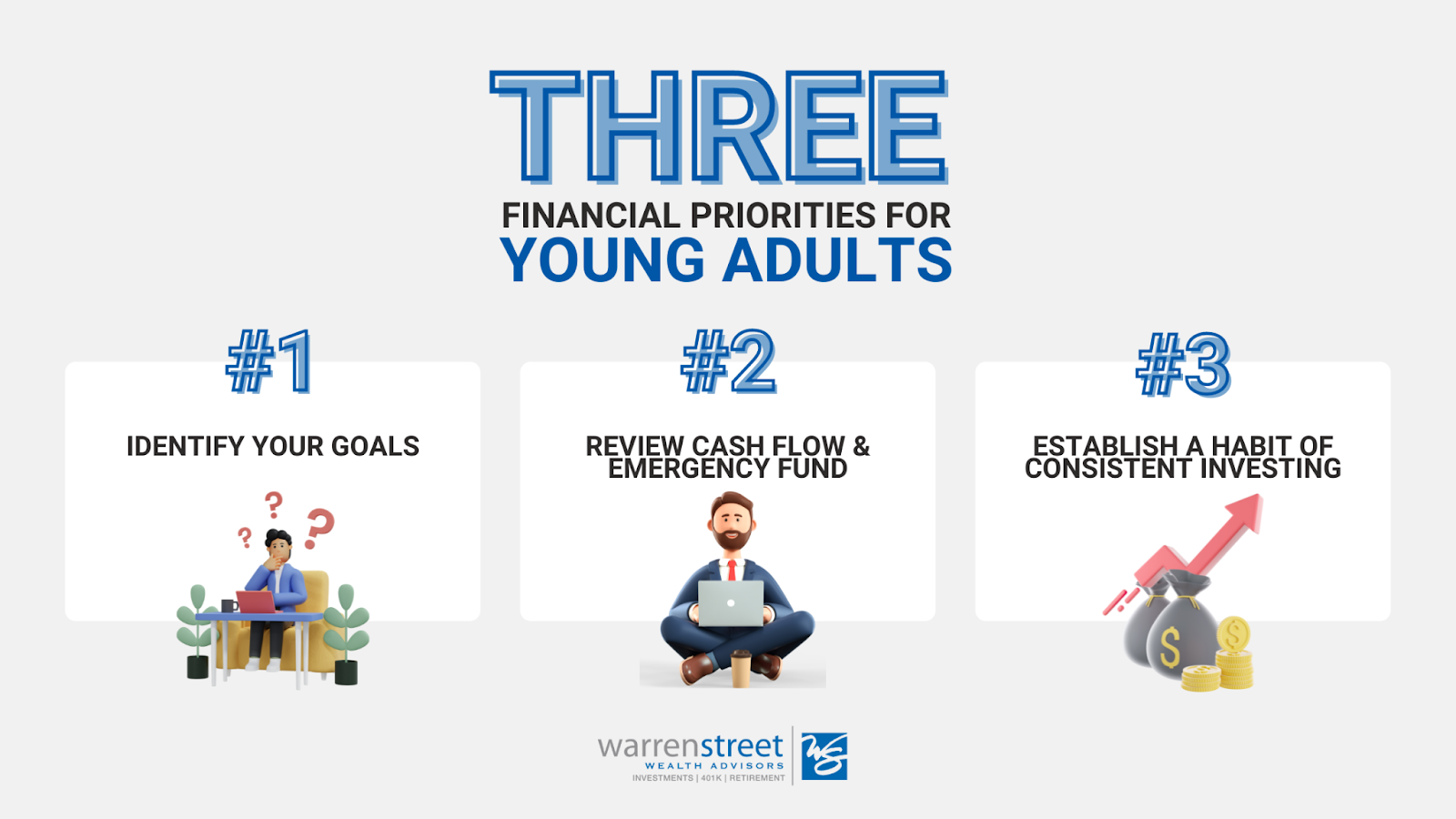
1. Identify Your Goals

Good financial planning requires goals or targets. There is no singular definition of financial success; your needs, wants, and wishes determine what a successful path looks like.

Like all goals, financial goals should be realistic, flexible, and measurable. Goals may include paying off debt, retiring by a specific age, starting a business, buying a home, supporting loved ones, or any other specific expenses that are important to you. 

Attach a dollar amount to your goals. If you are not sure how much you might need for a certain goal, there are often simple online tools that can help, such as retirement calculators (like these from SmartAsset and NerdWallet) or home affordability calculators (like these from NerdWallet andZillow).   

You may not know all the specifics of a certain goal. For example, when retirement is 20 or 30 years down the road, you might not be able to identify exactly how much income you will need from your investments. Don’t let uncertainty deter you from setting the goal! You can start with an estimate and continue to refine it as your plans take shape.

2. Basic Financial Housekeeping: Cash Flow and Emergency Fund

Cash flow refers to money coming in and money going out. At a minimum, you should know what your income is each month and generally what expenses you have. Don’t worry about making changes at first; just write the information down so you know where you are starting. Then you can start tracking your spending and getting an idea of areas where you may need to make changes. 

A basic emergency fund should cover three to six months of expenses. This money should be kept easily accessible in cash — a regular bank savings account, a high-yield savings account, or an online savings account are all great options. When you use some of this money for an unforeseen necessary expense (such as a car repair, covering your bills during a time of unemployment, or a hospital bill), work to replenish your fund once you are able.

3. Establish a Habit of Consistent Investing

Once you have taken care of your basic financial housekeeping, it is time to look to the future. Even if your goals are still just far-off estimates, establishing good habits now will pay off when it is time to get more specific.

Below are a few examples of investment accounts that might fit your situation:

  • 401(k) or 403(b) plan: If your employer and/or your spouse’s employer offers a 401(k) or 403(b) plan, you can contribute pre-tax dollars and possibly receive contributions from your employer. It’s as close as you can get to free money!
  • IRA or Roth IRA: An IRA is a retirement savings account that is independent of your employer. You can contribute up to a set annual maximum and potentially receive tax benefits. Tax deductions and the ability to contribute to a Roth IRA have some conditions, so check the current IRS rules.
  • Individual or Joint brokerage account: A brokerage account is an investment account that is not specifically for retirement. There are no tax deductions for contributions you make, but there are also no rules about when you can access money in the account. This is a good option for general investing that may be used for anything. There are also no contribution limits for brokerage accounts, so if you are already contributing the maximum to a 401(k) or IRA, a brokerage account can allow for additional long-term savings. 

Keep It Simple

There is an endless supply of financial advice floating around, and knowing what advice to follow can be overwhelming. When in doubt, keep it simple! Focusing on these three starting points will allow you to tune out all the noise and set you up for financial success.

Do you feel like you are ready for steps 4, 5, and 6 in your financial plan? Maybe it’s time to work with a pro. Contact us at Warren Street Wealth Advisors to learn more about how we can help you achieve your financial goals.

Kirsten C. Cadden, CFP®

Associate Advisor, Warren Street Wealth Advisors

Investment Advisor Representative, Warren Street Wealth Advisors, LLC., a Registered Investment Advisor

The information presented here represents opinions and is not meant as personal or actionable advice to any individual, corporation, or other entity. Any investments discussed carry unique risks and should be carefully considered and reviewed by you and your financial professional. Nothing in this document is a solicitation to buy or sell any securities, or an attempt to furnish personal investment advice. Warren Street Wealth Advisors may own securities referenced in this document. Due to the static nature of content, securities held may change over time and current trades may be contrary to outdated publications. Form ADV available upon request 714-876-6200.

https://warrenstreetwealth.com/wp-content/uploads/2022/05/YoungAdults.png 1080 1080 Kirsten C. Cadden, CFP® https://warrenstreetwealth.com/wp-content/uploads/2014/11/Warren_Street_logo-01.svg Kirsten C. Cadden, CFP®2022-05-12 09:00:002024-11-07 09:30:29Three Financial Priorities for Young Adults

The IRA and the 401(k)

September 13, 2018/in Financial Planning, Investing, Retirement, Taxes/by Justin D. Rucci, CFP®

The IRA and the 401(k)

Comparing their features, merits, and demerits. 

How do you save for retirement? Two options probably come to mind right away: the IRA and the 401(k). Both offer you relatively easy ways to build a retirement fund. Here is a look at the features, merits, and demerits of each account, starting with what they have in common.

Taxes are deferred on money held within IRAs and 401(k)s. That opens the door for tax-free compounding of those invested dollars – a major plus for any retirement saver. (1)

IRAs and 401(k)s also offer you another big tax break. It varies depending on whether the account is traditional or Roth in nature. When you have a traditional IRA or 401(k), your account contributions are tax deductible, but when you eventually withdraw the money for retirement, it will be taxed as regular income. When you have a Roth IRA or 401(k), your account contributions are not tax deductible, but if you follow Internal Revenue Service rules, your withdrawals from the account in retirement are tax-free. (1)  

Generally, the I.R.S. penalizes withdrawals from these accounts before age 59½. Distributions from traditional IRAs and 401(k)s prior to that age usually trigger a 10% federal tax penalty, on top of income tax on the withdrawn amount. Roth IRAs and Roth 401(k)s allow you to withdraw a sum equivalent to your account contributions at any time without taxes or penalties, but early distributions of the account earnings are taxable and may also be hit with the 10% early withdrawal penalty.1  

You must make annual withdrawals from 401(k)s and traditional IRAs after age 70½. Annual withdrawals from a Roth IRA are not required during the owner’s lifetime, only after his or her death. Even Roth 401(k)s require annual withdrawals after age 70½. (2)

Now, on to the major differences.

Annual contribution limits for IRAs and 401(k)s differ greatly. You may direct up to $18,500 into a 401(k) in 2018; $24,500, if you are 50 or older. In contrast, the maximum 2018 IRA contribution is $5,500; $6,500, if you are 50 or older. (1)

Your employer may provide you with matching 401(k) contributions. This is free money coming your way. The match is usually partial, but certainly, nothing to disregard – it might be a portion of the dollars you contribute up to 6% of your annual salary, for example. Do these employer contributions count toward your personal yearly 401(k) contribution limit? No, they do not. Contribute enough to get the match if your company offers you one. (1)

An IRA permits a wide variety of investments, in contrast to a 401(k). The typical 401(k) offers only about 20 investment options, and you have no control over what investments are chosen. With an IRA, you have a vast range of potential investment choices. (1,3)

You can contribute to a 401(k) no matter how much you earn. Your income may limit your eligibility to contribute to a Roth IRA; at certain income levels, you may be prohibited from contributing the full amount, or any amount. (1)

If you leave your job, you cannot take your 401(k) with you. It stays in the hands of the retirement plan administrator that your employer has selected. The money remains invested, but you may have less control over it than you once did. You do have choices: you can withdraw the money from the old 401(k), which will likely result in a tax penalty; you can leave it where it is; you can possibly transfer it to a 401(k) at your new job; or, you can roll it over into an IRA. (4,5)

You cannot control 401(k) fees. Some 401(k)s have high annual account and administrative fees that effectively eat into their annual investment returns. The plan administrator sets such costs. The annual fees on your IRA may not nearly be so expensive. (1)

All this said, contributing to an IRA or a 401(k) is an excellent idea. In fact, many pre-retirees contribute to both 401(k)s and IRAs at once. Today, investing in these accounts seems all but necessary to pursue retirement savings and income goals.

I want to talk to someone about my IRA or 401(k)


J Rucci

Justin D. Rucci, CFP®
Wealth Advisor
Warren Street Wealth Advisors


Justin D. Rucci is an Investment Advisor Representative of Warren Street Wealth Advisors, a Registered Investment Advisor. The information contained herein does not involve the rendering of personalized investment advice but is limited to the dissemination of general information. A professional advisor should be consulted before implementing any of the strategies or options presented.

This material was prepared by Marketing Pro, Inc. Any investments discussed carry unique risks and should be carefully considered and reviewed by you and your financial professional. Past performance may not be indicative of future results. All investment strategies have the potential for profit or loss. Changes in investment strategies, contributions or withdrawals may materially alter the performance, strategy, and results of your portfolio. Historical performance results for investment indexes and/or categories, generally do not reflect the deduction of transaction and/or custodial charges or the deduction of an investment-management fee, the incurrence of which would have the effect of decreasing historical performance results. Economic factors, market conditions, and investment strategies will affect the performance of any portfolio and there are no assurances that it will match or outperform any particular benchmark. Nothing in this commentary is a solicitation to buy, or sell, any securities, or an attempt to furnish personal investment advice. We may hold securities referenced in the blog and due to the static nature of the content, those securities held may change over time and trades may be contrary to outdated posts.

Citations.

1 – nerdwallet.com/article/ira-vs-401k-retirement-accounts [4/30/18]
2 – irs.gov/retirement-plans/retirement-plans-faqs-regarding-required-minimum-distributions [5/30/18]
3 – tinyurl.com/y77cjtfz [10/31/17]
4 – finance.zacks.com/tax-penalty-moving-401k-ira-3585.html [9/6/18]
5 – cnbc.com/2018/04/26/what-to-do-with-your-401k-when-you-change-jobs.html [4/26/18]

https://warrenstreetwealth.com/wp-content/uploads/2018/09/pepi-stojanovski-509192-unsplash.jpg 3420 5472 Justin D. Rucci, CFP® https://warrenstreetwealth.com/wp-content/uploads/2014/11/Warren_Street_logo-01.svg Justin D. Rucci, CFP®2018-09-13 09:45:432019-12-18 07:33:00The IRA and the 401(k)

Recent Posts

  • IPO Mania: What the Rocket Ships, Chatbots, and Rule Changes Mean for Your PortfolioJune 10, 2026 - 3:01 pm

    SpaceX, OpenAI, and Anthropic are leading a historic $200B IPO wave. Senior Portfolio Manager Phillip Law, CFA analyzes why these mega-offerings are happening now, the “index dilemma” threatening passive investors, and how to maintain a disciplined, quality-focused strategy amid the AI enthusiasm.

  • Meet Jennifer Horner, Operations & Compliance AssociateJune 5, 2026 - 11:11 am

    Meet Jennifer Horner, our new Operations & Compliance Associate at Warren Street. In this Q&A, learn about her crucial role in handling daily account transactions, keeping our firm secure, and how her core values of integrity and family align with our mission.

  • Meet Our Onboarding Coordinator: Isaiah Knox, MBAApril 28, 2026 - 7:02 am

    Meet Isaiah Knox, MBA, Warren Street’s Onboarding Coordinator! In this Q&A, learn how Isaiah ensures a seamless, supportive, and high-quality onboarding experience for new clients. Read about his client-first commitment and the role he plays within the team dedicated to your financial well-being at our firm.

  • On the War in Iran: Do Markets Not Care, and What’s Next?April 24, 2026 - 4:48 pm

    With 80 oil tankers stranded and a 9-million-barrel daily shortfall, why are markets hovering near all-time highs? In our April 2026 update, we dive into the “boxed-in” realities facing both the U.S. and Iran, the seven-step framework for “maximum pressure” negotiations, and why we’re choosing disciplined rebalancing over reactive shifts. Discover why the market is looking past the immediate conflict in what’s now a world of accelerated deglobalization.

Categories

  • Basic
  • Chevron
  • Education
  • Financial Planning
  • General
  • Intermediate
  • Investing
  • Quarterly Economic Update
  • Retirement
  • Taxes
  • Uncategorized

Contact Us

(714) 876-6200

hello@warrenstreetwealth.com

Warren Street Wealth Advisors, LLC
200 Spectrum Center Drive, Suite 300,
Irvine, CA 92618

As a Registered Investment Advisor, Warren Street Wealth Advisors, LLC is required to file form ADV to report our business practices and conflicts of interest. Please call to request a copy at 714-876-6200.

IMPORTANT DISCLOSURE INFORMATION

Stay Connected

© Copyright 2026 - Warren Street Wealth Advisors, LLC - 200 Spectrum Center Drive, Suite 300, Irvine, California 92618 - Enfold Theme by Kriesi
  • Link to Facebook
  • Link to Instagram
  • Link to LinkedIn
  • Link to Youtube
  • Link to Yelp
  • Link to X
  • Link to Mail
Scroll to top Scroll to top Scroll to top