Tag Archive for: retirement plans

Claiming Social Security: What’s a Break-Even?

When you’re deciding when to start claiming Social Security benefits, you’re facing a trade-off. Claim as early as age 62, and you’ll receive a larger number of smaller payments. Delay as late as age 70, and you’ll receive a smaller number of larger payments. To weigh your options, it’s helpful to find your “break-even” point—the age at which waiting longer to claim Social Security will result in a greater lifetime benefit. 

Picking the Right Horse

To begin, here’s a little scenario to help illustrate what a break-even is. Imagine a race between two horses—Early Bird (No. 62) and Late Breaker (No. 70). Late Breaker is a faster horse than Early Bird, no question. So to keep the competition interesting, Early Bird gets a half-lap head start. 

We know that, given enough time, Late Breaker will eventually catch up to Early Bird. Let’s call that moment the break-even. If the race ends any time after that break-even point, Late Breaker is a sure thing. If the race ends any time before the break-even, all the smart money is on Early Bird.

We can think of the way Social Security benefits accumulate in a similar way. Claiming early gives you a head start in accumulating benefits, but they come at a slower pace. Claiming later can earn you bigger checks, but it will take time before it catches up to the total accumulated benefits of claiming earlier. If you live past that break-even point, you will ultimately receive more income by claiming later. If you don’t, you will receive more by claiming earlier.

A Concrete Example

In reality, there are more than two horses in a race, and there are more than two options for when to start claiming Social Security benefits. In fact, you can choose any point after you reach your early retirement age of 62. For every year between the ages of 62 and 70, your monthly benefits will increase. (You can wait longer than age 70, but your benefits won’t continue to grow.) Any two points between ages 62 and 70 will have their own break-even.

Let’s consider three scenarios:

  • 1. You claim your benefits at age 62.
  • 2. You wait until full retirement age (67 for anyone born in 1960 or later) to claim. 
  • 3. You wait until age 70 to claim.

If you claim at 62—60 months before you reach full retirement age (FRA)—your checks will be 30% smaller than your full Social Security benefit. If your full monthly benefit is $2,000, your checks will be pared back to $1,400.

If you claim at full retirement age (67), you will receive the full $2,000 every month. 

If you delay your claims until age 70, your checks will be 24% larger than your full benefit. Instead of $2,000, you receive $2,480.  

If you chart the accumulated benefits of those three scenarios on a line graph, you’ll find the break-evens where the lines intersect:
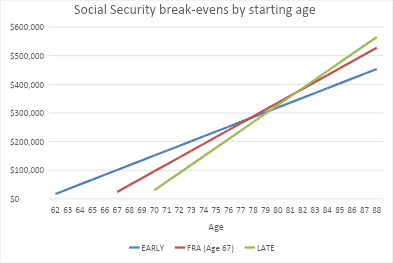
You’ll notice that the break-even between claiming at 62 and claiming at 67 is around age 78. Meanwhile, the break-even between claiming at 67 and claiming at 70 is around age 82, and the break-even between claiming at 62 and claiming at 70 is around age 80.

There’s a lot of math to consider—including a key variable we haven’t discussed: how long you expect to live. If you expect to live past 78, claiming benefits at full retirement age may be worth more over time than claiming at 62. If you expect to live past 83, then claiming benefits at age 70 may be worth more over time than claiming at 67. If you expect to live past 80, then claiming benefits at age 70 may be worth more over time than claiming at 62. 

Of course, none of us can predict our life expectancy with any certainty. But we can make some educated guesses based on factors like our current health and our family medical history. For instance, if both of your parents lived well into their 90s, you might have more confidence in your own life expectancy.

Other Important Considerations

Break-evens are a useful tool in deciding when to start claiming Social Security benefits, but they aren’t the only factor. For example, you may prefer to have more money in the early part of your retirement so you can spend more on the experiences money can buy. Coming out ahead in the final tally may be less important to you.

Depending on your specific circumstances, there may be strategic reasons to claim early or claim late—say, to reduce your tax burden or to fill in a necessary income gap. These reasons make this decision about more than simply pitting your expected longevity against different break-even points.

We don’t expect you to calculate break-evens for every possible scenario. Understanding the concept of break-even will help you take a more informed approach to this important decision on your retirement journey. We’re happy to work with you to do the math for different claiming strategies and how they might fit in with your larger financial picture and retirement goals. As always, the best choice is the one that makes the most sense for you.

Justin D. Rucci, CFP®

Wealth Advisor, Warren Street Wealth Advisors

Investment Advisor Representative, Warren Street Wealth Advisors, LLC., a Registered Investment Advisor

The information presented here represents opinions and is not meant as personal or actionable advice to any individual, corporation, or other entity. Any investments discussed carry unique risks and should be carefully considered and reviewed by you and your financial professional. Nothing in this document is a solicitation to buy or sell any securities, or an attempt to furnish personal investment advice. Warren Street Wealth Advisors may own securities referenced in this document. Due to the static nature of content, securities held may change over time and current trades may be contrary to outdated publications. Form ADV available upon request 714-876-6200.

Secure Act 2.0: Summary for Individuals and Employers

Who doesn’t enjoy tying up year-end loose ends? The original SECURE Act was signed into law on December 20th, 2019. Its “sequel,” the SECURE 2.0 Act, was similarly enacted at year-end on December 29th, 2022.

Both pieces of legislation seek to reform how Americans prepare for retirement while juggling current spending needs. How, when, or will each of us retire? How can government incentives, regulations, and safety nets help more people safely do so—or at least not get in the way? 

These are questions we’ve been asking as a nation for decades, across shifting socioeconomic climates. Throughout, a hard truth remains:

Employers and the government play a role in helping you save for and spend in retirement, but much of the preparation ultimately falls on you. 

Neither the original SECURE Act nor SECURE 2.0 has fundamentally changed this reality. SECURE 2.0 has, however, added far more motivational carrots than punishing sticks. Its guiding goal is right there in the name: Setting Every Community Up for Retirement Enhancement (SECURE). Following is an overview of its key components. 

Note: Implementation for each SECURE 2.0 provision varies from being effective immediately, to ramping up in future years. A few even apply retroactively. Many of its newest programs won’t effectively roll out until 2024 or later, giving us time to plan. We’ve noted with each provision when it’s slated to take effect. 

Saving More, Saving Better: Individual Savers

First, key provisions include several updates to encourage individual savers: 

  • Expanded Auto-Enrollment Requirements (2025): Because you’re more likely to save more if you’re automatically added to your company retirement plan program, auto-enrollment will be required for additional new retirement plans. Even with auto-enrollment, you can still opt out individually. Also, the Act has made a number of exceptions to the rules, including, as described here, “employers less than 3 years old, church plans, governmental plans, SIMPLE plans, and employers with 10 or fewer employees.” 
  • Higher Catch-Up Contributions (2024–2025): To accelerate retirement saving as you approach retirement age, SECURE 2.0 Act has increased annual “catch-up” contribution allowances for many retirement accounts (i.e., extra amounts allowed beyond the standard contribution limits); and, importantly, tied future increases to inflation. However, in many instances, the updates also require high-wage-earners ($145,000/year or higher) to direct their catch-up contributions to after-tax Roth accounts. 
  • Faster Plan Participation for Part-Time Employees (2024): If you’re a long-term, part-time employee, the SECURE Act of 2019 made it possible for you to participate in your employer’s retirement plan. With SECURE 2.0, you’ll be eligible to participate after 2 years instead of 3 years (after meeting other requirements). 
  • Saver’s Match for Low-Income Savers (2027): A Saver’s Credit for low-income families will be replaced by a more accessible Saver’s Match for those whose income levels qualify. While the credit offsets income on a tax form, the match will be a direct contribution into your retirement account, of up to $1,000 in government-paid matching funds.  
  • An Expanded Contribution Window for Sole Proprietors (2024): If you’re a sole proprietor, you’ll be able to establish a Solo 401(k) through the current year’s Federal income tax filing date, and still fund it with prior-year contributions. 
  • Potential Tax Error “Do Overs” (2025): To err is human, and often unintentional. As such, SECURE 2.0 has directed the IRS to apply an existing Employer Plans Compliance Resolutions System (EPCRS) to employer-sponsored plans and to IRAs. The details are to be developed, but as described here, the intent is to set up a system in which “most inadvertent failures to comply with tax-qualification rules would be eligible for self-correction.” 
  • Finding Former Plans (2024): It can be hard for company plan sponsors to keep in touch with former employees—and vice-versa. SECURE 2.0 has tasked the Dept. of Labor with hosting a national “lost and found” database to help you search for plan administrator contact information for former employees’ plans, in case you’ve left any retirement savings behind. 

Saving More, Saving Better: Employers

There also are provisions to help employers offer effective retirement plan programs: 

  • Better Retirement Plan Start-Up Incentives (2023): Small businesses can take retirement plan start-up credits to offset up to 100% of their plan start-up costs (versus a prior 50% cap). Also, businesses with no retirement plan can apply for start-up credits if they join a Multiple Employer Plan (MEP)—and this one applies retroactively to 2020.
  • A New “Starter 401(k)” Plan (2024): The Starter 401(k) provides small businesses that lack a 401(k) plan a simpler path to establishing one. Features will include streamlined regulatory and reporting requirements; auto-enrollment for all employees starting at 3% of their pay; a $6,000 annual contribution limit, rising with inflation; and a deferral-only structure, meaning the plan does NOT permit matching employer contributions.
  • Expanded SIMPLE Plan Contributions (2024): Under certain conditions, SECURE 2.0 allows for additional employer contributions to, and higher participant contribution limits for SIMPLE IRA plans. 
  • New Household Employee Plans (2023): Families can establish SEP IRA plans for their household employees, such as nannies or housekeepers.
  • Small Perks (2023): Until now, employers were prohibited from offering even small incentives to encourage employees to step up their retirement savings. Now, de minimis perks are okay, such as a gift card when a participant increases their deferral amount.

Next Steps

Stay tuned for the next part of this blog series, where we discuss strategies under the Secure 2.0 Act.

Justin D. Rucci, CFP®

Wealth Advisor, Warren Street Wealth Advisors

Investment Advisor Representative, Warren Street Wealth Advisors, LLC., a Registered Investment Advisor

The information presented here represents opinions and is not meant as personal or actionable advice to any individual, corporation, or other entity. Any investments discussed carry unique risks and should be carefully considered and reviewed by you and your financial professional. Nothing in this document is a solicitation to buy or sell any securities, or an attempt to furnish personal investment advice. Warren Street Wealth Advisors may own securities referenced in this document. Due to the static nature of content, securities held may change over time and current trades may be contrary to outdated publications. Form ADV available upon request 714-876-6200.

Reference Materials and Additional Reading: